They all grow blueberries, so why do his thrive while others' mold?
In most people's minds, blueberries have always been a "high-end" imported fruit, selling for one to two hundred yuan per kilogram on the market. Now, this fruit is being grown locally in Liuzhou too. In Longshan Tun, Ganggong Village, Tubo Town, Liujiang County, fruit farmer Wei Yunshan has planted several hundred mu of blueberries, and this year he has also reaped a good harvest.
The site of Wei Yunshan's blueberry planting base is nothing special, just on one or two small hillsides locally. As soon as the reporter entered the orchard, a delicate fragrance hit the nose, and plump, dark blueberries hung all over the branches, looking especially tempting against the green leaves.
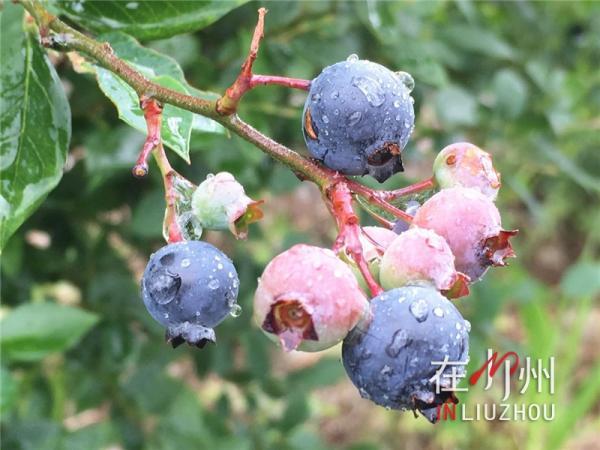
At this moment, Wei Yunshan was busy picking ripe blueberries. He said that early in the morning he and more than a dozen workers had gotten busy, because this batch of picked blueberries would enter some large supermarkets in Liuzhou City three hours later.
Wei Yunshan told the reporter that blueberries are known as the "queen of fruits." Their fruit is tender and juicy, sweet with a hint of tartness; not only do they taste good, they are also rich in various trace elements needed by the human body and have abundant nutritional value. On the market they can sell for one to two hundred yuan per kilogram. Although they can bring very good economic returns, because blueberries have relatively high requirements for conditions such as soil and climate, very few people in Liuzhou or even Guangxi grow them.
As early as 2011, some people in Ganggong Village began trial-planting blueberries, but all failed. The "conclusion" these villagers reached was that Liujiang County was not suitable for growing blueberries locally. For a period after that, indeed no one locally planted blueberries again. But Wei Yunshan believed that "having what others don't" was a business opportunity. So he decided to give it a try.
"To rent this hill, I got dead drunk three times," Wei Yunshan said. So what was going on?
It turned out that in 2012, Wei Yunshan spent two years looking everywhere for land, and finally found this hillside of more than 200 mu. Its altitude was more than 400 m, and the soil pH was around 4.8, very suitable for growing blueberries. This hillside land had originally belonged to one villager, who had planted only some miscellaneous trees on it, with very low returns. Wei Yunshan found this villager, but as soon as the man heard that he wanted to rent the land to grow blueberries, he immediately refused him, calling him a "crazy boy." After all, some villagers had already tried and failed to grow blueberries, so why was he following in their footsteps? But Wei Yunshan went to this villager three times, each time talking over drinks. The first two times were fruitless, and he himself was drunk under the table. Still, Wei Yunshan refused to give up. A few days later, he again went to that villager to discuss renting the land. This time, he explained many of his ideas and his market survey analysis in detail to the villager, who grew tired of listening. In the end, the villager could not stand it anymore and simply said, "If you drink this cup of rice wine, I'll agree." Unexpectedly, Wei Yunshan, already 80 or 90 percent drunk, downed that cup of "local Maotai" in one gulp, and ended up blind drunk, not coming to until the next afternoon. But the land rental was settled.
With the land secured, Wei Yunshan hired an excavator to start clearing the hillside, and introduced 1,000 blueberry plants from Zhejiang. But unexpectedly, one night a heavy rain washed all the blueberry seedlings planted by more than a dozen workers during the day down to the bottom of the hillside. "I nearly collapsed. Several hundred thousand yuan seemed to be gone, and all that money was my entire savings and funds pooled from relatives and friends." The next day, he begged the workers to find the blueberry seedlings washed down the hillside one by one and replant them, and it took a lot of effort to persuade everyone.
In May 2013, a few mu of trial-planted blueberries on this hillside bore fruit for the first time, and that year brought in more than 100,000 yuan in income, which excited Wei Yunshan greatly.
To expand the planting scale, Wei Yunshan began establishing a professional cooperative, trying every way to mobilize other villagers to join and carry out large-scale blueberry planting. To reduce detours, he traveled north to blueberry planting bases in the Jiangsu-Zhejiang area to learn from experience, while also specially inviting fruit agricultural technicians and experts to provide on-site guidance. Combined with his own diligent study, he finally figured out a way to grow blueberries.
Now, Wei Yunshan's cooperative has planted a total of 300 mu of blueberries, and the varieties have increased from just one or two such as "South High" at the beginning to six new varieties including Legacy, Biloxi and Rabbiteye. This year's annual output can reach more than 10,000 kilograms, and income can reach more than 1 million yuan.
"Others grow blueberries and get mold; he grows blueberries and gets beauty!" said the villager who rented him the land. As for what secret Wei Yunshan has for growing blueberries, he believes there are just two points. First, choose good blueberry varieties; some blueberries really are not suitable for local planting, and the reason those villagers failed before was that they did not choose good varieties. Second, management and care techniques must keep up. Growing blueberries has relatively high soil requirements. Besides suitable pH, fertilizing is very important. It is best to mainly apply farmyard manure, such as peanut bran and biological bacterial fertilizer, and adopt the colored paper pest-killing method. Only in this way can the blueberries grown be guaranteed to be green, ecological and pollution-free fruit.
Because of his success in growing blueberries, Wei Yunshan has become a local leader in getting rich. Now, Tubo Town in Liujiang County has made developing blueberry planting a targeted poverty alleviation industrial project, vigorously implementing it with the business model of "cooperative + base + farmer households." At present, the town's blueberry planting area has reached more than 900 mu, and more than 500 mu has now matured and gone on the market. Growing blueberries has become a "money tree" driving local people to escape poverty and become wealthy.
But Wei Yunshan said, "My being rich alone does not count as being rich. Only when the villagers all get rich together does it count as being rich. I believe that through my own efforts, I will certainly help more villagers become wealthy. This is also the greatest wish I set when I first started growing blueberries."
(From "In Liuzhou" reporter: Wu Tiezhong; editor: Zou Yue)