An analysis of the reasons behind a 65% increase over fourteen years
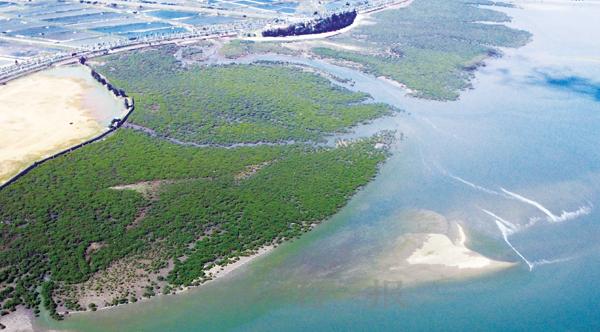
Golden Bay mangrove forest. Photo by Li Junguang, our reporter
The forestry department of Beihai City revealed recently that the viviparous woody plant known as the mangrove - which enjoys many accolades such as "coastguard," "sea forest," "bird paradise" and "granary of fish and shrimp" - is thriving in Beihai, with its total area increasing year by year, from 3120 hectares in 2002 to 5158.6 hectares at present, a growth of about 65%.
In recent years, the world's total mangrove area has been shrinking at a rate of more than 0.7% per year. Yet over fourteen years, Beihai's mangroves have not decreased but increased, with the total area growing by nearly 70%. While exploring the secrets behind this, the reporter noticed two true stories about Beihai's mangroves.
The first story took place in September 1996. Super Typhoon No. 15 struck Beihai, sinking nearly 300 boats and rafts at the Shatian fishing port in Hepu County, Beihai City, causing more than 40 deaths or missing persons. People were astonished to find that the more than 350 fishing boats and the people on board moored in the tidal creeks of the nearby Shankou National Mangrove Nature Reserve were all safe and sound.
The second story took place just this May. The Beihai Golden Bay Mangrove Ecological Tourism Scenic Area planned to hold "China's largest" clam-digging contest. After the news came out, environmental organizations and many Beihai residents keenly realized that this move could bring immeasurable harm to the Golden Bay mangrove ecosystem, and they lodged strong protests one after another. In the end, the organizers complied with public opinion and cancelled the contest.
"From being the protected subject of the 'coastguard' to becoming conscious guardians of the 'coastguard,' the environmental awareness of the people of Beihai has been continuously growing, and Beihai's ecological civilization has been continuously advancing." Dr. Fan Hangqing, international expert on mangroves for the United Nations Environment Programme Global Environment Facility and China's chief expert, and director of the Guangxi Mangrove Research Center, said in a recent interview with the reporter that the two stories, twenty years apart, vividly demonstrate the virtuous cycle of harmonious coexistence between this beautiful coastal city of Beihai and its mangroves.
The reporter learned that mangroves are the main vegetation species protecting the marine ecological environment and the bond that sustains the land-sea ecosystem, with special functions that terrestrial trees cannot replace. At present, Beihai City has 15 species of mangrove vegetation in 11 families and 14 genera (including 5 semi-mangrove species), accounting for 34.1% of China's existing 44 mangrove species (including semi-mangroves). The main species are Avicennia marina, Kandelia obovata, Aegiceras corniculatum, Rhizophora stylosa, Bruguiera gymnorrhiza, Excoecaria agallocha, Acrostichum aureum, Lumnitzera racemosa, Pongamia pinnata and others. The main formations are the Avicennia marina formation, the Aegiceras corniculatum formation, the Bruguiera gymnorrhiza formation, the Rhizophora stylosa formation, the Excoecaria agallocha formation and the Kandelia obovata formation.
For many years, Beihai City has always made mangroves a key target of protection, holding fast to the environmental bottom line in the course of economic development and adopting a variety of strong protection measures, enabling this precious coastal resource to keep expanding. All mangrove areas in the city have been designated as national-level ecological public welfare forests and brought into the scope of national forest ecological benefit protection.
In order to protect existing mangroves from harm, since the 1990s, Beihai City, after full investigation and scientific demonstration, has successively issued the "Beihai City Mangrove Protection and Management Regulations" (1999) and the "Notice of the Beihai Municipal People's Government on Strengthening the Protection of Mangrove Resources" (2000), and Hepu County has also successively issued the "Notice on Resolutely Stopping Arbitrary Felling and Destruction of Mangroves" and the "Notice on Strengthening the Protection of Mangrove Resources." To protect the birds of the mangrove wetlands, the Beihai Municipal Government issued the "Regulations of Beihai City on Bird Protection and Management" in 1996. The implementation of these documents has further pushed the protection and management of the city's mangroves toward standardization, legalization and institutionalization.
Establishing nature reserves is an important measure for strengthening the protection of Beihai's coastal wetland resources. Since the establishment of the Weizhou Island Nature Reserve in 1982, the city has so far established 2 national-level nature reserves, 6 small nature protection areas and 1 national-level wetland park, namely the Guangxi Shankou Mangrove National Nature Reserve, the Guangxi Hepu Dugong National Nature Reserve, the Rhizophora stylosa small nature protection area along the coast of Bailong Ancient City Port in Tieshangang, the Henglushan Mangrove small nature protection area in Pingyang Town, Yinhai District, the Gaode Dongwei Mangrove small nature protection area in Haicheng District, the Mu'an Mangrove small nature protection area in Dangjiang Town, Hepu County, the Qixing Mangrove small nature protection area in Shagang Town, Hepu County, the Yujiang Mangrove small nature protection area in Dangjiang Town, Hepu County, and the Guangxi Beihai Coastal National Wetland Park. Among them, the Guangxi Shankou Mangrove National Nature Reserve has been listed as a Wetland of International Importance.
Planting mangroves by hand can slow the flow of water and promote the recovery and growth of native mangroves. Starting in 2002, the city's forestry department successively trial-planted about 14,000-plus mu of mangrove species such as Aegiceras corniculatum, Kandelia obovata, Avicennia marina and Rhizophora stylosa in most coastal townships of Beihai City. Through more than ten years of continuous and arduous effort, Beihai's mangrove area has achieved restorative growth, and the ecological environment has also been continuously improved. According to incomplete statistics, 124 species of marine animals live in the city's mangroves, and 136 species of water birds have been recorded.
A good ecological environment is Beihai's advantage and competitiveness. In October 2013, according to the selection criteria of "whether the value is outstanding, whether the form is typical, whether the species is unique and whether protection is beneficial," the Guangxi Shankou National Mangrove Ecological Nature Reserve won the favor of netizens and experts and was successfully selected as one of "China's Top Ten Charming Wetlands," stunning people far and wide.