Side Effects of Chemical Fertilizers Identified, Biomimetic Green Fertilizer Wins Praise
Original title: Using Innovative Technology to Crack the Hard Nut of Chemical Agriculture
-- A profile of Liu Cunshou, associate professor at the College of Natural Resources and Environment, Northwest A&F University
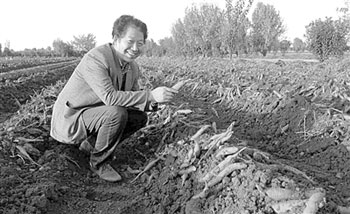
Liu Cunshou, associate professor at the College of Natural Resources and Environment, Northwest A&F University
At a press conference held by the State Council Information Office, Vice Minister of Agriculture Zhang Taolin said that China's agricultural resources and environment are under the dual pressure of exogenous and endogenous pollution, and that sustainable agricultural development has hit a bottleneck. For this reason, the Ministry of Agriculture formulated a "double reduction" plan for chemical fertilizers and pesticides, aiming to achieve zero growth in chemical fertilizers and pesticides by 2020. Reducing the use of chemical fertilizers and pesticides while at the same time ensuring high crop yields and high quality is a goal that most people regard as difficult to reach, yet Liu Cunshou, associate professor at Northwest A&F University, gave an affirmative answer through "two innovations."
Theoretical innovation: finding the causes of chemical fertilizer side effects in the principles of natural plant nutrition
As for the causes of chemical fertilizer side effects, Liu Cunshou consulted a large number of domestic and foreign publications and put forward a unique view: "After chemical fertilizers became industrialized, every country that applied chemical fertilizers, without exception, encountered the problem of chemical fertilizer side effects, and the forms and sequence of these side effects were completely identical. This shows that there are deep-seated reasons for chemical fertilizer side effects." In 1996, starting from the plant nutrient transformation process in forest humus soil, Liu Cunshou studied the plant nutrient transformation characteristics of forest soil and successfully measured more than 2,000 organic active substances from water-soluble humic acid in soil, discovered the principles of natural plant nutrition, and found the causes of chemical fertilizer side effects.
He classified the organic active substances composing soil water-soluble humic acid according to plant physiological functions into plant endogenous hormones, amino acids and small peptides, cell membrane stabilizers and signal substances, coenzymes, and so on, and found the basic substances by which organic fertilizers stimulate plant growth and enhance plant resistance. Analysis showed that more than 90% of the nitrogen and phosphorus elements in water-soluble humic acid exist as structural elements in organic molecules, and that plant mineral nutrient elements such as iron, zinc, and manganese in soil also exist in the form of organic coordination compounds; using an ICP analyzer, 38 mineral elements were measured from soil water-soluble humic acid.
On this basis, he carried out research projects on the relationship between the types of mineral elements in soil water-soluble humic acid and plant uptake, the effects of beneficial elements on plant growth and development, and the uptake and utilization of small organic molecules (organic nutrients) by plant roots, and derived three principles of natural plant nutrition: (1) healthy plant growth requires the uptake of multiple mineral nutrients; (2) the bioavailability of organic coordination compounds of mineral elements to plants is higher than that of inorganic ions; (3) plant roots can directly absorb and utilize various small organic molecules in water-soluble humic acid as nutrients.
The causes of chemical fertilizer side effects then become obvious: chemical fertilizers, which are in the form of inorganic salts, contain only the three nutrient elements nitrogen, phosphorus, and potassium, and contain no organic nutrient components, do not conform to the principles of natural plant nutrition in three aspects: the types of mineral nutrients, the chemical forms of mineral nutrients, and plant organic nutrition.
Technological innovation: developing green fertilizer
In response to the side effects caused by chemical fertilizers, researching and developing green fertilizer production processes that conform to the principles of natural plant nutrition has become a new direction. After 5 years of repeated experiments, Liu Cunshou's team successfully used the principle of artificially simulating microbial degradation of natural organic matter to rapidly degrade natural organic matter into water-soluble humic acid on an industrial scale, with an organic carbon conversion rate as high as 98%, a conversion speed 120 times that of microorganisms, an antibiotic harmless conversion rate of 97.6%, a harmful microorganism kill rate of 100%, and an animal hormone degradation rate of 100%. He used small organic molecules to carry out coordination reactions in proportion with various inorganic minerals and nitrogen, phosphorus, and potassium fertilizers to prepare biomimetic organic compound fertilizer.
Biomimetic organic compound fertilizer overcomes the shortcomings of traditional organic fertilizers and chemical fertilizers, strengthens the advantages of both, and achieves the "trinity" of soil ecological restoration, high and quality crop yields, and harmless and efficient utilization of renewable resources. Today, the effects of biomimetic organic compound fertilizer have been verified in many places and on many crops. An apple demonstration orchard in Qian County, Shaanxi, applied organic full-nutrition compound fertilizer for 5 consecutive years; apple yield increased by 42%, and with chemical fertilizer use reduced by nearly 50%, the yield per mu reached as high as 6,000 kg. At the same time, biomimetic organic compound fertilizer has now entered large-scale industrial production; Shaanxi Wangchen Industrial invested 120 million yuan, and a production line with an annual output of 600,000 tons of series fertilizers went into operation in 2015.
Liu Cunshou's research results have had a broad impact in the industry. As a result, he joined the expert group of Academician Zhao Yufen's project "China's Chemical Fertilizer Problems and Countermeasures," and in May 2015, at the Xiangshan Science Conference on "Major Scientific Issues in Establishing a Green Fertilizer Technical System," he gave a special report titled "Producing Green Fertilizer Based on the Principles of Natural Plant Nutrition." (Ma Jing)