Should corn be planted in equal rows or wide-narrow rows? With calculation methods included
Corn (and most crops) is planted in rows, divided into equal-row planting and wide-narrow-row planting. The plant spacing of corn (some farmers call it ridge spacing) refers to the distance between two adjacent corn plants within each row; the row spacing of corn refers to the distance between two adjacent rows of corn.
Calculation method for corn plant spacing:
1. Precision seeds for single-seed sowing
Precision sowing plant spacing (m)=667 (sq m) ÷ average row spacing (m, generally 0.57 m) ÷ number of plants retained per mu × seed germination rate (generally greater than 92%); 1 m = 3 chi = 30 cun. Calculating by chi gives the same result, 1 mu = 667 sq m = 6000 sq chi.
For the wide-narrow-row method, simply calculate the average row spacing first. When seedling loss caused by sowing quality and herbicides is relatively large, the plant spacing should be appropriately reduced, with no thinning. For example, Meiyu 5 and Yuhe 988 from Yuyu Seed Industry are both seeds that can be sown as single seeds. The seed germination rate marked on the product packaging is greater than or equal to 92%, and the germination rate test results are all between 95%-99%, with some as high as 100%.
Warm reminder:Precision sowing has very high requirements for seed quality (especially germination rate and purity). If the germination rate is below 92%, precision single-seed sowing must never be used.
2. Semi-precision sowing seeds
Semi-precision sowing plant spacing (m)=667 (sq m) ÷ average row spacing (m, generally 0.57 m) ÷ number of plants retained per mu; 1 m = 3 chi = 30 cun. When using half plant spacing or two seeds per hole, the seed germination rate is generally greater than 85% but less than 92%. When thinning to establish the final stand, set the plants according to the plant spacing, and when there is a gap, keep two plants in the nearest hole.
3. How do you calculate how many corn plants (stalks) are in a plot of land?
Number of plants (stalks)=[(field length ÷ plant spacing) + 1] × [(field width ÷ row spacing) + 1]
For example, for a plot 30 m long and 20 m wide, with corn planted in equal rows at a row spacing of 60 cm and a plant spacing of 30 cm, how many corn plants are planted?
[(30 ÷ 0.3) + 1] × [(20 ÷ 0.6) + 1] = 3434 plants
4. Corn density table
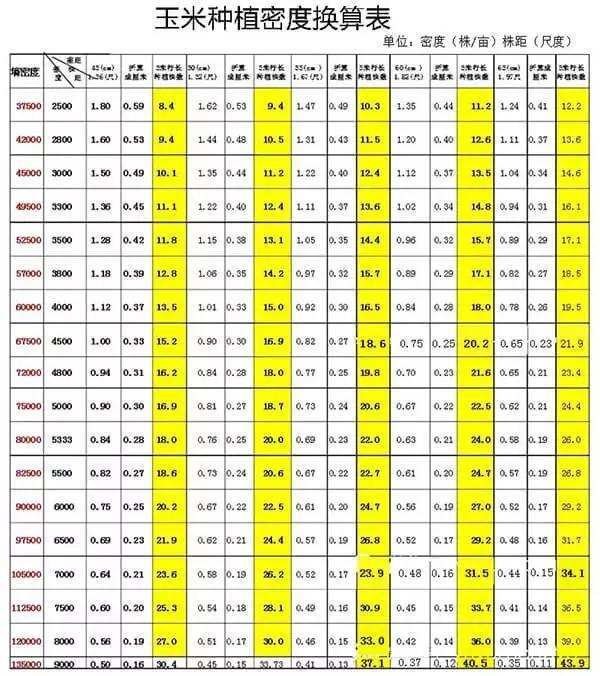
The size of corn planting density is one of the factors that directly affects corn yield. Adapt to local conditions, choose varieties suitable for local planting, and select a reasonable density according to variety characteristics, yield level, soil fertility and fertilization level, so as to increase corn yield to a greater extent.
Follow the Huobao Agricultural Input Investment Promotion Network official account: huobao3456tv, to learn more!