Plane tree sapling prices plummet, the former money tree reduced to worthless firewood
 SaplingsPrices plummet: plane trees go from "money tree" to worthless firewood"
>
SaplingsPrices plummet: plane trees go from "money tree" to worthless firewood" >
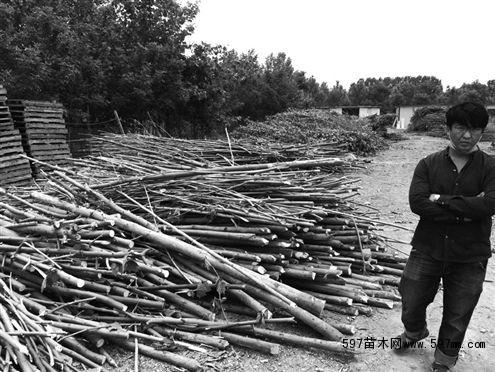
A tricycle loaded with plane tree trunks drove onto the weighbridge, the numbers on the display struggled back and forth a few times, and finally settled at 4208KG. Deducting the vehicle's own weight of 1798KG, the owner of the timber processing plant finally wrote down 2410KG in a yellow work ledger.
Because that load of plane trees had already been stripped of branches, leaves and roots, the timber processing plant offered the vehicle owner Zhao Wei the top price of the day: 0.11 yuan per jin. After collecting 530 yuan in payment, he smiled bitterly: "I worked hard growing these trees for two years, yet I can only sell them as firewood." At this point, the fifteen mu of plane trees Zhao Wei had planted had been basically dealt with, with total income of less than 2000 yuan.
Once, economic saplings dominated by plane trees brought growers returns far greater than grain, and also brought honor and attention to Yandian, a specialized sapling-growing town in Yanzhou, Jining. But after the peak came the cliff. Since the end of last year, due to market oversupply, sapling prices fell rapidly, and on top of that heavy snow froze and damaged the seedlings. Now in Yandian Town, Yanzhou, Jining, most plane trees can only be sold at a price of a few fen per jin. The "money tree" became worthless firewood overnight.
The story of Zhao Wei and others like him is still playing out. Text/photos by reporter Ji Qiang
If you want to get rich, plant more trees
Located in the west of Yanzhou, Jining, Yandian Town sits at the junction of Yanzhou, Rencheng, Wenshang and Jining High-tech Zone, and is a typical agricultural township. But here, grain is hard to find; saplings of varying heights cover almost all the fields.
"It is no exaggeration to say that the whole village does not have a single mu of grain." So said villagers of Xiziyang Village in Yandian Town. According to the introduction, as a typical specialized sapling village, villagers long ago had the habit of planting poplar and paulownia trees in their private plots. After 1998, the village's sapling planting base developed to more than 1600 mu. Although the types of saplings planted varied, the number of plane trees was especially large.
Around 2003, Xiziyang Village took the lead in setting up a website, then still a novelty, posting the village's sapling planting situation and prices online. Out-of-town buyers contacted them for business through the website, bringing in about 5 million yuan in sales revenue each year.
Local saplings, mainly plane trees, were sold as far away as Beijing, Shanghai, Tianjin, Henan and other places.
In 2007, then village Party branch secretary Xu Hongjun did the math: "The whole village has more than a thousand people, and the average annual income from tree planting alone reached 4000-5000 yuan. Adding income from working elsewhere, it was about 7000 yuan a year."
The inherited habit of planting trees turned the now wealthier Xiziyang Village into a famous star village near and far. Under its leadership, the tree-planting trend began to spread to surrounding areas. Xu Hongguo, president of the local sapling association, told this newspaper: "At that time only our village planted trees. Other places still grew corn and wheat. Seeing that planting trees made money, surrounding villages such as Zhanghai, Mengcun and Hongmiao also began to imitate it. Now the scale of tree planting has even reached other counties and districts, radiating more than fifty kilometers around."
Under the tree-planting boom, a specialized sapling broker industry even emerged. They contacted buyers externally and helped growers sell saplings internally. The 38-year-old Xu Hongguo entered this industry about fifteen years ago. On May 18, in his shop, he crossed his legs and recalled the prosperity of that time: "Back then growers really made money. If you planted some trees on a mu of land, ensured water, fertilizer and pesticide, a profit of three to four thousand yuan was as easy as playing. If you planted good varieties in a good market, one mu could earn eight thousand to ten thousand." With such rich profits, brokers also made a fortune. Xu Hongguo revealed that in the best market, a broker could earn 30 yuan from a single tree.
Government incentives
Driven by the demonstration village, the scale of sapling planting in Yandian Town continued to expand.
Data statistics retrieved by this newspaper show that by 2010, the locality had newly developed 3000 mu of saplings, and the sapling planting area in Yandian Town had reached more than 30000 mu, with nearly 20 specialized sapling villages formed across the town. A year later, the scale increased by another 5000 mu. After being rated a "Strong Sapling Town of Shandong Province," Yandian Town proposed further expanding the scale and striving to reach 40000 mu.
In an interview in 2015, then deputy mayor of Yandian Town Liu Xuguo revealed that the local sapling area had reached more than 80000 mu, with nearly a hundred seedling varieties and an annual output value of more than 300 million yuan. "Every day, hundreds of carts of hot-selling saplings such as plane trees and white ash are sold to Henan, Jiangsu, Anhui and various places in this province."
In five years, the sapling planting area nearly tripled. Along with the continuously expanding scale came government intervention and incentive measures.
As early as 2010, Yandian Town continuously mobilized farmers' enthusiasm for planting saplings by comparing the accounts of planting trees versus planting grain. An even more direct stimulus measure was: "For large investments with strong radiating and driving effects, a reward of 200 yuan per mu per year; adopt forms such as auction, leasing and exchange, make flexible use of land policy, and absorb private capital into the development of the sapling industry." At the same time, the local town Party committee and government actively coordinated with banks, credit unions and other financial departments to increase support for the sapling industry, effectively solving the problem of insufficient development funds for sapling farmers.
The material reward measures were further refined the following year. The locality stipulated a reward of 150 yuan per mu per year for contiguous sapling and flower bases of more than 200 mu, and 100 yuan per mu per year for fast-growing forests and economic forests. Under such stimulation, by 2011 Yandian Town had formed more than 20 specialized sapling villages.
In 2015, Yandian Town's attention to and support for sapling planting reached its peak.
In March, the locality established the 2015 Spring Afforestation Work Leading Group, organizing government staff and village and group cadres to go into villages and households to publicize the economic and ecological benefits of afforestation, creating a strong atmosphere of full mobilization and everyone taking part in afforestation.
By August of last year, Yandian Town had formed 45 specialized sapling villages, attracted more than 200 out-of-town investors to develop the sapling industry, and leased 45000 mu of land. "At the same time, we deepened the reform of the forest rights system, completed the main reform and supporting reforms for saplings across the town, successfully built a forestry-bank cooperation platform, broadened forestry financing channels, and focused on solving the financing difficulties of forestry enterprises and forest farmers. In 2014 alone, more than 12 million yuan in sapling mortgage loans was realized."
The market changed
With the incentive and support of the local government, the sapling industry in Yandian Town reached a glorious development peak. But after the peak came the cliff.
In the impression of Wang Guo (pseudonym), a grower in Xiziyang Village, not long after the cash reward policy was implemented, some outside capital flowed into the locality. "At that time the cost of renting land was not high, about five to six hundred yuan per mu. After renting land on a scale and planting trees, you could get a reward of 200 yuan per mu, plus the income from planting trees. It was almost a business that was sure to profit without loss."
Even local villagers did their utmost to obtain subsidies and rewards. "The most common was setting up cooperatives, gathering scattered households together to form a whole and reach the reward scale." Data published by Yandian Town in 2015 show that the locality had more than 140 sapling cooperatives. "They were not necessarily all established for the reward, but many certainly received subsidies."
When the scale reached its peak in 2015, the sapling market was also quietly changing. "At the end of 2014, the market had already begun to decline, but at that time a plane tree with a diameter at breast height of five centimeters still cost about twenty yuan each. By the end of 2015, that price had reached 5 yuan, and the trees still had to be delivered to the broker." Wang Guo introduced.