Watermelons Smaller Than Jujubes, This Farmer Is More Entertaining Than City Folk
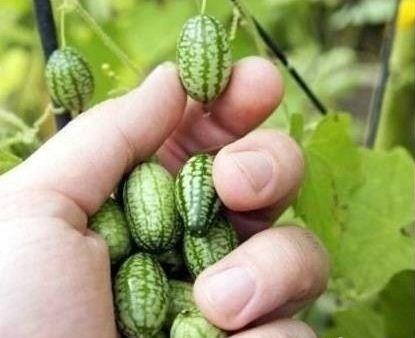
In June, which is also when watermelons start hitting the market in large quantities, we can pull half a watermelon out of the fridge in the afternoon and eat to our heart's content, and oh, how refreshing it is. Especially back in the days when I was working in the fields, just imagining that feeling of eating watermelon would instantly give me energy. The ancients could quench thirst by thinking of plums; I can shake off fatigue by thinking of melons. Huh? Wait a second, in the picture above, why is this person picking such tiny watermelons? Picking watermelons smaller than jujubes, is he crazy? Haha, of course not, these watermelons are already ripe. Normally, we eat big watermelons, and we've seen plenty of big watermelons, but many people are seeing such small watermelons for the first time. Does anyone know what they're called? I'll make an exception and show off a bit, so for now let's call them little watermelons.
Digging into the history of watermelons, it turns out watermelons are actually an imported product, so by analogy, this kind of little watermelon is naturally also an imported product. In my hometown, people used to grow big watermelons, and every watermelon season, every household would compete over whose watermelons grew biggest. But this year, Old Wang in the village quit doing that. He started growing this monster in his own greenhouse, that is, the little watermelons smaller than jujubes we saw earlier. This was a strange thing in the village. To be honest, at first many people said he was crazy. Actually, I thought so too. But he sat there steady as a mountain, no matter how others mocked him, just growing his own.
The editor couldn't resist asking around; after all, there's no shame in asking those below you. A farmer who doesn't know how to flatter people isn't a good editor. After my endurance of humiliation, Old Wang finally revealed his secret (don't overthink it, he doesn't live next door to me): this tiny finger-sized watermelon actually came from the other side of the ocean. And it had only recently entered the country. Old Wang said his own son works in the city, and he stands a bit higher and sees a bit farther, so he asked someone to find Old Wang some little watermelon seeds and told Old Wang not to grow big watermelons anymore, just grow little watermelons. According to Old Wang, a single seed sold for several dozen yuan. I was stunned at the time. How much would the watermelons grown from that be worth? Old Wang shook his head, and DUANG-ed out one line: I'm just not telling you, just not telling you, just not telling you.
Alright, back to the point. The stand-up comedy is over, and now we enter the news broadcast segment, and talk about this kind of watermelon. Slowly walking toward us in the picture is our important foreign guest today: the little watermelon. It is native to South America and belongs to imported agricultural products. In recent years it was introduced to China, and preliminary results have been achieved during cultivation. Because it is grown in greenhouses, it does not have a fixed season; it can be cultivated in spring and summer. If grown in the open field, its season is roughly the same as that of the strawberries and rosy apricots we usually eat. The general growth cycle of this little watermelon is 60-85 days. After trellising, a single plant is 1.2-1.8 m tall, and each plant yields 60-90 fruits. Unlike our watermelons, the flesh of this little watermelon is not red, but as shown in the picture; at first glance, doesn't it feel like a kiwifruit? But it is much better than kiwifruit. Do you dare eat kiwifruit skin? The skin of this little watermelon is soft and can be eaten directly, which makes it much easier than traditional big watermelons, at least you don't have to cut it open or peel it. In addition, its seeds can also be eaten, which is a great help for us when eating it.
This little watermelon was first introduced to China in 2011. After countless trials, it has already brought visible returns to many people. Because the yield is extremely small, its market price is also astonishingly high. Abroad, one jin sells for about 15 US dollars, and in China, the figure is even larger, about seventy or eighty yuan. Such high value has made the little watermelon leap to become a super aristocrat in China's fruit world, usually appearing only in high-end restaurants or luxury supermarkets. At ordinary fruit stalls, you don't even get a chance to look at it. Now look at Old Wang in our village again. Isn't he more entertaining than city folk?
Finally, it's time to reveal the answer. What exactly is this little watermelon? First of all, I call it little watermelon, and many people also call it little watermelon, mini watermelon, or mouse melon. So it is inextricably linked to watermelons. The big name of this thing is Pepquino. It is native to South America. Today let's break down its eight characters. Pepquino belongs to the plant kingdom, angiosperms, dicotyledons, Dilleniidae, Cucurbitales, Cucurbitaceae, and the genus Melothria. The common watermelon we see belongs to the plant kingdom, angiosperms, dicotyledons, Cucurbitales, Cucurbitaceae, and the genus Citrullus. In other words, they are relatives, and as for how close their blood relationship is, that is for readers to analyze.