New water-saving wheat variety forecast to yield 1200 jin per mu
Original headline: Zhaoxian County, Hebei widely promotes "new varieties + new technologies"
600,000 mu of wheat expected to yield 550 kg per mu
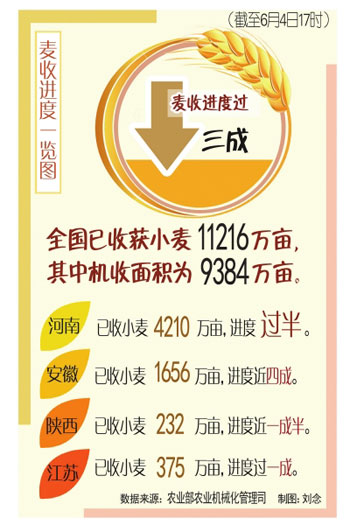
Wheat harvest progress chart
On the morning of June 1, technicians from the Agriculture, Forestry and Animal Husbandry Bureau of Zhaoxian County, Hebei Province, came to the wheat field of Li Sumin, a major grain grower in the county, to measure the yield of his 200-mu high-yield demonstration field. By examining the wheat growth, sampling technical indicators such as the number of spikes per mu, grains per spike and 1000-grain weight, they preliminarily predicted that the average yield of the demonstration field would exceed 600 kg per mu.
"The more than 200 mu I planted is the new water-saving variety 'Lunxuan 103'. It saves one-third of the water compared with ordinary wheat, is cold-resistant, lodging-resistant and high-yielding, and can also fetch a good price." Seeing the experts' sampling results, Li Sumin smiled. Li Sumin is the owner of the first family farm in Hebei Province and was awarded the title of "National Top Ten Farmer" by the Ministry of Agriculture in 2015. Through years of exploration and practice, he reached a conclusion: "new varieties + new technologies" are the magic weapon for increasing income.
Zhaoxian County is a major agricultural county. At present, its wheat planting area is about 600,000 mu, and it is a national-level production base for high-quality wheat and high-quality commercial grain. The county regards the selection and promotion of high-quality wheat varieties as a key step in ensuring a bumper summer grain harvest. Through screening, technicians from the county agricultural science institute eliminated old, degraded and poorly adapted varieties, and vigorously promoted newly approved high-quality varieties with good adaptability and outstanding comprehensive traits throughout the county.
Li Huili, director of the Zhaoxian County Agricultural Science Institute, introduced that the institute not only undertakes experiments for 6 research groups of the Institute of Genetics and Developmental Biology of the Chinese Academy of Sciences, but also undertakes projects such as the new wheat variety breeding experiment of the Chinese Academy of Agricultural Sciences and the national winter wheat variety regional trial for the northern Huang-Huai region. In 2015-2016, from the latest approved varieties, the Zhaoxian County Agricultural Science Institute screened and collected 6 new winter wheat varieties suitable for planting in the region for display, reserving resources for future wheat variety renewal and promotion. At present, the county's wheat is in the late grain-filling stage, and the wheat growth is even and consistent. Experts predict a yield of 550.3 kg per mu, and a bumper summer grain harvest for the whole county is in sight.
"At present, we have established 'one seed dressing and two sprays' trial and control fields of 10 mu each in Qiandazhang Township, and arranged 100 mu of water-saving and reduced-irrigation trial and control in the core block of the 10,000-mu demonstration area in Xujiazhai, to test and demonstrate high-yield cultivation techniques for wheat with one irrigation yielding 1000 jin and two irrigations yielding high yields." Li Huili said that in order to promote new water-saving varieties and explore new high-yield technologies, they established multiple trial fields and fertilizer-reduction trial fields in Qiandazhang Township and other townships in the county, advocating green water-saving planting. Judging from the situation in recent years, some new varieties have achieved 1000 jin with one irrigation, attaining the effect of saving water and increasing yield.
It is understood that in order to ensure the large-scale promotion of new wheat varieties and new technologies, the county scientifically planned and built to high standards 12 10,000-mu wheat high-yield demonstration areas in the county's main grain-producing areas, with a directly created area of 137,000 mu. In the demonstration areas, 8 key technologies were fully promoted, including the selection of water-saving, stable-yield and high-yield varieties, timely late harvest and late sowing techniques, multifunctional seed-coating agent dressing techniques, straw return and fine land preparation techniques, sowing with sufficient soil moisture, equal-row full-density planting techniques, mechanical precision sowing techniques and post-sowing compaction techniques. Comprehensive "one spray" pest and disease control was carried out to achieve unified prevention and control of pests and diseases throughout all wheat growth stages, reduce the number of pesticide applications and pesticide residue pollution, improve product quality and market competitiveness, and drive wheat production across the county through radiation. (Xu Zhepu, our reporter Hao Lingfeng)