Children from Cliff Village hike six hours through the wilderness to school
By the time Edi Yousan reached the foot of the mountain, his toes were all sticking out.
After hiking continuously on mountain paths for 5 hours, 8-year-old Jijue Erzi was drenched in sweat.
The children passed through a tunnel about 50 meters long.
The children stopped midway at the Atutetu group, spent 10 minutes finishing their meal, and then continued on.
Chen Guji found a water source in a cave at a reservoir construction site, fetched water, and had the children drink in turn.
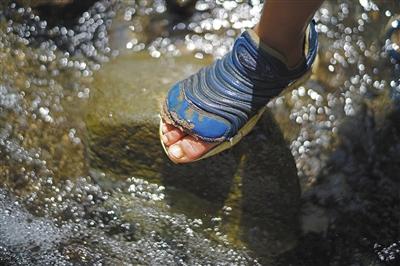
After walking for about 4 hours, when they passed a small stream, 6-year-old Jike Chengye took off his shoes and soaked his feet in the water.
For the first more than 1 hour of the journey, it was almost all uphill. The children were exhausted and lay down on the hillside to rest.
Beside a spring, Chen Guji used the cool spring water to help his 6-year-old son Chen Muhei cool down and beat the heat.
10-year-old Edi Qupo felt his feet could not hold up, so he made himself a walking stick for support.
June 6, 2016, was the day when 15 children from Atulie'er Village in the Liangshan Yi Autonomous Prefecture of Sichuan went down the mountain to school. This place, known as "Cliff Village," has a vertical distance of about 800 meters from the ground, and 76 households live here. To reach the outside world from the village, people need to climb 17 vine ladders along the cliff.
As usual, at 6:30 in the morning, the parents set off with the children, and by 7 o'clock they had gathered one after another at the cliff on the east side of the village. As they were preparing to set off, the group leader Edi Changjiang received a phone call from Api Jiti, the Party secretary of Zhier Mo Township: "Notify everyone that the children must not climb the sky ladder. They must detour and go down the mountain by another mountain road of more than ten kilometers."
Landslides, rolling rocks, tunnels, river valleys, abandoned bridges... For the children, the other road down the mountain meant 6 hours of exhaustion and hunger.
●Another road
Taking the detour did not mean absolute safety.
Starting from the gathering place, they first headed to the Atutetu group, about 3 kilometers away. The children first passed through several landslide sections ranging from more than ten meters to several dozen meters. The parents reminded them to keep a slightly larger distance and pass quickly to avoid falling rocks. After that, they advanced almost the whole way on roads with a slope of more than 30 degrees.
Because the route to school was changed at the last minute, from the previous sky-ladder route of more than 2 hours to another route involving a 6-hour detour, the children had not eaten when they came out in the morning. Village group leader Edi Changjiang called Jike Quri, the leader of the Atutetu group they would pass through, in advance and asked him to prepare food.
At 8:30, after more than an hour of arduous climbing, the children reached Jike Quri's home and spent ten minutes eating the prepared potatoes and tofu soup.
The Atutetu group also had more than 10 children studying at Le'er Primary School. Usually they took an extremely steep cliff road by the village to go to school. That morning, the group also received notice not to take the cliff road and to go down the mountain by the same detour.
The two groups of children gathered together. Including the parents, there were about 40 people.
●Tired and hungry
Next they entered Suzhu Village. It and Atutetu form two large slopes facing each other on the same mountaintop, and the route was downhill the whole way. However, the road surface was all fine broken stones and dense ferns, with some uneven rocks here and there. Most of the children's shoe soles were smooth, and people slipped from time to time. Fortunately, the road passed through the village near the foot of the mountain, so it was frightening but not dangerous.
Because the vegetation was dense, the children encountered snakes several times. Amid panicked screams, the snakes were also frightened away.
The children had walked for about 3 hours. Aside from refilling some drinking water when they ate, they had not seen a single water source along the way. After passing Suzhu Village, they entered a canyon area. The children ran into a work shed at a hydropower construction site, and the owner brought out the only small bucket of water for them to drink.
That little bit of water was not enough to drink. Guided by the construction workers, parent Chen Guji found a diversion tunnel under construction for a reservoir, where there was clear spring water.
After replenishing water, the children continued forward. Along the way, 6-year-old Chen Muhei kept saying to Chen Guji, "Dad, I'm tired and hungry. Why are we walking such a long way? How much farther is it?"
Chen Guji said, "Almost there, almost there. Once we get to the foot of the mountain, there will be a car to ride."
●Worn-out shoes
Entering the canyon, there were section after section of switchback downhill roads with slopes of more than 30 degrees. The road surface had large amounts of broken shale, which was rather sharp, so the children proceeded with extra caution.
The continuous downhill stretch put a lot of pressure on the children's toes. 13-year-old Edi Yousan's shoes already had a hole. When they set out, two toes were sticking out. By the time they reached the foot of the mountain, the damage was even worse, and all his toes were exposed.
"If the shoes can't be worn anymore, then during the 10 days of living at school, I'll just go to class barefoot." He said this was because they were his only pair of shoes.
Along the way, in a severe debris-flow area, an "L"-shaped tunnel about 50 meters long and less than two meters high passed through the debris-flow zone. One parent went in front using a mobile phone for light, and the children held hands from behind as they passed through one turning section where they could not see their own hands.
Not long after coming out, there was a stream 3 meters wide. Some children crawled and plunged their heads into the water to cool off, and some took off their shoes and soaked their tired feet.
More importantly, the children, who had been short of water for a long time, could drink their fill.
●"My legs can't make it"
At 12 o'clock, the children passed through another river valley. The water flow in the valley was relatively gentle, and the water surface was about five or six meters wide. The only way across was an abandoned bridge with iron cables and wooden planks. The younger children had to be carried or held by their parents to get across.