What are the best cultivation methods for autumn-planted potatoes?
Autumn potato cultivation generally begins with sowing in August and harvest in November. In the early stage, high temperatures favor the growth of aboveground stems and leaves, while in the later stage, lower temperatures are suitable for underground tuber expansion. Yields are higher than with spring planting, but after sowing, tubers tend to rot and seedlings die. Planting whole tubers and strengthening field management can avoid this phenomenon and achieve relatively high returns. The main cultivation techniques are as follows.
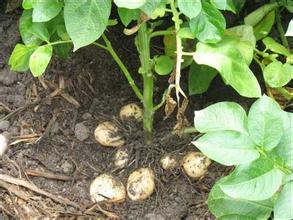
1 Whole tuber planting The sowing period for autumn potato cultivation falls in the high-temperature, rainy season of August. Planting cut pieces easily leads to tuber rot and dead seedlings. Using whole tubers for planting can reduce tuber rot and dead seedlings in autumn, prevent degeneration, and increase yield.
1.1 Selection criteria Seed potatoes for autumn planting should be small tubers of about 50 g that were harvested early from the spring crop and carefully selected. These tubers should be undamaged, disease-free, with bright skin color and moderate size. About 200 kg of seed is needed per 667 sq m.
1.2 Treatment of whole tubers Whole-tuber planting emerges more slowly than cut-piece planting, and when spring potatoes are used as seed, the seed tubers are dormant at autumn planting time. Before sowing, they should be sprouted or soaked in chemicals to promote sprouting. Generally, 5 days before sowing, soak them in a 15-20 mg/L gibberellin solution for 20-30 minutes, remove them, and bury them in moist sand to promote sprouting. Sow when the sprouts are 1-2 cm long.
1.3 Sowing at the right time If autumn potatoes are sown too early when temperatures are high, the seed pieces rot easily, there are gaps in the stand, and viral disease is severe; if sown too late, the growth period is insufficient and yields are low. In North China, sowing should generally be done from August 5 to 15.
2 Sowing method Sowing autumn potatoes is generally different from spring potatoes. Because autumn potatoes are sown in a season of high temperature and strong light, a cooler environment should be created by sowing on shady slopes to help early and uniform emergence. Sowing should be done before 10:00 and after 15:00. Open furrows, sow, and cover with soil immediately. Also dig drainage ditches. Generally, row spacing is 60 cm, plant spacing is 25 cm, and 5,000 plants are kept per 667 sq m.
3 Field management
3.1 Watering Water promptly after sowing to keep the furrows moist, but the water volume should not be too large, and cultivate promptly after watering to strive for early emergence. Management after emergence should be carried out early to push the potato vines to grow well around the Autumn Equinox.
After each watering, cultivate the furrows once, combined with wide-ridge hilling, to favor root and leaf growth. After emergence, water frequently in small amounts to keep the soil moist. After October, the number of waterings can be reduced, with only one small watering before frost to prevent frost damage.
3.2 Topdressing Autumn potatoes can emerge about 10 days after sowing, and topdressing should be done promptly to promote aboveground stem and leaf growth. Generally, after full emergence, apply 10 kg of ammonium sulfate or 5 kg of urea per 667 sq m. The second topdressing is carried out when the seedlings are about 20 cm tall, applying 15 kg of urea per 667 sq m. If the stems and leaves are weak and the leaves turn yellow, the amount and frequency of topdressing should be appropriately increased. But it must be done before October 10. Otherwise, with low temperatures later, plant growth is slow, absorption is limited, and the fertilizer cannot fully take effect, giving poor results.
3.3 Cultivation, weeding, and hilling In autumn potato cultivation, temperatures are high, humidity is high, and weeds are abundant, so herbicides should be sprayed promptly. Cultivation and weeding should also be carried out as early as possible. After emergence, the first cultivation can be deeper; when the seedlings are about 20 cm tall, carry out the second cultivation and the first hilling. At flowering, carry out the second hilling; do not bury the lower stems and leaves when hilling. The third hilling can be done in late October to keep the tubers from frost damage.