Check the market conditions before planting Chinese medicinal herbs
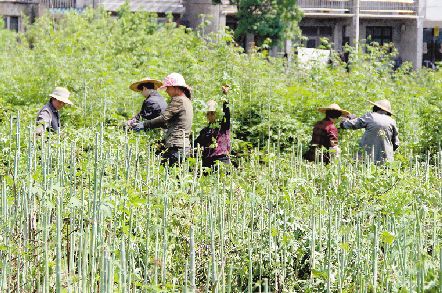
At the planting base of Peng Fugui, a medicinal herb grower in Chengnan Town, more than a dozen workers were "buried" in the bushes, cutting down raspberry branches one by one and picking the raspberries growing on them. These raspberries are different from the ones we usually eat. Apart from a few with a slight reddish tint, they are basically all green. "Raspberries turning red means they are ripe and can be eaten as fruit. But mine are for use as medicinal herbs, so I need the green, unripe ones," Peng Fugui said.
Cultivated raspberries can sell for 90 yuan per jin
Peng Fugui started growing Chinese medicinal herbs five or six years ago. "Before, I grew Atractylodes macrocephala, but this variety is fairly common and the returns were not very good either, so the year before last I started growing raspberries and iris," Peng Fugui said. This year is the first harvest of raspberries and also the year with the best price in recent years. "After picking began in early May, they could sell for about 90 yuan per jin. On the market, the price of dried raspberry fruit was 58 yuan to 70 yuan per jin the year before last, and 65 yuan to 75 yuan last year."
Because fresh raspberries are hard to preserve, Peng Fugui specially bought a dryer to sun-dry or machine-dry the raspberries. "At the start of picking, the raspberries were still fairly tender, and it took about 3.5 jin to 4 jin to dry into 1 jin of dried fruit. Now 3 jin can be dried into 1 jin of dried fruit," Peng Fugui estimated. This year, one mu of land can harvest 100 jin of dried raspberry fruit. "The main reason is that the flowering period ran into long periods of rain, which affected the yield. I estimate that next year one mu of land can harvest 200 jin to 300 jin of dried fruit."
Peng Fugui is not worried about the sales channels for raspberries. "Not many people grow raspberries now, and on top of that, wild raspberries are low in quantity and poor in quality, so the price of cultivated ones keeps being pushed higher. Sales are very good, and medicinal herb companies come to purchase them on their own initiative."
In addition to raspberries, in August this year, Peng Fugui's iris will also usher in a bumper harvest. "The market price of iris this year is not low either. It can sell for 14.5 yuan to 15 yuan per jin. The year before last it was only 7.5 yuan per jin."
More than 600 mu of Chinese medicinal herbs are grown in Chengnan, and growing more can earn subsidies
Peng Fugui is not the only one growing Chinese medicinal herbs. In the past two years, many growers in Chengnan have begun to step into the Chinese medicinal herb market. "Up to now, Chengnan Town has planted more than 600 mu of Chinese medicinal herbs, with the main varieties being raspberry, lily, and Tetrastigma hemsleyanum. Peng Fugui alone has planted 60 mu of raspberries and 60 mu of iris," said a person in charge of Chengnan Town.
To encourage local people to grow Chinese medicinal herbs and flowers on a large scale, Chengnan Town also issued relevant subsidy policies last year, giving subsidies ranging from 600 yuan to 1,000 yuan per mu for 3 consecutive years. For example, for ornamental Chinese medicinal herbs grown in contiguous plots of 20 mu or more with a land lease term of 3 years or more, the first year gives a subsidy of 1,000 yuan per mu, the second year gives a subsidy of 600 yuan per mu, and the third year gives a subsidy of 300 yuan per mu. The same applies to economic Chinese medicinal herbs grown in contiguous plots: the first year gives a subsidy of 600 yuan per mu, the second year 400 yuan per mu, and the third year 200 yuan per mu.
The products Peng Fugui planted this time involve both subsidies for ornamental Chinese medicinal herbs and economic Chinese medicinal herbs. "I was the first to apply, and I have already received more than 80,000 yuan in subsidies for the first year," Peng Fugui said.
Growing Chinese medicinal herbs cannot be too blind; Dendrobium officinale is a counterexample
According to preliminary statistics from the municipal Agriculture and Forestry Bureau, the planting area of Chinese medicinal herbs in Wenling has already reached over 1,000 mu, among which the largest is Dendrobium officinale.
"Chinese medicinal herbs in our city are mainly Dendrobium officinale, distributed mainly in Daxi, Wenqiao, Chengnan, Zhenheng and other places. According to incomplete statistics, the city's Dendrobium officinale area has already reached more than 800 mu, and it is mainly cultivated under protected conditions. Besides Dendrobium officinale, in the past two years saffron, Tetrastigma hemsleyanum, raspberry, foxglove and others have also been planted from time to time," said a relevant staff member of the municipal Agriculture and Forestry Bureau. However, because many growers have not done enough market research, they run into difficulties in sales channels and prices. Take Dendrobium officinale, for example. Its price has fallen quite a bit in recent years. Dendrobium officinale that used to cost over 1,000 yuan per kilogram can now be bought for less than 100 yuan.
Some growers said that in 2013, one jin of Dendrobium officinale could still sell for five or six hundred yuan. By 2014, it had fallen to two or three hundred yuan, and in the past two years, even one or two hundred yuan is hard to sell.
"Before growing Chinese medicinal herbs, you still need to understand the market environment better and cannot be blind. For example, growing raspberries in Chengnan is actually a pretty good choice. On the one hand, it is because raspberries are not very difficult to grow. On the other hand, it is because there is market demand. In addition, wild raspberries cannot grow in contiguous stands, which provides development opportunities for cultivated raspberries," the staff member said.
He also reminded that when growing Chinese medicinal herbs, it is best to choose understory planting. "Many Chinese medicinal herbs are suitable for growing under the forest. The quality will be better, and the forest land can also be used rationally. Not only is the rent cheaper, but there is also no need to build too much infrastructure, which can save quite a lot of costs. However, although understory planting gives better quality, because it imitates wild cultivation, the yield may be affected."