The largest bayberry planting base in Yibin, Sichuan, China, welcomes its ripening season
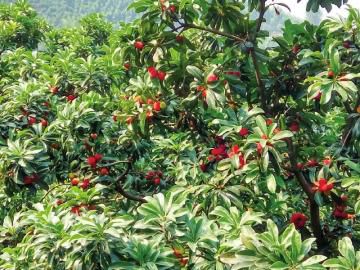
The trees are covered with bayberry fruits
It is now the season for eating bayberries. The bayberry trees at Yibin's largest large-scale bayberry planting base have long since borne fruit, and the ripe bayberries have turned from red to black. In fact, Yibin is not the native home of the bayberry, so how was it introduced?
Yesterday, a reporter traveled by car for less than half an hour to Group 15, Jianshe Village, Zhaochang Subdistrict, Cuiping District, and saw the bayberry trees laden with fruit on the mid-slope and their owner, Li Yi. It turns out that he was the one who introduced bayberries to Yibin. Li Yi's base is called Jinpo Family Farm, about 300 mu, with 5,000 bayberry trees growing densely on the mid-slope beside Curve No. 3 of the Foxian Mountain road.
According to Yan Fei, deputy director of the Cuiping District Agriculture, Forestry and Animal Husbandry Bureau, this is a relatively successful case of localized bayberry introduction in Yibin.
A liquor merchant turns farm owner and boldly tries a foreign variety
Li Yi was originally a liquor merchant. Because he loves nature and yearns for a pastoral life, in 2003 he began preparing to enter the forestry market.
Li Yi discovered that at that time there were no bayberries on the Yibin market, while in the Zhejiang area, the bayberry market had good prospects. The altitude of Qixing Mountain in Zhaochang, Yibin, was just right for bayberry growth, so he began looking for partners. By a stroke of luck, he met Li Liangxi. Li Liangxi, who had dealt with tea for more than thirty years, suddenly wanted to try something else one day in 2004.
The two thus became partners. In 2003, they selected 13 bayberry saplings for a trial planting. In 2007, these 13 saplings bore fruit for the first time. "The taste was sweet and tart. We weighed them, and a single fruit was about 50 grams." The two successively bought 120 and 1,200 bayberry saplings in 2005 and 2006 respectively. In 2011, the bayberry orchard welcomed its first large-scale fruiting, with an average of 30-50 jin of bayberries harvested per tree, and that year's income exceeded 10,000 yuan. Li Yi said that altogether, the farm planted about 6,000 bayberry trees, of which about 5,000 ultimately survived, with a total investment of about 6 million yuan.
Think tank offers advice: output can reach 120,000 jin at peak production
Storms gather without warning. In 2013, a heavy rain left the two dumbfounded. To minimize losses as much as possible, they brought in technicians from the local forestry department to help. Under the guidance of technicians from the "think tank" at the Cuiping District Agriculture, Forestry and Animal Husbandry Bureau, they collected some of the still-good bayberries to make bayberry wine, which tasted equally mellow.
Having tasted the "benefits" of the think tank, the two were greatly encouraged. In the subsequent bayberry planting process, whenever they encountered a problem, they would immediately think of asking the think tank to come up the mountain to help solve it.
In addition to the local forestry department, Li Yi invites relevant experts from Zhejiang every year to guide at the farm and sends employees out to learn techniques.
"Compared with the foreign bayberries sold in the city for a few yuan per jin, these bayberries are sweeter and fresher." Li Yi said that the bayberries currently sold on the Yibin market basically come from Yunnan, and transportation takes at least 3 days, affecting the freshness of the bayberries. "At present, we grow two varieties of bayberry trees, with plenty of juice, a sweet taste, large size and greater freshness."
The bayberry trees have gradually begun to bear fruit, and this year's bayberry output is expected to reach about 2 tons. Li Yi said this is only the beginning. In 2-3 years, when the bayberry trees reach peak production, the total bayberry output of the entire farm can reach about 120,000 jin.
Not sold on the market, mainly experience-based picking
In the bayberry grove, the two built a quaint courtyard house. In the small pond in the courtyard, lotus flowers are blooming beautifully. In his spare time, Li Yi always sits on a bamboo rattan chair in the courtyard, sipping tea, reading books and studying Lizhuang culture. When guests occasionally come, he busily greets them. In Li Yi's heart, growing bayberries is like life on the mountain: one must endure loneliness. "To see results in agriculture and forestry requires a long process. Now 13 years have passed, and although the farm has not yet made a profit, I still very much love this undertaking."
At present, because output is not high, Li Yi's farm does not receive too many outside guests, and the bayberry price is kept at 20 yuan per jin. He said that in the future, the farm will continue to improve its reception capacity. Bayberries will not be sold in large quantities on the market, mainly focusing on experience-based picking of small fresh fruits, so that citizens who come to visit can both taste fresh bayberries and experience the joy of picking.
It is understood that, in addition to bayberries, chicks roam freely everywhere under the bayberry grove on the farm, and other fruits such as blueberries, peaches and kiwifruit are also grown in the nearby mountain fields.