Shepherd Wang Weiwei's Dream of Starting a Sheep Farming Business
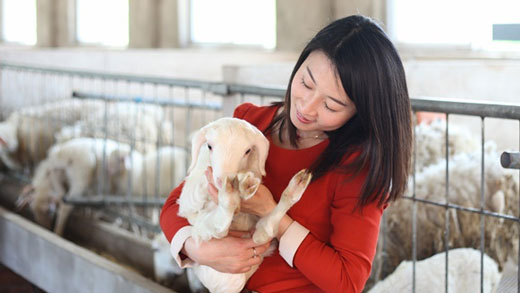
"You still have to have dreams - what if they come true?" Wang Weiwei, a post-85s girl from Jiangsu, knows this all too well. Back when she graduated from high school, Wang Weiwei already had a dream: to become a successful businesswoman. Now, she is on her second entrepreneurial venture, having invested the "first pot of gold" she earned in college by selling goat milk on commission into a Hu sheep farming project in her hometown of Hongze County. Everyone around her says this is the legend of a young entrepreneur, but to her, it is a journey of chasing a dream.
In Her Sophomore Year, She Began Her "Entrepreneurial Path"
Wang Weiwei was born into a family that was not well-off, which gave her a sense of responsibility and duty from an early age. As soon as she entered university, Wang Weiwei, who majored in broadcasting and hosting, started doing her "old trade" part-time outside campus - on-location hosting. Over more than a year, Wang Weiwei accumulated a lot of experience in interpersonal communication and team leadership, but this also made her realize that hosting is a "youth-dependent job" and not a long-term plan. So Wang Weiwei thought of starting her own business, using a tangible project to lay the foundation for her ideals.
Her fateful connection with "sheep" and her real entrepreneurial start began in her sophomore year. That was 2008, and Wang Weiwei was investigating business projects. As a student, she did not have much startup capital, so any project she could take on had to be low-cost and sustainable.
Because it coincided with the melamine infant formula scandal, the domestic dairy market was in turmoil, and Wang Weiwei thought goat milk could seize the opportunity to open up the market. But unexpectedly, at first no one accepted goat milk, and it would not sell in supermarkets or retail stores. Seeing that much of the goat milk was about to expire, she had no choice but to recall it all and bring it back to school to give to classmates to drink. Some classmates could not finish it, so they used it to wash their faces and soak their feet, which broke Wang Weiwei's heart to see. At the very beginning of her business, she lost seven or eight thousand yuan.
Even so, Wang Weiwei did not give up. In order to open up the market, Wang Weiwei, who had never studied marketing, personally stepped up with her small team to hold free product tasting activities at various sales outlets. Goat milk is called the "king of milks" and has high nutritional value. After proper promotion, it quickly won the favor of the public, especially high-end consumer groups. As the market gradually opened up, Wang Weiwei opened her own "Yangyangdao" goat milk specialty store in Changzhou, specializing in the sale of liquid goat milk and goat milk powder from various domestic brands. Through such efforts, Wang Weiwei had opened three goat milk specialty stores before graduating from university and had her own trading company, and even successfully got goat milk products into large supermarkets such as Auchan.
After Graduation, She Returned to Her Hometown to Become a "Shepherd"
In 2011, Wang Weiwei graduated from Changzhou Institute of Technology. While continuing her goat milk agency business, she was also pondering a new entrepreneurial plan. While working as an agent, Wang Weiwei often went to factories for meetings and inspections and had seen many milk source bases. She had a heartfelt love for sheep, so Wang Weiwei thought, why not just raise sheep? Through continuous investigation, Wang Weiwei discovered the Hu sheep. This breed is resistant to high temperatures and humidity, has strong disease resistance, a high reproduction rate, a gentle temperament and a high meat yield, making it very suitable for large-scale farming management. Therefore, Hu sheep became her only choice for entrepreneurship.
In 2012, Wang Weiwei brought the startup funds she had painstakingly raised back to her hometown of Gonghe Town, Hongze County, and began to establish her own farm. Wang Weiwei invested the several million yuan she had earned during her school years into this project, and also raised part of the funds through relatives and friends, bringing the total investment to 5.5 million yuan. She then transferred more than 700 mu of land in Zhaoji Village, Sanhe Town, Hongze County. The initially built farm had 6,980 sq m of standardized sheep sheds and feed rooms, a 3,000-cubic-meter silage pit, and 7 sets of feed processing equipment.
"Everyone's potential is unlimited, and you must dig into it, otherwise you will never know what you can accomplish. As long as you do it, there will always be hope. If you look down on yourself, then you truly have nothing." Wang Weiwei admitted that the entrepreneurial process carried enormous pressure. "When the farm was being built, my family suffered one misfortune after another. I had also only recently graduated and knew nothing about construction. I ate and lived at the construction site, keeping a close eye on progress and strictly controlling project costs."
What she remembers most vividly is the summer of 2013, when she lived alone in the newly built office, surrounded only by farmland and sheep sheds still under construction. Mosquito and insect bites were nothing by then; sometimes snakes would even slither into the room. Wang Weiwei had no choice but to keep a German Shepherd to guard the door, which finally gave her a bit of a sense of security.
In the Future, She Wants to Lead Her Fellow Villagers to Prosper Together
When it comes to future development, Wang Weiwei is full of confidence. Several years of practical exploration have allowed her to accumulate a great deal of experience in practical management and other areas.
In Wang Weiwei's vision, she will attract interested farming households to participate through a "company + base + cooperative + farming households + bank" model. This will not only free small-scale farmers from the cost of land requisition and building sheds, with "unified management, unified epidemic prevention, household-based raising, and unified sales," but also reduce farmers' breeding risks and achieve a "win-win" for both the farm and the farmers.
Looking further ahead, Wang Weiwei hopes to gradually improve the upstream and downstream industrial chain, starting with a mutton sheep slaughtering and deep-processing project, to build a vertical industrial chain of "leading enterprise + large-scale breeding base + mutton sheep slaughtering and deep processing + cooperative + farming households" and a horizontal industrial chain of "breeding sheep improved-variety propagation + mutton sheep fattening + feed processing (forage, concentrate) + organic fertilizer production."
"Only by achieving the step from breeding to slaughtering and processing can we truly embark on the path of branding the company's products, and thereby gradually build a high-end chilled fresh mutton brand for China." Wang Weiwei is full of confidence about the future. She says entrepreneurship is always an ongoing journey.