Zhang Song, a "Good Vegetable Farmer of China," makes a promise to every single vegetable
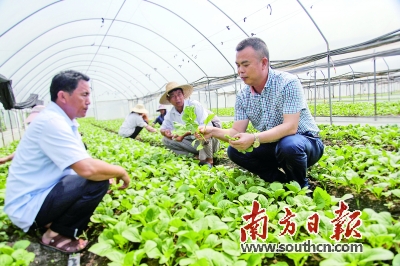
Zhang Song (first from right) is honored on the "China Good People List."
On the afternoon of June 2, Zhang Song, chairman of Sijilv (Four Seasons Green), who was waiting for visitors, strolled across the road to the melon and fruit greenhouse, casually picked up a melon, wiped it with his hand and bit off half of it: Mm, it's ripe, tastes pretty good.
A few days ago, the Central Spiritual Civilization Development Steering Commission released the May "China Good People List." Zhang Song, chairman of Huizhou Sijilv Agricultural Products Co., Ltd., was honored on the May "China Good People List," becoming Huizhou's 15th "China Good Person" and also Huizhou's first "China Good Person" in the "honesty and trustworthiness" category.
"Integrity is doing one's duty, not something you make a special effort to do." Zhang Song believes in doing things dutifully and believes in the power of technology and branding. Amid skepticism, he succeeded, completing a "comeback" from an ordinary vegetable farmer to the head of a provincial agricultural leading enterprise.
Everyone at Sijilv, from top to bottom, eats the company's own products. "We watch it being grown ourselves. You wouldn't joke around with your own family, right? My parents have been eating the company's vegetables for all these years," an employee who has worked at Sijilv for many years told reporters.
This kind of reassurance stems precisely from Zhang Song's obsession with "integrity."
"Whoever wants to add anything, I'll make them resign"
Persistent to the point of near-obsession, shrewd to the point of pursuing duty, Sijilv chairman Zhang Song leaves a vivid and strong impression.
Wu Yihui, assistant to the chairman of Sijilv, has followed Zhang Song for more than 10 years. Over these more than ten years, she has sincerely admired the chairman's adherence to principles, but has also more than once failed to understand Zhang Song's positions.
In the production of a certain oil product, according to national regulations, about 5% blended oil may be added - this has little impact on quality, yet can reduce product costs by about 4%. However, Zhang Song insisted that Sijilv's production must be 100% additive-free. It complies with regulations and can directly increase corporate profits, so why not do it? Wu Yihui couldn't figure it out and argued with Zhang Song for a long time. In the end, Zhang Song got angry: "What we need to do is 100% additive-free. Whoever among you wants to add anything, I'll make them resign."
Sijilv thus guaranteed that its oil products are 100% pure. Now, the more Wu Yihui recalls it, the more she admires him, and Zhang Song's ideas have gradually become the primary principle in her own thinking.
In Zhang Song's own words, integrity is doing one's duty, not something you make a special effort to do. At present, Sijilv carries out online sales, achieving online and offline, equal quality at equal price. A very important point is to let customers supervise, and those who are dissatisfied can refuse to pay. In some wholesale markets, a box labeled 30 jin of vegetables may contain seven or eight jin of insulating ice packs and preservative paper alone, and the quality of the upper and lower layers of vegetables also differs. Sijilv's vegetables, by contrast, are required to have a net weight of 31 jin, and the upper and lower quality must be consistent. "Every detail is a test of character. If you can't make money this way, you can choose not to do it," Zhang Song said. Adhering to this philosophy in business, he not only did not fail, but grew bigger and bigger. His conclusion is: "The greatest gain in business is giving very little but getting a lot. Honesty does not put you at a disadvantage."
This shrewd businessman, who even at his son's wedding did not forget to advertise Sijilv vegetables, chose an unusual path, a path few people take and one that therefore once made many people think it could not be walked.
Wu Yihui revealed that when Sijilv was starting out, after seeing that insects still lived well for a short time after "pesticide" was sprayed, many cooperating farmers came to her with advice: What you're doing won't work; the insects aren't even killed. However, Zhang Song and Sijilv were unmoved. The farmers could receive a stable income according to the contract, so they stopped worrying about it. In fact, not applying pesticide did not mean forgoing harvest. To ensure a good harvest, Sijilv had its own clever methods, such as using special green organic fertilizer to make insects "indigest" so they no longer nibbled the vegetables and eventually slowly "starved" to death. In this way, although the vegetables suffered some losses, safety was ensured.
Half a lifetime of growing vegetables, making a solemn promise to every single vegetable
Zhang Song, who now has nearly 40,000 mu of vegetable-growing land, started from a lower point than many people.
At age 3, Zhang Song became an orphan; at age 8, in order to study, Zhang Song grew vegetables in a field beside a tree under which there were more than a hundred funerary urns. After becoming an adult, he went to Hainan to reclaim and cultivate land, and violent typhoons destroyed years of hard work in an instant.
Hardship either destroys faith or tempers character. For Zhang Song, there is no doubt he chose the latter.
In 1991, Zhang Song came to Danshui in Huiyang and rented land in a local village to grow vegetables. From one field and one stall, he gradually developed to more fields and multiple stalls. In 1992, Zhang Song began to contract the entire farmers' market and promised externally that vegetable farmers over 60 years old, under 18 years old, pregnant women, disabled people, disadvantaged families, and those with daily sales of less than 50 yuan would be exempt from all fees in the farmers' market.
A few years later, Zhang Song opened a 300-mu vegetable planting experimental base in Huidong, and subsequently opened several agricultural product planting bases in Putian and Senmukeng in Huidong, Yonghu and Pingtan in Huiyang, Shaoguan, Hainan and other places. To ensure quality, Zhang Song set the rules: seeds, fertilizers, and pesticides are all provided by the company; farmers are only responsible for management and harvesting; the company pays wages according to actual output; and all planting costs and sales risks are borne by the company.
To ensure the safety of vegetables, facing pressure from a buyer for 2 million yuan in compensation, Zhang Song still insisted on destroying on the spot vegetables worth more than 100,000 yuan; he refused franchise stores with good prospects and did not hesitate to increase economic investment to build self-operated stores; he promised that if anyone could prove that a single vegetable exceeded pesticide residue standards, they would be rewarded 10,000 yuan.
Over decades of growing vegetables, Zhang Song claims to have a "vegetable farmer complex." On the one hand, he understands agricultural development, having seen domestic agriculture go from using very little chemical fertilizer and no pesticides to using large amounts of chemical fertilizer and pesticides, and now to green agriculture gaining more and more recognition. He has witnessed the deterioration of food safety and also realized that enormous business opportunities lie within it: "Product safety is the bottom line. The problem of pests and diseases can be solved with circular agriculture. Agriculture must be large-scale agriculture and circular agriculture."
"I think I am a capable person. There are many ways to make money, but they have no particularly special meaning in themselves, while growing vegetables has great meaning." Zhang Song believes that everyone cannot do without agricultural products. Providing safe agricultural products not only benefits consumers, but can also drive others to do the same, increase the income of cooperating farmers, and methods such as drip irrigation for saving water can also bring large areas of wasteland into use. Land that was originally 200 yuan per mu of wasteland, after reasonable cultivation, is now rented from farmers at 1,000 yuan per mu, driving changes in farmers' lives.
Speaking of the currently hot "Internet Plus" in the agricultural field, Zhang Song, who has already established the Sijilv online mall, has his own understanding. He said that the buying and selling of fresh agricultural products has gone from old-style vegetable markets to supermarkets and then to the Internet. For agricultural products to do online sales, they must achieve seamless connection before, during, and after production. Any minute of oversight damages the safety of agricultural products. What Sijilv is doing is delivering directly from fields or slaughterhouses through cold-chain distribution to consumers' homes, minimizing intermediate links as much as possible. This is the healthiest food.
At this moment when the south is ushering in sweltering summer weather, Zhang Song's son is leading a team "growing vegetables" in Yinchuan: the hot and dry environment there is very conducive to the growth of vegetables. Including Huizhou and Yinchuan, Sijilv currently has more than 20 planting bases nationwide, with a total planting area of close to 40,000 mu.