During wheat harvest season, the work team helps villagers cut wheat, and their hearts grow closer
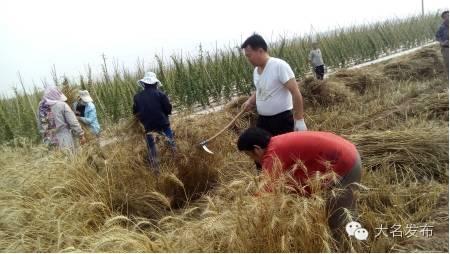
Summer harvest and summer planting are extremely urgent, commonly known as "rushing the summer." Because if the wheat ripens and is not harvested in time, continuous rainy days will cause the wheat to sprout, affecting the harvest. Therefore, households without strong labor worry during the "double summer" season.
When Wang Chengjun, team leader of the Municipal Archives Bureau work team stationed in Zhongzhang Village, brought team member Zhao Dongchuan to the fields to assist with the burning ban, they discovered many people harvesting with sickles in a wheat field. Through inquiry, they learned that the male head of the household had suffered a high-level paraplegia from being struck while working at a construction site 7 years ago, and could not take care of himself. His child was still in school, and all the farm work at home relied entirely on the female head of the household alone, making life very difficult. Whenever the busy farming season came, the woman would rise early and return late, working extra hours, and warm-hearted neighbors would also come to help.
What the village-stationed work team saw was neighbors helping harvest the wheat. Upon learning this, the comrades of the village-stationed work team immediately went to help, taking the sickle from the elderly woman's hands and joining the helping team.
During the wheat cutting, through chatting with the warm-hearted Aunt Wu, the work team learned about the hardship of farmers growing wheat, and also understood that from sowing to harvest, one must water several times, apply fertilizer several times, spray pesticides several times, and hoe weeds several times. By some calculations, growing one mu of wheat only earns enough grain to eat. This further strengthened the work team's determination to lead the villagers toward poverty alleviation through industry and transform the planting model, and made them feel the heavy burden on their shoulders even more.
Photos by Zhao Dongchuan, text by Wang Chengjun, edited by Li Haixue