The current state of rural China is shocking. Who will farm the land in the future?
A saying is now circulating in rural areas: those born in the 1970s are unwilling to farm, those born in the 1980s do not know how to farm, and those born in the 1990s do not even mention farming. This is by no means people's banter or a joke, but a problem that genuinely and widely exists in rural areas today. Most of those left in the villages farming are the elderly and middle-aged women, while the children have all gone to the cities to work. Who will farm the land in the future? Where will the grain for more than a billion Chinese people come from?
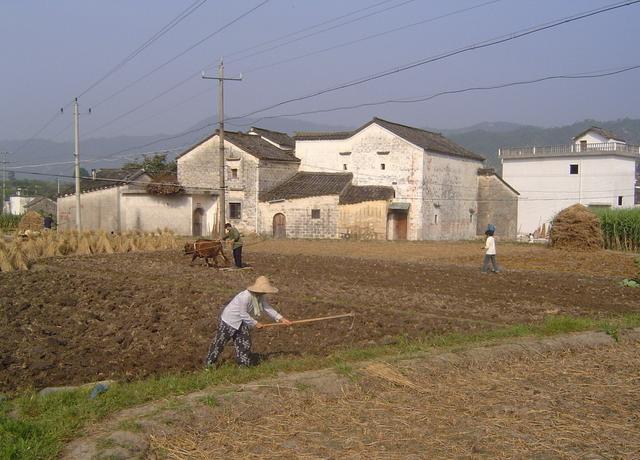
Who will farm the land in the future?
According to a report by People's Daily Online, a survey of two major agricultural counties in Henan and Shandong found that people under 55 in rural areas basically do not farm: they do not want to, and they do not know how.
Zhang Wenming, a farmer in Pingling Village, Sizhai Township, Henan, has a family of five. His son and daughter-in-law work away from home, earning more than 6,000 yuan (RMB, same below) a month. His wife looks after their grandson, and all 10 mu of land is managed by Zhang Wenming alone. "I don't expect to get rich by farming; it just brings in a bit of pocket money."
Li Cheng, a 74-year-old villager, only stopped going out to the fields after surgery the year before last. His 12 mu of contracted land was handed over to his son Li Wenxian. He said: "It's not that my son wants to farm; it's that his health is poor too, he can't go out to work, and he has no particular skills, so he can only farm at home."
Pingling Village has 550 households and 4,900 mu of land. The village chief admitted: "Those under 55 are almost nowhere to be seen in the fields. Those born in the 1970s are unwilling to farm, those born in the 1980s do not know how to farm, and those born in the 1990s do not even mention farming. The village's land has not been transferred on any large scale; most of it is farmed by the elderly and women at home."
This is still the situation in the rural plains of northern Henan. If you go into the southern Taihang Mountains and look at the terraced fields in the mountainous areas of Shanxi, you will see another scene entirely. Across whole slopes of terraced fields, hardly a few people can be seen working, and quite a lot of land has been left abandoned and unplanted.
The report said that in earlier years, policies encouraged large-scale grain growers. Guo Weifeng, a major grain grower in Shazhuang Village, Senggu Township, Yanjin County, joined forces with three other farmers, and by 2014 the transferred area had grown to 600 mu, with several hundred thousand yuan spent on agricultural machinery. But "grain prices were good for two years, then last year they fell sharply, and I lost more than 90,000 yuan. I had originally planned to transfer another 900 mu, and the land was all agreed on, but I didn't dare rent it."
Signs of land being returned have begun to appear. Zhao Guohuan, chairman of the Yanjin Century Rich Cooperative, said the cooperative had transferred a total of 1,800 mu of land on 10-year contracts. Although the contracts have not yet expired, he expects half the land to be returned by the second half of the year.
"Chinese agriculture has been smashed to pieces by reform and opening up"
A blog post online titled "Chinese agriculture has been smashed to pieces by reform and opening up" wrote: estimating by the median commodity prices of 1980, the prices of the vast majority of goods in China have now risen more than a hundredfold, while grain prices have risen only a fewfold. In 1980, the market price of corn was 3 jiao 5 fen per jin; now it is a little over 1 yuan, a rise of only 3 times. If you go to a hospital to see a doctor, carrying 50 jin of corn on your back will only get you registered. With such a huge price disparity, how can it be adjusted? No matter how it is adjusted, grain is always the least valuable thing. For farmers, farming can only be a helpless choice. As long as there is any other way to survive, they will absolutely not farm!
Growing grain does not make money, and bank loans have become even tighter. The head of one cooperative said: "For the past 5 years we borrowed from a bank, and on each sum we had to pay double interest: after borrowing, we first deposited it back, then borrowed it out again. But having money was better than not having it. Unexpectedly, last year the bank heard that growing grain was losing money, and this year it refused to lend." Quite a few farmers' professional cooperatives are struggling to operate, and some exist in name only.
Rural land lies waste; the current state is shocking
In 2015, an observational note from an on-the-ground survey of a Hunan village circulated widely online. Its author, Wang Junbai, used his writing to show a corner of a declining rural China.
Around 1985, the village had a total of 132 people, with a reasonable mix of old, middle-aged and young, and young people made up about half. But at present, only 54 people live in the village long term, and they are basically mainly the elderly and the young. Here people cannot speak of any hope; the older generation lives here helplessly, and the younger generation will leave once they reach fifteen or sixteen.
In addition, the land lies waste with few people farming it. Of the village's paddy fields, less than one tenth are planted with rice seedlings, and they have gradually all been switched to corn. The villagers do not have enough rice to eat, so they buy it in town.
As for dry land, cultivation now relies entirely on herbicides and pesticides. After many years of continuous planting this way, the fields have degraded, the soil has become compacted, and crop yields have fallen sharply.
In the end, even simple methods of farming dry land were beyond them, so the villagers planted tea or oil tea, just to show that the fields still had owners. Meanwhile the trees grew unchecked, leaving crops in the farmland short of light, and animals of all sizes in the woods competed with people for grain.
At present, the farmland is still being held up with difficulty by the older generation of villagers. In the future, when the young people do not know how to farm, the decline of the village will be unavoidable.
The article said that in traditional villages, society was orderly, and relations between people and between families were in a good state most of the time. In this balance, good customs and fine traditions became an important social resource, making rural life orderly and giving people's lives meaning. But in today's rural areas, were it not for a few old-fashioned elders holding them up, the good customs and fine traditions of the past might already have been washed away completely.
In addition, the article also mentioned that in today's rural areas, which have lost traditional culture, filial piety has disappeared, sexual relations are chaotic, marriages are unstable, and on top of that rural environmental pollution is severe, with cancer villages everywhere?? The author believes that the decline of the countryside is a trend, and one that is becoming more and more serious. As a country with a huge population, if the countryside is allowed to decline, the consequences in the future will be very serious.