The rabbit farming story of the Rabbit King in Tanglang Village, Dashan Town, Pan County, Guizhou
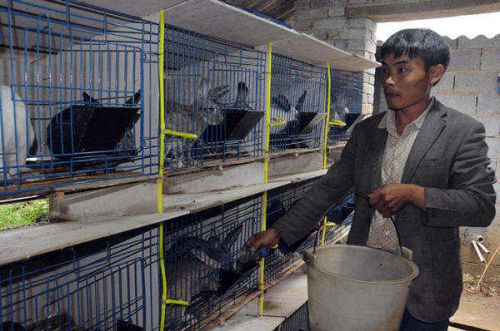
In Tanglang Village, Dashan Town, Pan County, Guizhou Province, "Rabbit King" Tang Hong feeds rabbits (photographed on May 21).
Inside an iron cage there is a "bird's nest" lined with straw and fine fur, and curled up in the "bird's nest," wriggling from time to time, are twelve or thirteen rabbit kits that have not yet grown fur. In the rabbit shed of Tang Hong, a villager of Tanglang Village, Dashan Town, Pan County, Guizhou Province, there are quite a few such "bird's nests."
Tang Hong is called the "Rabbit King" by the villagers.
"Idle and broke..." Two years ago the villagers still described Tang Hong this way; at that time Tang Hong rode a rust-covered motorcycle all day, "wandering here and there."
Tang Hong was always "looking around" at other people's Panax notoginseng plantations and going to the rural market to watch others collect chickens and buy eggs; in fact, he was looking for business opportunities. Because he "only looked and did not act," Tang Hong was misunderstood by the villagers for quite a while: "Planting Panax notoginseng has high costs, and I have no money; free-range chickens and ducks have low costs, but earn little."
Once Tang Hong went to visit relatives in Pu'an County, Guizhou Province. The relatives had already been raising rabbits for a year. "I found that raising rabbits is amazing. Rabbits breed quickly. Two rabbits have babies, and in a year you can bring to market several hundred rabbits and their offspring."
Even if sold as "meat rabbits at pork prices," calculated at 10 jin each and 15 yuan per jin, in a year he could get 60,000 yuan. Tang Hong had set his sights on this development project and could not hold back. But the initial investment of several tens of thousands of yuan for raising rabbits was a huge sum to Tang Hong, and he had not mastered the relevant techniques either, so he was so anxious that he "grew white hair."
After learning of Tang Hong's intentions, cadres from Dashan Town took Tang Hong to participate in the "Party Building Fosters Wisdom" entrepreneurship and poverty-alleviation training, and he received support of a 50,000 yuan entrepreneurship loan. Tang Hong was thus able to go elsewhere to learn rabbit-raising techniques.
At the end of 2014, Tang Hong used waste bricks to build a row of simple rabbit sheds with more than 500 cage spaces in total, and each cage space could hold several rabbits. Then he spent 300 yuan to buy 1 male rabbit and 1 female rabbit. After 30 days, the female rabbit gave birth to 12 rabbit kits.
"In just three months, the rabbit kits grow up and can be bred. To make management convenient, rabbit breeding is all arranged on one day, and after 30 days all the pregnant rabbits give birth." Tang Hong said that here he has more than 200 female rabbits that have given birth, as well as several hundred "reserve" female rabbits for giving birth, and every few months a batch of rabbit kits is born together.
Pointing to the "bird's nests," Tang Hong told the reporter that all newborn rabbit kits must be placed inside them. Now the rabbit shed has more than 100 "bird's nests" and more than 1,000 rabbit kits in total. "Every morning they are all sent together to the female rabbits' cages to nurse, and they are full in 5 minutes; then they are taken back to the 'bird's nests.'"
"The temperature in the nest is 30°C to 40°C, the survival rate of the rabbit kits is high, and there is no need to install air conditioning..." Tang Hong talked endlessly when it came to his rabbit-raising know-how.
The rabbits' breeding capacity exceeded Tang Hong's expectations. In just over a year he built four or five more rows of rabbit sheds.
To save costs, Tang Hong also bought a pellet machine to make rabbit feed himself, saving 1,000 yuan per ton. After the rabbits grow up, rabbit traders come specially to the village to buy rabbits; some are from within the province, and more are from Guangdong, Guangxi and Sichuan.
"In less than two years, more than 2,000 have been brought to market, and I have already earned more than 300,000 yuan. Not counting the rabbit kits, the breeding rabbits and meat rabbits in the shed are still worth more than 100,000 yuan." Tang Hong grinned broadly.
"At first I worried they could not be sold, but later I found demand exceeded supply, and they bought as many as there were; sometimes when there were not enough, we even had to contact other farmers." Said Zhao Lihua, Tang Hong's wife.
Under Tang Hong's leadership, more than 40 targeted poverty-alleviation households in Tanglang Village have raised rabbits, among which 6 households have already invested tens of thousands of yuan to build rabbit sheds and are preparing to develop into large farming households bringing 2,000 to 3,000 meat rabbits to market annually. "This is a good path with little investment and quick results. The town has already issued policies to encourage farmers to take this path to escape poverty and become prosperous." Said Shen Xiang, a cadre of Dashan Town.