Recycling cow dung to raise earthworms, cattle farm earns an extra 200,000 yuan
Original headline: Maochang Cattle Raising Cooperative in Tunchang County, Hainan:
Raising earthworms on cow dung, cattle farm earns an extra 200,000 yuan
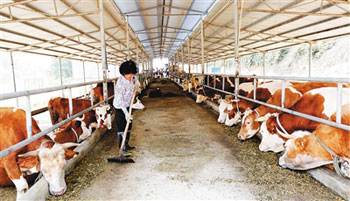
On the morning of April 23, buyer Adong came to Maochang Cattle Raising Cooperative in Nankun Town, Tunchang County (see photo at right, by our reporter Chen Yuancai, correspondents Deng Jizhao and Yu Junjun), and bought 100 jin of earthworms from cooperative member Zeng Hailing, taking in 1,600 yuan in the blink of an eye. (Online illustration: Hainan Daily)
Manure disposal has always been a headache for livestock and poultry farmers, but at Maochang Cattle Raising Cooperative in Tunchang County, Hainan Province, cow dung has become a "hot commodity." Members use fermented cow dung to raise earthworms, which sell for 16 yuan per jin.
In 2015, the Tunchang County government proposed developing ecological circular agriculture across the whole region, with treating manure pollution from livestock and poultry farming as the top priority. Xie Zuli, chairman of Maochang Cattle Raising Cooperative, told reporters that the cooperative raises large-framed Simmental cattle introduced from Switzerland, whose feed intake is much greater than that of ordinary yellow cattle. To turn cow dung into treasure, solving pollution while also making money, Xie Zuli, who enjoys fishing, thought of raising earthworms.
Xie Zuli explained that earthworms generally feed on fermented manure from cattle, pigs, sheep and chickens as well as household garbage, and do not compete with other animals for feed. After collecting cow dung and mixing in straw, it is fermented for about a week and can then be used to raise earthworms. To increase earthworm output, the cooperative specially introduced a high-yield variety from Japan; this variety has a rearing cycle of about two and a half to three months, shorter than other earthworms. At present, Maochang Cooperative's earthworm breeding area is about 12 mu, with an annual output of 10,000 jin, an output value of nearly 200,000 yuan, and an annual consumption of more than 360 tons of cow dung, effectively solving the cooperative's cow dung disposal problem.
"In the traditional cattle industry, cow dung is treated as garbage. But in the ecological circular chain of 'cattle - fermentation - earthworms,' cow dung is the most important link," Xie Zuli said. Earthworm castings are a top-grade organic fertilizer that can be used for the cooperative's forage grass cultivation and also sold to nearby growers, adding about 10,000 yuan in income a year from this item alone.
Wang Ence, director of the Tunchang County Agriculture Bureau, said that relying on this circular agriculture model, Maochang Cooperative has now recruited 6 members in cattle raising, with an average annual income of 40,000 yuan per household; 30 member households raise earthworms, with an average annual income of 30,000 yuan per household. (Yu Junjun, our reporter Deng Weizhe)