Cold chain logistics cuts costs, fresh produce cross-province transport bids farewell to room temperature
Original title: High cold chain costs, few facilities, fresh food e-commerce development hits logistics bottleneck
Only when the cold chain does not break can fresh food stay fresh (Focus on supply-side reform)
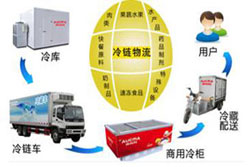
Cold chain logistics (network illustration)
Cutting costs is one of the important tasks of supply-side structural reform. The Central Economic Work Conference held at the end of last year required helping enterprises reduce costs. It explicitly stated, "We must reduce logistics costs and advance reform of the circulation system." Insufficient cold chain facilities and excessively high costs are one of the weak links in China's logistics system, restricting the healthy development of industries such as fresh food e-commerce. At present, China urgently needs to reduce cold chain logistics costs by improving related supporting facilities and policies.
Chen Jianfeng was pleasantly surprised to find that he could buy Haagen-Dazs ice cream on the SFbest website and send it to his mother in Ji'an, Jiangxi, as a Mother's Day gift. Just a few years ago, in a small city like Ji'an, buying ice cream online was still a luxury, and imported fruit on many shopping websites could not be delivered there either.
No one knows when it started, but on express delivery electric bikes, besides cardboard boxes of all sizes, sometimes there is also a small car-mounted refrigerator. Imported yogurt, Dutch tulips, Argentine frozen red shrimp... Cold chain express delivery has grown from nothing, once again bringing people closer to the world.
Cold chain distribution resources are insufficient, and fresh food is mostly transported across provinces at room temperature
Cold chain express delivery is obviously not yet as developed as ordinary express delivery. Mr. Wang from Beijing once went to Guangdong on business and wanted to send a box of Maoming lychees to his family. He asked several express delivery companies before finding one that could provide full cold chain distribution. In the end, when his family received it, some of the lychees had still gone bad. "The lychees were wrapped in a foam plastic box with two small ice packs inside, and by the time they arrived the ice packs had completely melted," Mr. Wang said. "If it happened that no one was home, and the courier carried the lychees around all morning, wouldn't they all be ruined?"
"This is precisely one of the difficulties faced by cold chain express delivery." A relevant person in charge of SF Cold Chain said that the most obvious difference between express delivery and logistics is that logistics is port-to-port and station-to-station, while express delivery is door-to-door. One feature of cold chain express delivery is scattered order-taking and scattered dispatch, which means doors will be opened frequently during delivery, making temperature control in the refrigerated space more difficult. Moreover, cold chain express delivery has higher timeliness requirements. Problems often encountered in express delivery, such as electric tricycles being seized and not being allowed into residential compounds, have a greater impact on cold chain express delivery. Including situations like the one Mr. Wang mentioned where no one is home, these all greatly increase distribution costs.
"Never mind cold chain express delivery, even the development level of cold chain logistics cannot meet market demand. Inadequate cold chain distribution has become a bottleneck restricting the development of fresh food e-commerce." said Chen Tao, logistics director of Cainiao Network Technology Co., Ltd.
Cainiao Network is an express and logistics coordination platform under Alibaba, and helping e-commerce companies coordinate distribution resources is one of Chen Tao's daily tasks. "Our biggest impression when coordinating cold chain resources is that resources are insufficient," Chen Tao said. "The fruits from their places of origin that we eat in daily life, such as ** grapes and Guangdong lychees, are actually mostly transported by road at room temperature, then put into cold storage after reaching the sales destination, and shipped when a customer places an order. As a result, the damage rate is relatively high, and the taste is also somewhat affected."
Cold chain distribution costs are high, the total number of enterprises is insufficient, and service quality varies greatly
When transporting grapes from ** to Beijing, the loss from road transport at room temperature may be 1/3 or more. Why do merchants still choose room-temperature transport instead of cold chain transport? The most direct reason is the high cost of the cold chain.
"At the same turnover rate, the investment in cold chain distribution is at least twice that of ordinary express delivery." The relevant person in charge of SF Cold Chain calculated an account for the reporter: In terms of vehicles, cold chain transport requires refrigerated trucks. The state has restrictions on the exterior dimensions of trucks traveling on highways, and refrigerated trucks must be fitted with insulation layers, so their storage capacity is smaller than that of ordinary trucks, and refrigeration equipment also consumes energy, so operating costs are considerably higher. In terms of warehousing, cold chain express logistics requires three-temperature warehouses, and the cost is also higher than that of room-temperature warehouses. In terms of transfer and sorting operations, cold chain express delivery requires constant-temperature operation rooms and specially made work clothes. Constant-temperature operation rooms not only require large upfront investment, but also consume a lot of energy during operation. In terms of last-mile distribution, cold chain express delivery requires dedicated containers and suitable refrigerant solutions, which are also much more expensive than the cardboard boxes and delivery bags used in ordinary express delivery...
For fresh food e-commerce companies that directly face consumers, the volume of each order is often not large, and costs cannot be diluted by increasing scale, so the cost of cold chain express delivery is even higher.
Another reason merchants are unwilling to choose cold chain transport is that the total number of cold chain express logistics enterprises is currently insufficient and service quality varies greatly.
The actual current market situation is that the price of cold chain express delivery for food is not much higher than that of ordinary express delivery. For example, the price difference for same-city distribution is less than double. Therefore, not many enterprises are willing to develop cold chain express logistics.
Chen Tao said that, on the one hand, China's cold chain infrastructure is insufficient overall. For example, refrigerated trucks account for only 0.3% of China's total stock of freight vehicles, while in Japan the figure is 2%. On the other hand, cold chain distribution operators are small in scale. There are quite a few enterprises scattered around the country that can handle same-city cold chain business, but not many can handle full-process cross-province cold chain distribution, and there is a lack of highly reputable brand enterprises.
Enterprises should take the path of specialisation, and government departments need to clear obstacles and build platforms for enterprises
The pain points of the market are the opportunities for development. The fact that e-commerce companies feel cold chain distribution cannot meet demand precisely shows that the market space for developing cold chain distribution is huge. "Promoting the development of cold chain distribution will effectively stimulate market demand," said Shao Zhonglin, an expert at the State Post Bureau think tank. "Just as the rapid development of the express delivery industry has supported continuous new records in online retail, if cold chain distribution can develop, the development of fresh food e-commerce will become much smoother, which will inevitably promote consumption upgrading and further invigorate the internet economy."
From the perspective of enterprises, the first hurdle to developing cold chain distribution is cost.
Innovation in packaging materials and refrigerant technology can effectively reduce costs. For example, the EPP recyclable insulated boxes developed by SF are lighter, more pressure-resistant and drop-resistant, reducing cold chain distribution costs. In "last-mile" distribution, SF switched to self-developed ultra-low-temperature coolant instead of dry ice for delivering ice cream, which not only reduced costs but also extended the cold-retention time.
Informatisation methods such as big data can also reduce costs. The high cost of cold chain distribution for fresh food in China has an objective cause: transport is mostly one-way, so trunk-line refrigerated trucks often return empty. Cainiao Network, by coordinating information between e-commerce companies and delivery enterprises, on the one hand consolidates fresh product logistics orders from scattered into bulk to dilute costs; on the other hand, when returning it does not turn on the refrigeration and transports daily consumer goods at room temperature, improving the use efficiency of refrigerated trucks. In addition, the application of big data technology can also help cold chain distribution enterprises identify distribution temperatures that both preserve freshness and save energy, which can also play a role in reducing costs.
However, the investment in cold chain distribution will definitely be greater than that in ordinary express delivery. Therefore, taking the path of specialisation is a more realistic choice for developing cold chain distribution. Shao Zhonglin said: "The cold chain transport requirements for different goods such as solids, liquids, frozen goods, refrigerated goods, meat, and vegetables vary, and the required equipment and technical requirements also differ. Focusing on one category can reduce upfront investment. Alternatively, one can focus on just one link such as warehousing, trunk-line transport, or home delivery, and do it in a specialised and refined way."