Corn and onions are high-risk, so growing grass is a safer bet
Original title: Afraid corn prices will drop, afraid onions are a "speculative game," Gansu Bayi Farm -
Growing good forage grass lets the livestock industry "eat and eat well"
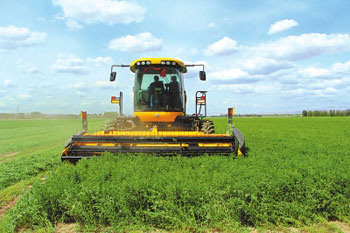
On May 24, the newly purchased New Holland self-propelled alfalfa harvester of the Jinnong Agricultural Machinery Professional Cooperative of Gansu Provincial State-owned Bayi Farm began cutting operations. This harvester is fast and highly efficient, completing the harvesting task of 4,000 mu of subsurface drip-irrigated alfalfa grass on the farm. (Online accompanying image: Gansu Daily correspondent Zhang Guozhi)
"I'm old and can't farm anymore. Last year I transferred my land to the farm. At the time I still felt a bit reluctant, but now thinking about it, my sons and daughters are all in other places, and I'm just a bag of old bones who can't work anymore. If you can think of growing alfalfa, that counts as a good thing. At least growing grass uses less pesticide, causes less pollution, and is healthy for the cows to eat. I order one jin of milk every day and drink it with peace of mind," said an old man at Gansu Bayi Farm.
Recently, the newly purchased New Holland self-propelled alfalfa harvester of the Jinnong Agricultural Machinery Professional Cooperative of Bayi Farm began cutting operations, completing the harvesting task of 4,000 mu of subsurface drip-irrigated alfalfa grass on the farm.
"Trailed harvesters have low working efficiency and a small cutting width, and after harvesting the stubble is uneven." The harvesting personnel explained, "The self-propelled harvester turns flexibly and is fast. After cutting, the stubble is neat and the forage grass is tidy, which makes mechanical tedding convenient. It not only benefits the growth of the next crop of alfalfa but also saves time and effort."
In March last year, farm Party Committee Secretary Liu Zhongwen led a team to **Hutubi County Breeding Cattle Farm and a ranch near Urumqi for an inspection, in order to evaluate alfalfa varieties suitable for planting at Bayi Farm. After repeated discussions upon returning, they decided to select and plant Adina purple flower alfalfa. The Adina variety is a new multi-leaf alfalfa variety bred by the American company Cal/West with high yield, high quality and good persistence, and the seed is produced by the Canadian company Beiqing. This variety has good resistance to the main alfalfa diseases and pests, and the plants have many branches, fine stems and multi-leaf characteristics, meeting the requirements of merchants seeking high-yield, high-quality forage grass.
Production practice has proven that Adina is relatively resistant to mechanical rolling and has good regrowth ability, and can be cut 3-5 times per year. The farm not only carefully selected the seed but also adopted subsurface drip irrigation technology for planting. Adopting this technology not only realized the farm's requirements for full-process mechanized operations and integrated water-fertilizer management, but also, as the farm has continuously applied new technology in crop irrigation methods in recent years, played a demonstration and driving role for local agricultural cultivation. Compared with the traditional flood irrigation method, subsurface drip-irrigated alfalfa planting costs an average of 1,380 yuan per mu per year, saving 14% in cost per mu compared with flood irrigation; the average yield of purple flower alfalfa during the three-year high-yield period is expected to be 1.1 tons per mu, an increase of 16% per mu compared with flood irrigation, with an average annual benefit of 500 yuan per mu, an increase of 150% per mu compared with flood irrigation. In addition, it can increase the land utilization rate by 15%, improve fertilizer utilization, save 15% of fertilizer and save 40% of water.
Old man Cheng, who was working in the alfalfa field, said: "This year the farm transferred our land and gave us stable land rent income, and we still have time to do odd jobs in the fields to earn money. Otherwise, I would be worried about what we could plant this year. We don't dare plant corn; if we do, we can't sell it. Onions are a 'gambling ghost' - if you win the bet, you get rich overnight; if you lose, you lose everything. We farmers just want stability. The current situation is the best. Now the grass planted by the farm is also operated on a large scale, the farm's industry has gradually started, and our income is increasing year by year."
The grass industry and livestock industry are an important part of the structural reform of the agricultural supply side. But at present, China's livestock industry has a single variety, low output and lacks competitiveness. Moreover, problems such as the prominent contradiction between livestock and grass, low individual performance, large seasonal slaughter, monthly forage grass imports reaching more than 100,000 tons, and insufficient integration of agriculture and animal husbandry are increasingly apparent.
Bayi Farm is located in the "sickle bend" region. After reducing corn, employees faced the test of choosing what kind of "substitute" to plant. After practical testing, the farm's choice to actively transfer employees' land at market prices, operate it uniformly, and build a forage and feed planting base is correct.
Given the objective reality that the farm is located in the "sickle bend" region, implementing "grain-to-feed" conversion, converting and adding value through local feeding, and maximizing benefits is a correct path. Relying on the construction of the Tianmu Dairy 10,000-head dairy cattle base, the farm is committed to expanding the industry and has taken the lead in adjusting the industrial structure, not only realizing the wish to increase employees' income but also further exploring the way for the enterprise to adapt to the market. (Zhang Guozhi)