Is succulent etiolation irreversible? Here's how to help your succulents recover
Etiolation generally refers to the phenomenon where a plant's stems and leaves grow excessively due to imbalanced nutrition and other factors. For succulents, it typically shows as increased height with visible stems; the gaps between leaves stretch out, no longer tight and dense as before; and the leaves become diamond-shaped and thin rather than their previous flat form.
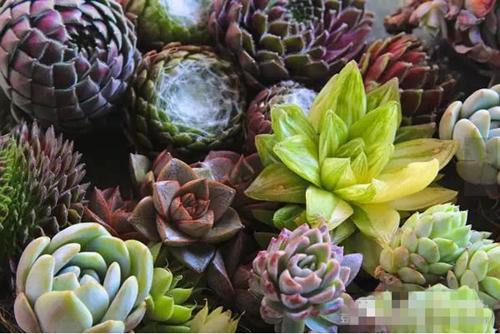
In addition, after etiolation, succulents also lose their color. All of this is devastating for succulents, because many succulent enthusiasts can't accept it, and some even stop loving them, lose confidence in their ability to grow them well, and then give up. Actually, once you know the causes of succulent etiolation, it's very easy to grow them well.
1. Insufficient ultraviolet light
Why ultraviolet light rather than sunlight? Because over billions of years of evolution, succulents have found that the amount of ultraviolet light and the amount of sunlight always maintain a proportional relationship - strong sunlight means more ultraviolet light - so succulents simply use the amount of ultraviolet light to judge the total amount of sunlight.
However, what they never expected is that there is something in this world called glass that can block 90% of ultraviolet light, so their sunlight measurement system fails. Succulents behind glass always think they are only receiving one-tenth of the actual light - isn't that adorably silly! If your succulent thinks this amount of light is enough, that's fine, but once it internally judges that the light is below its critical threshold, it will take self-rescue measures.
Self-rescue method one: Spreading out flat like a pancake or even "wearing a skirt," expanding the leaf surface area to receive light.
Self-rescue method two: Etiolation, minimizing the shading between leaves as much as possible to improve the utilization rate of leaf area.
So, if you plan to grow them entirely indoors, it's best not to buy outdoor-grown succulents. Greenhouse-grown succulents are more suitable, because although greenhouses have good light, they also lack ultraviolet light, so they are easier to care for when brought home. In addition, frequently opening windows can also let some scattered ultraviolet light in, alleviating this condition.
2. Overwatering
Etiolation caused by overwatering is a problem of mismatch between water amount and sunlight amount. When leaves have too much water that cannot be consumed by photosynthesis, it accumulates in the stem. The stem's vacuoles expand, causing the succulent to use its already limited organic matter to build stem cells, resulting in stem etiolation.
So, water as much as your light allows. Greenhouse-grown plants grow fast because they receive dozens of times more light than yours, not because watering speeds things up. Those who advocate that casual rain exposure won't cause etiolation are talking about outdoor-grown succulents - you still need to be restrained with your own.
3. Soil too rich (excess nitrogen)
Home-grown succulents are generally given compound fertilizer, and compound fertilizer is always nitrogen-dominant (which can make leaves and branches lush), but nitrogen fertilizer is not good for succulents because it accelerates cell division. If photosynthesis can't keep up, the succulent will etiolate, and it will be a weak, spindly etiolation that easily lodges.
Actually, the biggest advantage of succulents compared to other flowers and plants is their slow growth and stable shape. If you truly love them, there's no need to force them to grow quickly to satisfy your own pride - as long as they look good, that's enough. If it's for making money, it's best to rent a greenhouse.
Actually, succulents need to be grown tough and pushed a bit. With poor soil, the succulents' resilience can be activated. Home-grown succulents really don't need to be fertilized at all.
4. Poor placement of succulents
Succulents' phototropism is also a cause of etiolation. If a succulent is placed beside a windowsill, and every day the first ray of sunlight only reaches a small part of its top, then if I were it, I would also desperately grow and stretch my neck to reach more sun. Therefore, having a balcony is absolutely the best place for growing succulents.
5. Poor root respiration
Since succulents originally live in arid high mountain areas, their leaves have weak respiratory capacity - they need to close their stomata during the day to conserve water and collect carbon dioxide at night. So the important task of respiration is delegated to the roots.
So, if a succulent's roots cannot breathe properly, the entire plant will be in a state of suffocation. Under oxygen-deficient conditions, the succulent's photosynthesis slows down considerably. The organic matter produced will be prioritized for the stem - after all, the stem is the hub. This causes stem etiolation. To avoid this situation is also very simple: ventilation and water control. Flower pots must have holes with good water permeability and air permeability, otherwise even if etiolation doesn't occur, problems like rot and black stem will.