Only 11 global pilot projects worldwide, and Zhejiang accounts for 2 of them
A few days ago, Qingtian County in Lishui welcomed a heavyweight international guest - Mr. Jose Graziano da Silva, Director-General of the UN Food and Agriculture Organization.
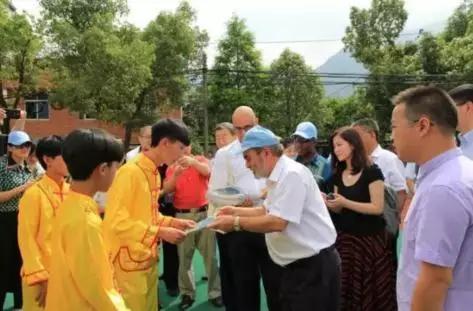
Mr. da Silva and his delegation came to visit the Globally Important Agricultural Heritage System (GIAHS) "Qingtian Rice-Fish Co-culture System." What magic does this system possess that it could attract a visit from the Director-General of the UN Food and Agriculture Organization?
Currently, a total of 36 projects from 15 countries have been listed as Globally Important Agricultural Heritage System conservation pilots, of which China has 11,Zhejiang accounts for 2。The Qingtian Rice-Fish Co-culture Systemis one of them, and in addition there is alsothe Shaoxing Kuaijishan Ancient Chinese Torreya Community System. What is so unique about these two "systems"? Let us learn about their distinctive charm together!
Qingtian Rice-Fish Co-culture System The rice-fish co-culture system is a resource compound utilization system, whose greatest feature is raising fish with rice and promoting rice with fish, achieving ecological mutual benefit and a double harvest of both rice and fish.
Rice provides shade and organic food for the fish. The fish, in turn, perform functions such as plowing the field and removing weeds, loosening the soil and increasing fertility, providing oxygen, and devouring pests.
This ecological circulation system greatly reduces dependence on chemical fertilizers and pesticides, increases the biodiversity of the system, ensures the ecological balance of the farmland, and achieves a double harvest of rice and fish.
Taking Renzhuang, a major town for rice-field fish farming in Qingtian, as an example, the town currently has 6000 mu of rice-field fish farming area, with an annual output of 600 tons of field fish and 2700 tons of rice, and a total output value of more than 40 million yuan, and farmers' incomes have increased significantly.
The Qingtian Rice-Fish Co-culture System not only revitalizes the traditional ecological circular agriculture model, but also carries out beneficial exploration for the conservation and inheritance of Globally Important Agricultural Heritage Systems.
Shaoxing Kuaijishan Ancient Chinese Torreya Community SystemFeatures of the ancient Chinese torreya communityA large number of ancient Chinese torreya trees, with concentrated resources
The Kuaiji Mountain range has 105,000 large fruit-bearing Chinese torreya trees, of which more than 72,000 are over 100 years old, and more than 4,500 are over 1,000 years old.
A long history of cultivation
Chinese torreya cultivation in Kuaijishan has a history ofmore than 2000 years. The ancient Chinese torreya tree known as"King of Chinese Torreya in China"is located in Feiwang Village, Zhaojia Town, Zhuji City, with a coverage area of more than 500 sq m; the ancient Chinese torreya tree known as"King of Thousand-Year Torreya Trees"is located in Zhan'ao Village, Jidong Town, Keqiao District (formerly Shaoxing County), planted in 581 AD, with a tree age of 1435 years. These two ancient Chinese torreya trees bear abundant fruit year after year, with the fruit output value per tree reaching 20,000-40,000 yuan.
A "living specimen" of ancient superior variety selection and grafting techniques
The ancient Chinese torreya trees are superior varieties developed from wild Chinese torreya trees through artificial selection and grafting. As early as more than 1400 years ago, the ancestors of Kuaijishan had already mastered fruit tree grafting techniques.
A uniquely distinctive production method
Chinese torreya trees are dioecious. Flower buds differentiate in the first year, flowers and fruits form in the second year, and the fruit matures in the third year. From flowering and fruiting to seed maturity takes as long as 18 months. Chinese torreya trees generally need to be cultivated for more than 15 years before harvesting Chinese torreya and generating benefits, and the production period is more than 30 years after cultivation. The economic lifespan of Chinese torreya trees can reach more than a thousand years.
An excellent mountain land utilization system
The ancestors of Kuaijishan built fish-scale pits (dams) and terraced fields on steep slopes to plant Chinese torreya, and used intercropping (relay cropping) with tea, miscellaneous grains, vegetables, forage grass, and so on to carry out compound management of torreya forests,the "Chinese torreya-terraced fields-understory crops" compound management systemforming a unique mountain land utilization system with a good ecology and relatively high economic value.
Beautiful landscapes,richculture
Chinese torreya trees are dioecious, with male trees upright and tall, and female trees in a thousand shapes and forms. Ancient trees have huge crowns and luxuriant branches and leaves. For thousands of years, the people of Kuaijishan have formed an indissoluble bond with Chinese torreya in aspects such as culture, diet, medicine, marriage, and feng shui.
Source: Zhejiang Agriculture, Zhuji Fabu