Laixi farmer obsessed with ancient farming methods achieves wheat yield of 1,500 jin per mu
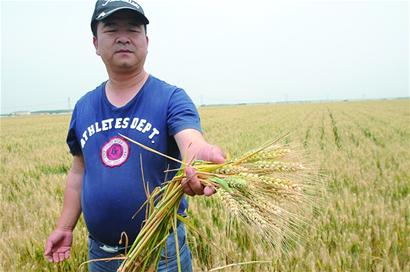
Right now, it is the busy agricultural season for wheat ripening and harvesting, and thousands of combine harvesters in Qingdao are about to begin the summer harvest. Wang Zhitao, Party branch secretary of Xinglongtun Village, Jiangshan Town, Laixi City, is especially excited, because his "ancient farming methods" experimental field is about to welcome its second year of high yield. Yesterday morning, a reporter saw in Wang Zhitao's hundred-mu wheat experimental field that the wheat about to ripen and be harvested had plump grains and a bumper harvest in sight. Wang Zhitao began trying the "ancient farming methods" model 3 years ago, and a brand-new "ecological cycle method of livestock breeding and agricultural planting" succeeded. Not only had the wheat's drought resistance increased, but the yield per mu had already reached about 1,500 jin, winning praise from experts of the Ministry of Agriculture.
High-yield experimental field promises a bumper harvest
"This is the high-yield wheat experimental field, with a total area of nearly one hundred mu. Its drought resistance and yield are second to none in the Qingdao area." Yesterday morning, 44-year-old Wang Zhitao pointed to a golden field of wheat and said excitedly that this experimental field was a high-yield experimental project carried out jointly by him and the Laixi City Agriculture Bureau. Under the guidance of relevant experts from Qingdao Agricultural University, after 3 years of experimentation, initial success had already been achieved, and yield stability testing was currently underway.
"Look, the grains of this wheat look plumper than ordinary wheat grains." Wang Zhitao rubbed out dozens of wheat grains with his hands and said that for the same number of wheat grains, the wheat from his experiment weighed considerably more than ordinary wheat. Last year, after calculation by agricultural experts, the hundred-mu experimental wheat field had already reached a yield of about 1,500 jin per mu, which had reached the peak level in Qingdao's wheat cultivation history. Based on factors such as this year's average temperature and environmental changes, this year's wheat yield per mu is expected to reach more than 1,400 jin. Although slightly lower than last year, this yield is already considerably higher than ordinary wheat.
"Passing through the belly and returning to the field" increases organic matter
"The high-yield wheat experiment is actually a return to the primitive farming methods of the ancients, demanding quality from the land." Wang Zhitao said that in ancient times, crop cultivation all used organic fertilizers such as manure from domesticated animals. The more than 400 dairy cows he raises produce organic fertilizer each year from using crop straw as feed, and together with a small amount of modern chemical fertilizer, this is just enough to supply the hundred-mu experimental field.
"Organic fertilizer, deep plowing to preserve soil moisture, and increased and denser wheat seeding are all indispensable." Wang Zhitao introduced that the organic fertilizer produced by dairy cows is called "passing through the belly and returning to the field," and a kind of organic matter contained in this kind of farmyard manure is exactly the substance currently lacking in the soil. This organic matter can make the density of wheat grains greater, and their weight will increase accordingly. In the past, farmers were accustomed to the same plowing depth for the same kind of cultivated land, causing a "hard block" partition layer at the bottom of the soil layer, which was unfavorable for wheat roots to penetrate deeply and absorb nutrients, and even more unfavorable for preserving soil moisture. He adopted a deep plowing model to loosen the hard blocks that had long existed in the soil layer, allowing a large amount of water to be retained within it. In dry weather, this could effectively preserve soil moisture, making the wheat appear more drought-tolerant than ordinary crops.
"This cyclical farming method will not only achieve ecological and environmentally friendly grain production in the future, but also enable more farmers to increase production and income." Wang Zhitao said.
"The high-yield wheat experiment has been carried out for 3 years, and the hundred-mu experimental base in Xinglongtun Village has already won recognition from relevant experts of the National Ministry of Agriculture." A relevant person in charge of the Laixi Agriculture Bureau introduced that currently in the Qingdao area, the high-yield wheat of Xinglongtun Village is unique, and Wang Zhitao has also been called the "wheat king" by experts from Qingdao Agricultural University. This year, a high-yield testing site led by the National Ministry of Agriculture will also be established in Xinglongtun Village, and this kind of "ancient farming methods" cultivation is expected to be promoted nationwide.
3.88 million mu of wheat citywide will begin harvesting
At present, Qingdao's summer wheat harvest work has already begun. According to a survey by the Municipal Agriculture Committee, this year the city plans a total summer harvest area of 3.886 million mu. Some mountainous and dryland wheat has already begun to be harvested, and summer planting is about to begin.
The Municipal Meteorological Observatory issued a message reminding wheat farmers that in the coming week, Qingdao will mainly have cloudy to partly clear weather. On the night of the 7th, some areas will have showers, and later there will be fog along the coast. Temperatures will generally not be high, with the highest temperature in the urban area and along the coast at 20-25°C, and inland at 21-30°C; the lowest temperature citywide will be 15-19°C. Southerly winds will dominate, with short periods of northerly winds at force 3-4. Meteorological conditions are favorable for wheat harvesting and drying, and temperature and light conditions are favorable for summer corn sowing and emergence, but precipitation is insufficient, so preparations must be made for sowing with soil moisture created by irrigation.