Northwest Fenlong technology boosts wheat yield by 30 percent per mu
Original title: Northwest Fenlong wheat yield increased
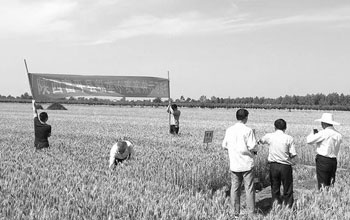
On-site yield measurement and acceptance of the "Wheat Fenlong High-Efficiency Cultivation Demonstration in Fuping County, Shaanxi Province" project
As northwest China enters the summer harvest season, wheat waves surge and farmers are happily harvesting wheat. On June 5, organized by the Guangxi Academy of Agricultural Sciences, experts from the Chinese Academy of Sciences, Northwest A&F University, the Gansu Academy of Agricultural Sciences, the Weinan City Agriculture Bureau of Shaanxi and other institutions conducted on-site yield measurement and acceptance of the "Wheat Fenlong High-Efficiency Cultivation Demonstration in Fuping County, Shaanxi Province" project, implemented by Guangxi Wufeng Machinery Co., Ltd. and the Cash Crops Research Institute of the Guangxi Academy of Agricultural Sciences and other institutions.
The yield measurement results showed that in Caocun Town, Fuping County, Shaanxi Province, in northwest China, where Fenlong agricultural technology was applied to wheat cultivation for the first time, the yield reached 527.26 kg per mu, an increase of 121.37 kg per mu, or 29.9 percent, over traditional tillage cultivation managed under the same conditions on the same plot of land.
According to reports, in October 2015 the project used self-propelled Fenlong machinery developed by Guangxi Wufeng Machinery Co., Ltd. to carry out Fenlong tillage to a depth of about 35 cm, while the control plot used traditional rotary tillage with a tillage depth of about 18 cm. Sowing took place on October 20 of that year, and the Fenlong and control plots had identical fertilizer levels and field management measures, both managed according to local production levels.
"The machine is absolutely great. After it passes, there is no need to level the ground again, and the machine does not compact the soil." Standing in his wheat field about to be harvested, Zhai Xinshe, a villager from Daqu Village, Caocun Town, Fuping County, described the pre-planting scene to a China Science Daily reporter, and what delighted him even more was the wheat's growth after Fenlong tillage, "each patch more beautiful than the last."
A China Science Daily reporter observed on site that Fenlong-cultivated wheat had robust plants with strong late-season growth, and at harvest still showed green stems and waxy stalks, clearly outperforming conventionally grown wheat in appearance. From the soil profile, the loosened soil layer of the Fenlong-cultivated wheat land remained at 20 cm, while the conventionally cultivated soil layer was only 13 cm; moreover, Fenlong-cultivated wheat had well-developed roots with a certain number of white roots, indicating strong vitality.
"The high yield of Fenlong-cultivated wheat in Fuping County once again proves that Fenlong agricultural technology can achieve deep and subsoiling tillage, retain water and fertilizer, and is an effective way to increase crop yields, raise farmers' incomes and gain ecological benefits," said Song Songquan, a researcher at the Institute of Botany of the Chinese Academy of Sciences and head of the acceptance expert group. He stated that this new farming technology, which can ensure increased yields and incomes without additional input, is a major invention and a new technology needed by Shaanxi's arid, low-rainfall land, as it allows natural precipitation to be stored in loose soil, thereby producing more grain from every drop of water.
Experts including Zhang Baojun, a professor at the College of Agronomy of Northwest A&F University, and Lyu Peng, chief agronomist of the Weinan City Agriculture Bureau, spoke highly of Fenlong technology when discussing the field acceptance opinions, holding that Fenlong can activate the soil and improve its water retention; enhance wheat population quality, with increases in effective spikes per mu, root population numbers and biological yield; and that Fenlong wheat has strong late-season growth, delayed senescence and an extended grain-filling period - these factors are key to the substantial yield increase achieved by Fenlong-cultivated wheat.
"For the northwest, water is especially important for crop growth." After the yield measurement concluded, the group visited Shan Lun, a leader in China's dryland agriculture and an academician of the Chinese Academy of Engineering. He said that judging whether a technology is good depends first on its immediate yield-increasing effect and second on whether it is sustainable.
The application of Fenlong agricultural technology to wheat has shown an obvious yield-increasing effect. Previously, the Institute of Agricultural Resources and Regional Planning of the Chinese Academy of Agricultural Sciences established a continuous Fenlong cultivation trial in Qianli Village, Caowa Township, Wuqiao County, Hebei. In 2011, with a Fenlong depth of 30 cm, the second crop of wheat increased by 128.32 kg per mu, a 34.2 percent increase, and in the fourth year the wheat still increased by 141.59 kg per mu, a 32.57 percent increase. In 2013, the Henan Academy of Agricultural Sciences implemented Fenlong cultivation of wheat (depth of more than 30 cm) in Wenxian County, and after expert acceptance organized by the provincial Department of Science and Technology, the average yield was 565.71 kg per mu, an increase of 131 kg per mu over the control, or 30.13 percent.
At the yield measurement and acceptance site, Wei Benhui, the principal inventor of Fenlong agricultural technology and a researcher at the Guangxi Academy of Agricultural Sciences, told a China Science Daily reporter that Fenlong agriculture and its technical system is a technology that returns to nature and can increase yields, improve quality and retain water without increasing the amounts of chemical fertilizers, pesticides, irrigation water or manual input. Over 8 years, it has had the advantages of deep and subsoiling tillage without disturbing soil layers, retaining water and increasing oxygen, temperature and desalination, not being limited by region, and facilitating stable crop yield increases, and has been applied and verified on more than 20 crops in 20 provinces across the country. "Fenlong agriculture and its technical and theoretical system can provide a solution for China's agriculture today," Wei Benhui said. (Our reporter Qin Zhiwei)
>>> Agriculture, rural areas and farmers technology: more ways to wealth await you
http://www.gdcct.net/agritech/kjxnbl/
>>> Science and technology feature: uncovering the scientific secrets behind traditional agricultural experience
http://www.gdcct.net/agritech/feature/
>>> Farming commentary: the most creative professional opinions on agriculture, rural areas and farmers
http://www.gdcct.net/agritech/bzh/