Northern sweet cherries successfully flower and bear fruit when planted in the south
Original title: The "north cherry moves south" problem has been solved
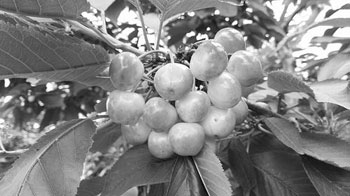
Cherry
In the Jiangnan region in May, the sunlight is warm and bright. Brooks, Stella, Tulare, Champagne, Rainier... clusters of sweet cherries, smooth and glistening, shimmer among the branches and leaves, and the air is filled with a sweet fragrance that makes the mouth water. Sweet cherries, this aristocratic fruit that could originally only dwell in cool regions, have now made their home in Jiangnan.
The team led by Zhang Caixi of the School of Agriculture and Biology at Shanghai Jiao Tong University recently released their latest achievement - solving the cultivation dilemma of "north cherry moves south" and overcoming the problem of sweet cherries flowering but not fruiting.
Zhang Caixi introduced that sweet cherry is a temperate deciduous fruit tree of the genus Prunus, subgenus Cerasus, in the Rosaceae family. It originated along the Black Sea coast of Europe and western Asia, with its main production areas concentrated between 35°N and 45°N. Because it needs to experience a relatively large accumulation of low temperatures to complete winter dormancy, this limits its large-scale cultivation in southern China. At present, the sweet cherries cultivated in China are mainly varieties from European and North American countries, and they grow well in northern China. Due to huge market potential and relatively high planting returns, China's sweet cherry production has rapidly expanded from the traditional production areas of Shandong and Liaoning to Henan, Hebei, Shaanxi, Gansu, Beijing, as well as the cool highlands of Yunnan, Guizhou, and Sichuan. However, in southern China, where winters are warm and humid and the effective low-temperature accumulation is relatively small, sweet cherries are very prone to the situation described as "when spring reaches the warm land, flowers bloom in profusion; when summer comes to Jiangnan, fruits can be counted on one's fingers" - flowering but not fruiting, with a very low fruit-setting rate.
"Because sweet cherries are brightly colored, delicious, and rich in nutrients, and because their fruit development period is short and pesticides are used less, they are very suitable for green fruit production, and are therefore deeply loved by consumers. As an efficient global planting industry, sweet cherries are also called the 'golden industry' of the fruit sector in European and American countries. For a long time, sweet cherries sold in southern regions have mainly come from foreign imports and northern regions, and prices have been relatively expensive," Zhang Caixi said. After 18 consecutive years of observational research, his team found that most European large cherry varieties can normally complete the flower bud differentiation process in Shanghai, and pollen development and vigor are normal, but ovule and embryo sac development is seriously poor. The proportion of ovules absent, ovules present but embryo sacs absent, and abnormal embryo sacs is extremely high, thus leading to flowering but not fruiting. For this reason, they took the winter dormancy stage as a breakthrough point and found that a low-concentration hydrogen cyanamide solution can effectively break dormancy, promote ovule and embryo sac development, and increase the fruit-setting rate, basically meeting the needs of economic cultivation.
Zhang Caixi said that if research on new short-chilling varieties and the application and independent development of new technologies can be strengthened early, then the cultivation area of sweet cherries in China can continue to be pushed southward, promoting the rapid development of the sweet cherry industry. "I believe that in the near future, in citrus-producing areas such as Fujian and even Guangdong in southern China, patches of sweet cherry production areas can also be seen." (Huang Xin)
>>> Agriculture, rural areas, and farmers technology: more ways to get rich are waiting for you
http://www.gdcct.net/agritech/kjxnbl/
>>> Science and technology feature: uncovering the scientific mysteries behind traditional agricultural experience
http://www.gdcct.net/agritech/feature/
>>> Agricultural commentary: the most creative professional opinions on agriculture, rural areas, and farmers
http://www.gdcct.net/agritech/bzh/