Plant viruses meet their nemesis in the microscopic world: Chen Jianping
Original title: Chen Jianping: Being the "nemesis" of plant viruses
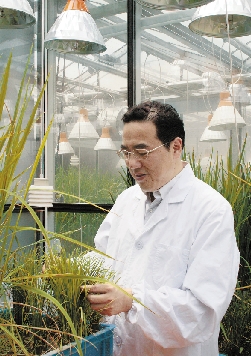
Chen Jianping in the laboratory (web image: Zhejiang Daily)
According to a report by China National Radio's "News and Newspaper Summary," discovering the secrets of plant viruses in the microscopic world and seeking methods of prevention and control is the devoted research work of Chen Jianping, academician of the Chinese Academy of Engineering. Over 30 years, he conquered the world-class problem of fungal transmission of plant viruses, clarified the occurrence patterns of important viral diseases of 5 food crops, and the integrated control technologies he established have been applied on a large scale nationwide, playing an important role in sustainably controlling the diseases.
In 1990, at only 27 years old, Chen Jianping was studying at the Rothamsted Experimental Station in the UK. After observing nearly ten thousand ultrathin sections of Polymyxa graminis, he discovered barley and mild mosaic virus within the fungal body. This was the first direct evidence revealing fungal transmission of plant viruses, and in one stroke he conquered a world-class problem that had troubled the field of plant virology for 30 years. Chen Jianping's scientific research achievements were remarkable, and he received invitations to join many research institutions in the UK and the US, but at that time unfair international evaluations of China deeply stung him. After obtaining his PhD in plant virology from the University of Dundee in the UK in 1995, he made up his mind to return to China for development. Over the following ten years, Chen Jianping led his research team in continuous exploration and research, rapidly raising the laboratory's strength and overtaking the laboratory where he had once worked in the UK. At present, in the field of fungal-transmitted wheat viruses, Chen Jianping and his team have reached a world-leading position. Between 2005 and 2015, more than 60% of the world's papers on fungal-transmitted wheat viruses came from his team.
Chen Jianping: The working conditions back then were indeed difficult, especially for research work like mine, working in the microscopic world of plant diseases, which required very advanced instruments. The conditions were extremely tough, but I felt I was making progress every day.
"Applying learning to practice" is Chen Jianping's motto in life. In 2012, Chen Jianping took part in poverty alleviation work in the mountainous area of Chun'an, and the experience made him realize that increasing agricultural income is not only a scientific and technological issue. After that, he shifted more of his energy from plant viruses to research on agricultural complexes.
Chen Jianping: Much of China's agricultural work is fragmented. How to make it systematic, how to integrate it, requires very good top-level design. Next I still want to do one thing: research the shortcomings and bottlenecks in the development process of China's agriculture, rural areas and farmers, and study macro-agriculture. (CNR Beijing June 8 message, reporter Li Jia)
Related links >>>
Chen Jianping, male, born in Ningbo in April 1963. Graduated in July 1985 from Zhejiang Agricultural University with a major in plant protection, received a PhD in plant virology from the University of Dundee in the UK in December 1995, has served as president of the Zhejiang Academy of Agricultural Sciences since April 2002, and was elected among the first batch of Zhejiang provincial special-grade experts in 2005. He has long been engaged in plant virology and virus prevention and control research, and has successively won 1 item among the 1992 National Top Ten Scientific and Technological Achievements, 4 first and second prizes of the National Science and Technology Progress Award, 7 first prizes of ministerial and provincial science and technology progress awards, as well as more than 10 honors including the China Young Scientist Award. (According to Zhejiang Daily)