Wheat water-saving technologies integrated on demand, stable yields guaranteed
Original title: Technology integration boosts the competitiveness of the wheat industry
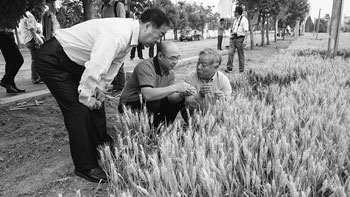
Experts inspect wheat growth in the field. Photo by Li Chen
In a few days, the 3,300 mu of wheat fields at the Sanxing Family Farm in Dakuai Town, Fengquan District, Xinxiang City, Henan Province will be harvested. Farm owner Fan Haibao is very confident about this year's wheat harvest. He told the China Science Daily reporter: "Last year we began using the sprinkler irrigation water-saving technology of the Chinese Academy of Agricultural Sciences. We watered one time less, saving 40 cubic meters of water; at the same time, we used the unified pest and disease control technology and sprayed one time less. This saved 30 to 50 yuan per mu in costs. Moreover, that same year the per-mu yield rose from more than 400 kg in the past to more than 500 kg."
The two technologies Fan Haibao mentioned are two of a set of green yield-increasing and efficiency-enhancing technologies integrated for the wheat industry by a collaborative research team formed by the Institute of Crop Sciences, the Institute of Farmland Irrigation, the Institute of Plant Protection, the Institute of Agricultural Resources and Regional Planning, the Institute of Food Science and Technology, and the Institute of Agricultural Machinery of the Chinese Academy of Agricultural Sciences, together with the Wheat Research Institute of the Henan Academy of Agricultural Sciences, the Xinxiang Academy of Agricultural Sciences, the Xinxiang Municipal Agriculture Bureau and other units. This year, his family farm adopted all 7 integrated technologies and became a demonstration site for the project.
After an on-site inspection, Chen Mengshan, Party Secretary of the Chinese Academy of Agricultural Sciences, told the China Science Daily reporter that technology extension and socialized services are important factors determining stable wheat production in China, saving labor and reducing labor intensity. "In the course of pursuing wheat production, we have found that scientific and technological progress plays a very obvious role in promoting the development of the wheat industry."
Only integrated technologies can achieve water savings
"Only by integrating the seven technologies can water savings in wheat production be achieved." Xiao Shihe, a researcher at the Institute of Crop Sciences of the Chinese Academy of Agricultural Sciences and chief scientist of the wheat industry technology system, stressed to the China Science Daily reporter that applying just one or two water-saving technologies cannot achieve the goal of saving water.
The seven integrated technologies include: new water-saving and high-quality wheat varieties, standardized precision sowing technology for wheat, soil-moisture-monitoring supplemental irrigation water-saving technology for wheat, soil-testing formula fertilization reduction technology for wheat, wheat pest, disease and weed control technology, full-process mechanized production technology for wheat, and wheat quality analysis and monitoring technology. Xiao Shihe explained that, taking the first technology as an example, the water-saving performance of different wheat varieties varies greatly, so water-saving varieties must be selected according to planting needs; when precision sowing, comprehensive consideration is needed as to whether water savings or seed savings are better in certain places; and through soil-moisture-monitoring supplemental irrigation, one watering can be reduced, saving 40 cubic meters of water...
It is reported that the project established a technology research, development and extension platform combining production, learning and research under the model of "research institutions + local governments + enterprises + farmers," giving play to the overall advantages of combining research institutions, local governments and enterprises, and following the principles of limited objectives, highlighting key points, unified design, division of labor and cooperation, collaborative research, and key breakthroughs.
Among them, the integrated and innovative "Huang-Huai-Hai wheat mechanized production technology" and "unified control technology for major wheat pests and diseases" have been released by the Ministry of Agriculture as nationally promoted agricultural technologies, playing an important guiding role in wheat production across the country.
Starting from the demand side to transform research thinking
"Technology integration and support have changed the past way of looking at problems through technology. This time it is completely different: technologies are assembled according to users' needs." Xu Weigang, director of the Wheat Research Institute of the Henan Academy of Agricultural Sciences, told the China Science Daily reporter.
According to Xiao Shihe, the main technologies demonstrated this time were, according to the needs of new production organizations, integrated into technology models needed by different production organizations under three organizational forms: government organization, farmer cooperatives and professional farmers, providing direct and practical technical solutions for the future development of wheat production.
"Integrating the latest production technologies according to the actual needs of new production organizations and providing them directly to different production organizations not only increases the promotion of improved varieties and methods and strengthens the technological content of wheat production, but also helps farmers stabilize production and increase income, steadily grow economic benefits, and gradually improve industrial competitiveness." Xiao Shihe gave an example: in Funingji Town, Yuanyang County, Henan Province, according to the idea of advancing high-yield creation across the entire township, new "water-saving, fertilizer-saving and pesticide-saving" technologies for wheat production were integrated, including fine land preparation, standardized sowing, water-saving (soil-moisture-monitoring regulated deficit) irrigation, soil-testing formula fertilization, and "one spray, three preventions" during the grain-filling period, improving resource use efficiency on the basis of high and stable yields.
In Dakuai Town, Fengquan District, Xinxiang City, according to the need to support family farms, drive production cooperatives and improve production efficiency, technologies such as new variety breeding, water-saving irrigation, full-process mechanization, and unified pest and disease control were integrated. The 1,000 mu of Zhengmai 7698 seed field of Sanxing Family Farm drove 12,000 mu of wheat of the Luye Farmers Cooperative to achieve improved varieties and methods, increasing yields and income.
In Jitun Town, Huixian City, Xinxiang City, through the Wufeng Grain Cooperative signing a 30,000 mu high-quality and premium-price purchase contract for Xinmai 26 wheat with surrounding farmers, and according to the nutritional needs of strong-gluten wheat, integrated technologies for high-quality wheat production such as fine land preparation, standardized sowing, water-saving (soil-moisture-monitoring regulated deficit) irrigation, soil-testing formula fertilization, and postponing nitrogen fertilizer were provided, driving farmers to increase yields and income. In 2016, the recovery price of wheat was 0.4 yuan/kg higher than the market price; this item alone increased the income of farmers in the town by 1.28 million yuan.
How can wheat maintain its international competitive advantage?
Henan Province has 80 million mu of wheat planting area, ranking first in the country. "I have been in office for less than half a month, and this is already my second trip to Henan." Liu Chunming, director of the Institute of Crop Sciences of the Chinese Academy of Agricultural Sciences, told the China Science Daily reporter that China has the world's second-largest germplasm bank and very strong breeding capacity. "But to solve the grain problem well is not something one unit can do; we must join forces with local research institutions. Our gap with foreign countries lies in the application of various technologies."
This is also a point Chen Mengshan repeatedly stressed to project team members.
At present, the total international trade volume of wheat in the world is 160 million tons, while China's wheat output is 130 million tons. Among the world's top ten major wheat supply countries, China has the highest yield per unit area, reaching 5,200 kg per hectare in 2015, higher than the world average of 3,288 kg at the same level and 50% higher than that of the United States. "The yield per unit area shows our level of wheat research." Chen Mengshan said. But over the past fifty-plus years, the global wheat supply-demand relationship has been a slight surplus in good years and a slight shortage in poor years. If the overall trend of international trade changes, it may break the political balance, "and this risk is very large," Chen Mengshan pointed out.
At the same time, Chinese wheat as a staple food is mainly used for noodles and steamed buns, which differs from the variety characteristics required for bread, the main use of wheat in Western developed countries. "It is also impossible to rely on the international market to meet the special needs of our domestic consumption." Chen Mengshan said that research departments and production management departments must firmly remember that maintaining the domestic quality of wheat is China's national condition and also an important point in implementing our national security in the new century.
Chen Mengshan therefore suggested: "We must increase collaborative innovation and integrated innovation and form an aircraft carrier for national wheat research." China has more than 500 wheat research teams, with large investments at all levels, duplication and overlap, poor coordination between higher and lower levels, and unreasonable resource allocation, which has also caused a lot of waste. "To break through the problems of wheat industry development and scientific and technological bottlenecks, it is very difficult to rely only on a single variety and one-way technology. So now we need to match agricultural machinery with agronomy, including a comprehensive solution technology plan for the entire wheat system, and we need technology integration and collaborative research to establish models of high-yield and high-efficiency technology." Chen Mengshan said. (Our reporter Li Chen)