Growing edible mushrooms under the forest helps farmers increase their income and become better off
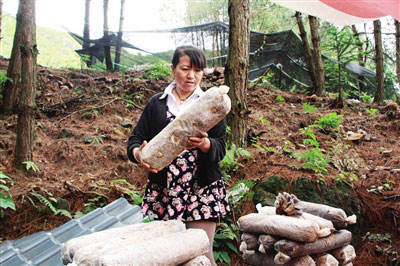
Inspecting the growth of the mushroom logs.
Edible mushrooms that have already formed.
Washing the edible mushrooms.
In recent years, Liuzhi Special District has encouraged returning migrant workers to start their own businesses, providing more jobs for the local rural surplus labor force and promoting rural economic development. Against this backdrop, Li Yu and Chen Taihong, who returned home to start businesses, came up with the idea of developing under-forest economy, with a business development approach of growing simulated-wild edible mushrooms under the forest in 1.2 million mu of forest and also operating under-forest Chinese medicinal herbs, advancing rural ecological civilization construction and actively developing the under-forest economy.
The cooperative grows edible mushrooms, and its "money" prospects are great
A few days ago, a reporter saw at the planting base of Guizhou Honglin Agricultural Technology Co., Ltd. in Langdai Town, Liuzhi Special District, that white lingzhi mushrooms were nestled among the trees, and staff members were picking the thriving mushrooms.
"We have already picked several times. It took only just over 40 days from planting the mushroom spawn to harvesting. At present, the company has purchased all of them, and they have already directly generated more than 7,000 yuan in economic benefits." Huang, the party secretary of Xinchun Village, Yuelianghe, Langdai Town, said with a big smile as he told the reporter about their cooperative's harvest from growing edible mushrooms.
Watching the villagers busily picking edible mushrooms, the township leader standing nearby reminded the villagers about the picking method while explaining the development of the under-forest economy. The leader said that at first, growing edible mushrooms seemed like something new to the villagers, and many were just watching. Although this development of edible mushroom cultivation in Xinchun Village planted only 10 mu, benefits were seen in a short time. The 10 mu of land planted this time in Xinchun Village was led by a cooperative, driving 6 targeted poverty alleviation households to carry out edible mushroom cultivation together.
"To develop edible mushroom cultivation, we first need someone to take the lead, and it must be someone with a certain level of capability, so that more villagers can be driven to participate and become well-off together." Speaking of future development, the township leader was full of confidence.
"The lush branches and leaves of the dense forest can provide shade, block wind, and conserve moisture, meeting the growth needs of edible mushrooms." The company's technician said that after the edible mushrooms are harvested, the remaining mushroom logs are organic fertilizer needed for tree growth, and the two can complement each other, forming a circular economy through under-forest cultivation. "Ordinary trees take 8 to 9 years to mature, but trees in under-forest economy development grow about 15% faster and can mature 1 to 2 years earlier." the technician said.
The reporter learned from the Liuzhi Special District Forestry Bureau that with the rapid growth of total forest resources, in order to make full use of under-forest land resources and spatial environment, develop multiple functions of forestry, and increase farmers' income, the market-oriented operation method of "enterprise + professional cooperative + farmer household" is being vigorously promoted to develop edible mushrooms, free-range chickens, and other development models.
Reduce planting risks and build a strong under-forest economy brand
Against this backdrop, Li Yu and Chen Taihong, who returned home to start businesses, came up with the idea of developing the under-forest economy. With strong support from the Liuzhi Special District Forestry Bureau, they invested 2 million yuan and registered Guizhou Honglin Agricultural Technology Co., Ltd., which is one of the experimental demonstration sites for "under-forest economy" in the forest farm reform of Liupanshui City, Guizhou Province.
The company is a municipal-level key agricultural market-oriented professional research and experimental company specializing in under-forest simulated-wild edible mushrooms, integrating planting technology research, superior seed breeding, planting promotion, and branded agriculture. The company currently has 25 employees, 1 edible mushroom engineer, and 6 technical extension technicians, mainly engaged in the cultivation and sales of under-forest simulated-wild edible mushrooms and the research and development, cultivation, and promotion of new varieties. During the pilot period, the company established technical cooperation relationships with units such as the Guizhou Academy of Agricultural Sciences and Guizhou University, and is committed to building a green and environmentally friendly brand for the under-forest economy.
In terms of industrial development, the company, in light of local forest resource conditions, focuses on the cultivation and sales of under-forest simulated-wild edible mushrooms and the research and development, cultivation, and promotion of new varieties. It leases more than 5,000 mu of forest land from the Huade River Forest Farm in Liuzhi Special District as the company's production base. At present, many kinds of edible mushrooms have been successfully trial-planted. On-site confirmation by relevant experts shows that the local soil quality and climate are very suitable for simulated-wild edible mushroom cultivation and can support large-scale production. The main trial-planted varieties include Beifeng mushroom, elm oyster mushroom, maitake, black-skinned termite mushroom, oyster mushroom, shiitake, and bamboo fungus. Their mushroom yield is 1.2-1.5 times that of greenhouses, the taste is very good, they are not prone to discoloration, and their fresh-keeping period and shelf life are much longer than those cultivated in greenhouses.
At present, the company has built a 160-square-meter reception and management building, a 300-square-meter factory building, an 800-square-meter mushroom material production yard, and an 80-square-meter sterile laboratory. It has introduced a set of combined machinery and tools related to edible mushrooms, hardened an area of nearly 2,000 square meters, and will, based on government leadership, "company + farmer household," company + e-commerce, product brand promotion, supermarkets, and direct sales, drive surrounding farmer households to become better off.
"We will provide members with mushroom logs, uniformly provide technical services, and finally purchase the edible mushrooms in a unified way." Chen Taihong introduced that in this way, for farmers, planting risks are reduced and there are no worries at all.
While ensuring steady growth and orderly development, the company actively drives surrounding farmer households to escape poverty, become better off, and move toward a moderately prosperous life. The company has built a "company + farmer household" framework and operates through an integrated supply and marketing model, namely: first, during the company's trial and large-scale edible mushroom cultivation, it absorbs surrounding farmer households to participate in planting, production, and sales at the company, so that they can fully master the production, supply, and sales process of simulated-wild edible mushrooms, laying a solid foundation for the company to drive farmer household development; second, the company provides farmers with mushroom spawn and mushroom logs and uniformly buys back the edible mushrooms (mushroom spawn and logs are distributed to poor households, and the production cost of the mushroom spawn and logs is deducted when the finished mushroom products are bought back); third, a protective price is set to ensure that farmer households increase their income by more than 5,000 yuan per month on average.
Why choose open under-forest land? Chen Taihong counted off the benefits for the reporter: edible mushrooms have certain requirements for temperature and humidity levels and stability, while the lush branches and leaves of dense forest can provide shade, block wind, and conserve moisture, meeting the growth needs of edible mushrooms; tree growth needs carbon dioxide, while fungal growth needs oxygen, so the two can complement each other. The waste material left after harvesting edible mushrooms is fertilizer needed for tree growth, and under-forest cultivation forms a circular economy; using open under-forest land saves precious arable land resources.
At present, more than 30 poor farmer households are working at this company and learning techniques. After the poor farmer households fully master edible mushroom cultivation and management techniques, the company will distribute 5,000-10,000 mushroom logs for cultivation according to their actual labor capacity and buy back the finished products.
"By combining science and technology with natural resources, making full use of internet resources, establishing the concept of ecological health, taking the branded agriculture route, strictly controlling quality, and achieving from field to table, consumers can eat the safest, most ecological, and most green and environmentally friendly products." This is how the company, in the future, in the face of increasingly abundant forestry resources, will become better off through developing the "under-forest economy," opening up a good "money path" of under-forest economy development for forest farmers.