Dafangzi Village in Xinbin: Agritourism Brings Joy to Farming Families
“If you want to talk about the changes agritourism has brought us, it really is like night and day!” Looking at the bustling farmyard outside her window, Dafangzi Village resident Zhao Xiuya, her face flushed with excitement, kept marveling to the reporter.
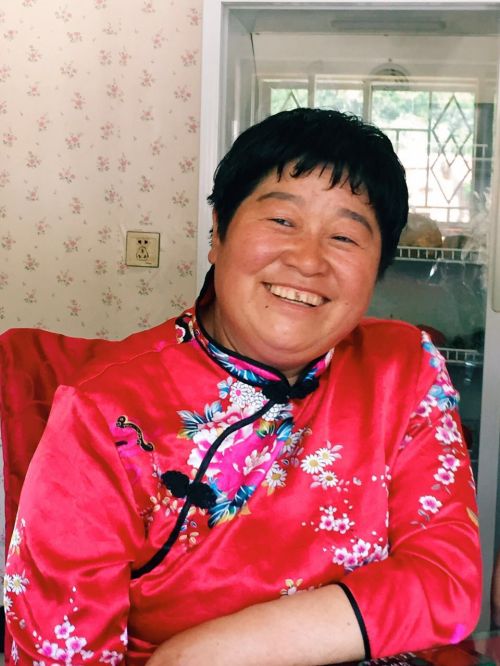
Dafangzi Village resident Zhao Xiuya
Dafangzi Village is located in Xinbin Manchu Autonomous County, Fushun City, Liaoning Province, adjacent to the 4A-level Houshi National Forest Park. The village has 115 households, with less than 1.2 mu of arable land per person, and “thin soil and poor people” had long been a stubborn problem that was hard to break. In recent years, relying on the development of local tourism, the whole village of Dafangzi has pushed forward with all its might. Nearly one-fifth of the households have opened agritourism businesses, with annual incomes reaching more than 100,000 yuan for some and 70,000 to 80,000 yuan for others. Dafangzi Village has also transformed from a typical poor mountain village into a demonstration village for rural tourism development.
“In the past, our village mainly relied on farming, and a family's annual income was only two or three thousand yuan.” Speaking of the hard days before, Zhao Xiuya sighed endlessly. “But now we can net more than 100,000 yuan a year, dozens of times what it was before. Our hearts are full of joy.”
Zhao Xiuya's agritourism business started in 2007. As the number of tourists to the nearby scenic area increased, more and more people reported to the village that they could not solve the problems of eating and accommodation. The shrewd Zhao Xiuya had a sudden inspiration: why not set up a stove and cook specially for everyone? She acted at once, and “Pangjie Agritourism” opened in full swing. Because most of Pangjie Agritourism's ingredients were local wild vegetables, livestock and poultry, the flavors were fresh and authentic, and business got better and better. “Pangjie Agritourism” became a local calling card. Seeing that Sister Pang was doing so well, other villagers gradually joined in, and at the peak the number reached 34 households.
Exterior of Pangjie's farmyard
To prevent malicious low-price competition, in 2008 the villagers spontaneously formed the “Dafangzi Village Agritourism Industry Association.” Internally, the association set uniform prices and unified management, playing a supervisory and restraining role; externally, the association could directly connect with the tourism bureau or the government to seek support and coordinate conflicts.
Now, Dafangzi Village has formed a family business model of “the male head of household farms while the female head of household runs the agritourism business.” It receives 150,000 tourist visits annually, and comprehensive tourism revenue reaches 60 million yuan. In 2014, Dafangzi Village was awarded “Rural Women's Tourism Demonstration Site”; in 2015, 10 agritourism households in the village were rated by the National Tourism Administration as “China Rural Tourism Gold Medal Agritourism Households,” and Dafangzi Village also became a famous rural tourism brand product inside and outside the province.
The Rural Women's Tourism Demonstration Site plaque is hung high
Jiang Yanmei, director of the Xinbin County Tourism Bureau, said: “The development of Dafangzi Village has shown us a path that can be replicated. In recent years, we have clearly defined the development goal of ‘promoting agriculture through tourism, helping agriculture through tourism, and enriching farmers through tourism,’ and we are promoting Dafangzi Village's upgrade and transformation from a single type of agritourism to comprehensive experiential products.” It is understood that last year the local government integrated 10 million yuan in funds from various departments to carry out a comprehensive upgrade and renovation of Dafangzi Village: widening rural roads, reinforcing river embankments, unifying the style of gray brick and tile houses, and building Manchu-style walls and courtyard gates……
Now, strolling through Dafangzi Village, one sees amid the surrounding mountains two rows of agritourism courtyards with Manchu flavor built along the street. A man-made stream flows gracefully past each household's front gate, and laughter keeps drifting out from the farmyards behind wooden fences.
“Next, I plan to expand the house and strive for a larger flow of guests.” Zhao Xiuya told the reporter full of confidence. (Reporter for this website: Liang Bingqing)