What is the development prospect of the black guinea pig farming industry?
Green agriculture refers to a mode of agricultural production and operation centered on producing, processing and selling green food. Green food refers to pollution-free, safe, high-quality and nutritious food that follows the principle of sustainable development, is produced in a specific way, has been certified by a specialized agency, and is permitted to use the green label. Actively developing green agriculture and adhering to the concept of sustainable development have become a global strategic move to meet international challenges.
Developing green agriculture is a requirement of adhering to sustainable development and protecting the environment. Compared with green agriculture, "black agriculture" often relies heavily on large farm machinery, chemical fertilizers and pesticides, which not only consumes large amounts of non-renewable energy but also causes soil loss, air and water pollution and other harmful consequences. Developing green agriculture, by contrast, can fundamentally solve these problems. With "green environment", "green technology" and "green products" as its core, green agriculture promotes the transformation from chemical agriculture, which relies excessively on chemical fertilizers and pesticides, to ecological agriculture, which relies mainly on the intrinsic mechanisms of living organisms.
The black guinea pig, originally called the guinea pig (tu li), is a small grain-saving herbivorous animal with extremely strong reproductive capacity. Its meat is tender and delicious, fragrant and crisp, with no gamy or rank odor; it is a low-fat, low-cholesterol meat and a premium tonic among black foods, with a very strong wild-game flavor. Its fur is also a good raw material for processing fur clothing and craft ornaments, while its testicles, gallbladder and blood are raw materials for the pharmaceutical industry.
The black guinea pig is black all over and has an extremely high melanin content, giving it both medicinal and edible value. It can eliminate free radicals in the human body, lower blood lipids, support yang function and relieve stomach ailments, and it has a clear dietary-therapy effect on high blood pressure and coronary heart disease; among the general public it is regarded as a "treasure for strengthening the body."
The Chinese black guinea pig is a precious herbivorous animal that combines wild-game flavor, medicinal value, food value, fur, ornamental value and nourishment in one. Its meat is delicious and highly nutritious. According to tests by relevant experts, black guinea pig meat is a high-protein, low-fat, low-cholesterol food, rich in the seventeen amino acids and various trace elements needed by the human body, and especially rich in the anti-cancer elements zinc and selenium as well as melanin, which has a bidirectional regulating function in the human body. It has effects such as nourishing yang and promoting body fluids, detoxifying and regulating qi, beautifying and improving intelligence, activating blood circulation and relaxing tendons, anti-aging and preserving complexion, and resisting and preventing cancer, and it has a good conditioning function for high blood pressure, cardiovascular and cerebrovascular diseases and other conditions in middle-aged and elderly people.
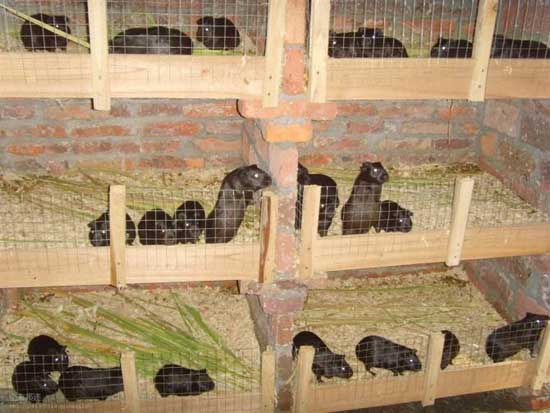
Black guinea pigs are easy to raise, low in cost and fast to breed, making them very suitable for rural household farming. The black guinea pig is a typical small herbivorous livestock animal; it does not compete with people or livestock for grain, and various wild grasses, tree leaves, vegetable leaves, stalks, sugarcane leaves and dry rice straw are all high-quality feed for it. Raising black guinea pigs can make full use of these abundant resources in China, enabling farmers to obtain relatively good economic returns and high-grade wild-game natural black nutritional tonics in a short time. Raising 5-10 pairs in spare time does not affect production or work; a wooden box, bamboo cage or brick pool 30 cm high in an idle room, under a staircase or on a balcony is enough for raising them, and it is clean, hygienic and pollution-free. More than 10 can be raised per sq m; each female guinea pig can produce 4-6 litters per year, with 2-8 young per litter, and about 30 can be bred cyclically per year; raising one pair of black guinea pigs brings an annual income of about 400-500 yuan. Black guinea pigs have strong disease resistance and no threat of plague; under normal farming conditions, no injections or medication are needed, and the farming conditions and technical requirements are simple, making them very suitable for household raising by urban and rural residents and a good project for quickly escaping poverty and becoming prosperous.
With the improvement of people's living standards, pursuing deliciousness, nutrition, health benefits and a return to nature has become a new fashion for modern people. As a black guinea pig with a strong wild-game flavor, complete nutrition and high dietary-therapy efficacy, it precisely caters to people's pursuits; therefore, eating black guinea pigs is bound to become a new favorite on people's dining tables.