Smart agriculture APP helps you farm and raise livestock worry-free with just your phone
Original title: Smart agriculture enters the Hetao region, farmers "play" with their phones while farming and raising livestock
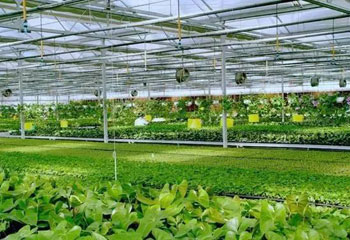
Using the agricultural Internet of Things (network illustration)
San Nong Express comprehensive report: Solving the "last kilometer" of agricultural science and technology services and developing smart agriculture are nothing new, but due to limits on the number of agricultural science and technology personnel, transportation conditions, and the cost of new technology, only a small number of farmers and herders have benefited. In late May, reporters in the Hetao Plain of Inner Mongolia were delighted to see that smart agriculture has begun to enter ordinary farmers' greenhouses, and the "last kilometer" has become a smooth path for science and technology services.
On May 26, Bayannur City, located in the Hetao region, suddenly warmed up, and watermelon and Hami melon seedlings wilted in large patches. A farmer information officer in Mantianhong Village, Hanggin Rear Banner, immediately uploaded pictures via a mobile APP to the phone of senior agronomist Zhang Xiuling, who also received calls from more than 10 farmers in succession. The situation was urgent, and Zhang Xiuling braved the scorching sun at noon to answer villagers' questions and solve their problems in the fields.
On May 25, a livestock farmer called the Spark Science and Technology "12396" hotline to say that several sheep at home were sick and sent several photos of the sick sheep. Senior animal husbandry specialist Quan Hengxiang made a preliminary diagnosis of sheep pox and went to the site to confirm it. Quan Hengxiang also published the sheep's symptoms and prevention and treatment methods with pictures and text on the mobile APP.
Opening the Spark Science and Technology 12396 mobile service platform (APP) on a phone, 24 sections including expert Q&A, agricultural situation warnings, meteorological information, supply and demand information, agricultural product market prices, mutton sheep market prices, sunflower market prices, service stations, service cases, practical technology, expert teams, information officers, and Bayannur Party Building are displayed with pictures and text. Farmers and herders can obtain science and technology information services with a light tap on their phones. For various crop and livestock farming technical problems discovered during production, farmers and herders only need to take photos with their phones and upload them, and the information will be promptly reported in pictures and text to 12396 service experts, while they can check the experts' handling suggestions in real time. This eliminates the inconvenience of previous door-to-door consultations and the frustration of being unable to communicate accurately by telephone consultation.
Today, Bayannur City has formed a city, banner, township, and village four-level information service network supported by four agricultural and livestock science and technology service stations: the "Spark Science and Technology 12396 Command Center," agricultural and livestock science and technology service centers in each banner and county district, Hetao College, and the Linhe Meteorological Bureau. It has a service team of 72 high-level experts in fields including agriculture, animal husbandry, forestry, water, and meteorology, and a group of 251 science and technology information officers selected from villages and communities. It has formed a comprehensive information service system integrating expert telephone consultations, expert on-site visits, remote video diagnosis, and mobile service platform interaction. At present, the service scope of the Bayannur City Spark Science and Technology 12396 information service system has covered 70% of the city's townships and village groups. Starting this year, the city science and technology bureau plans to develop 100 science and technology information officers each year, striving to extend science and technology information services to every village and community in the city. With the cooperation of China Unicom, farmers and herders pay no telephone or data charges when calling the 12396 service hotline or logging into the mobile APP platform to inquire about information.
"With the agricultural Internet of Things, growing vegetables in greenhouses is much easier. Visiting neighbors and going shopping are not delayed, and a tap on a phone makes things cheaper," said Li Liang, a farmer from Lianfeng Fourth Cooperative, Bayi Township, Linhe District, in an interview with reporters on May 26. Li Liang has two greenhouses of 1.5 mu each, and each greenhouse brings an annual income of 100,000 yuan. In 2015, the Internet of Things equipment installed in each greenhouse for only 3,000 yuan (currently a domestic agricultural Internet of Things system costs at least 10,000 yuan per set) completely freed him.
Li Liang's greenhouse is equipped with the "Ruian Network Agricultural Internet of Things Intelligent Management System" developed by Bayannur Ruian Network Security Co., Ltd. Company head Zhao Yun introduced that since the city science and technology bureau proposed developing an Internet of Things system that farmers can afford, after two years of effort, the research and development goal was basically achieved in May.
This system uses a network image acquisition module as the Internet of Things gateway, directly connecting the data of various sensors and controllers required by greenhouses to the Internet. At the application terminal, the on-site images and sensor data are displayed via mobile phone or computer, and remote control instructions are issued to the controllers. It also realizes real-time monitoring of environmental sensor data affecting crop growth and linked automatic control of greenhouse facilities through any mobile APP or any computer Web browser on the same screen via the cloud, including: video images of greenhouse crops, air temperature and humidity, light intensity, soil temperature, CO2 concentration, soil moisture, soil salinity (EC), etc.; these data are used for intelligent control of remote opening and closing of rolling shutters, ventilation, supplemental lighting, water pumps, and more.
To reduce costs, Ruian Company created a dedicated Internet of Things camera that both collects video images and also serves as a gateway, forming "visual Internet of Things technology." It independently developed a variety of practical sensors and independently developed APP and computer client software. At the same time, it realizes cloud storage of sensor data and video data, forming a big data analysis system and providing first-hand reliable data for agricultural product traceability systems.
At present, more than 100 farmers in the Hetao region have already used this low-cost Internet of Things. (Staff reporter Hu Zuo)
>>> San Nong Technology, more ways to get rich await you
http://www.gdcct.net/agritech/kjxnbl/
>>> Science and Technology Feature, uncovering the scientific mysteries behind traditional agricultural experience
http://www.gdcct.net/agritech/feature/
>>> Agricultural Commentary, the most creative professional opinions on agriculture, rural areas, and farmers
http://www.gdcct.net/agritech/bzh/