Mulberry Sanghuang hard to tell real from fake? Teach you to identify it by smell
We often encounter first-time customers buying our Sanghuang who, after receiving the goods and trying them, raise questions such as:
① Your Sanghuang tastes too bland, is it real?
② Why does it have no taste at all when brewed, it must be fake, right?
③ Isn't it said that good medicine tastes bitter, so why is yours not bitter at all?
。。。。。。。。。。。。。
Questions like these constantly fill our computer and phone screens.
The phrase "good medicine tastes bitter" comes from Han Feizi, Outer Congeries of Sayings, Upper Left: "Good medicine is bitter to the mouth, yet the wise persuade one to drink it, knowing that once it enters, it will cure one's illness." And from The School Sayings of Confucius, Six Roots: "Good medicine is bitter to the mouth but benefits the illness; honest advice grates on the ear but benefits one's conduct."
"Good medicine tastes bitter" holds true in most cases, but this does not mean that a medicine that is not bitter, has no taste, or tastes bland is not a good one. Examples of this are too numerous to mention, and I will not list them one by one here.
Today, since we are talking about the taste and flavor of Sanghuang, let us discuss the differences among several common types of "Sanghuang," so that Sanghuang enthusiasts can also distinguish true mulberry Sanghuang by taste alone.
① Poplar Huang. Poplar Huang is generally very small in size, with angular edges, and brewing it in water gives off a strong sour, foul odor.
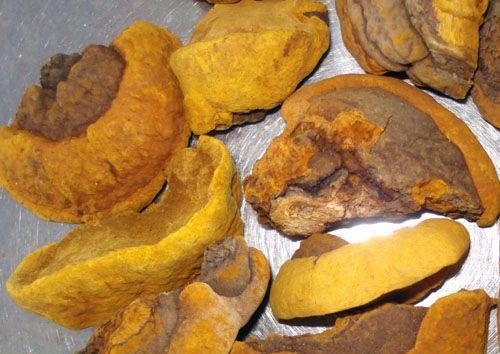
② Purple Oil Huang. Purple Oil Huang gives off a strong, pungent odor even without soaking in water, and its color is dark brown.
③ Mulberry Sanghuang. The genuine mulberry Sanghuang, by contrast, is relatively light in texture and does not feel heavy. When cut open it has a faint, delicate fragrance, and when brewed in water it has no particular taste, or any mixed or strange flavors.
Because there are so many species of Sanghuang, many customers who are just starting to use Sanghuang are unable to tell them apart. Trusting only the one-sided claims of certain merchants, they often end up buying fungi that grow on other trees. Some people I know substitute ordinary horse-hoof Huang for mulberry Sanghuang and sell it on Taobao and WeChat for over 1000 yuan per kilogram. It is very popular with customers and sells quite well, which also reflects some of the shortcomings of the Sanghuang industry. These "clever" merchants have seized on the fondness of certain consumers for bargains, offering a kind of psychological comfort to family members of patients who have already spent a great deal of money treating their loved ones.
The purpose of writing this article is not to attack certain merchants, but simply to provide some useful information for those friends who truly want to find mulberry Sanghuang, even if such people are only 1% of Sanghuang users.
Author: Peng Chuling, dedicated to promoting knowledge about Sanghuang in China, and an advocate of the health philosophy that preventing disease is better than treating it. Friends who love health and wellness are welcome to exchange ideas,
Author: Peng Chuling, dedicated to promoting knowledge about Sanghuang in China, and an advocate of the health philosophy that preventing disease is better than treating it. Friends who love health and wellness are welcome to exchange ideas, WeChat: 240460617