Nuomici lychees sell for 80 yuan per jin, how did she do it?
The sun blazes fiercely, and the outdoor temperature has already reached 35°C.
Wearing a straw hat, trouser legs already covered in mud, Jiang Guirong, a lychee grower in Jinggang Village, Conghua, Guangdong, skillfully starts the spray pump and raises the several-meter hose toward the top of the lychee tree. In less than half a month, the Nuomici will be on the market. “There has been a lot of rain this year, and some places around the trees have flower rot. This is the last round of fruit protection before they hit the market, and it is very crucial.” She looks serious.
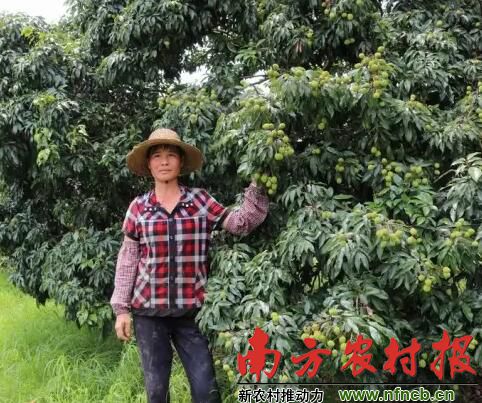
Jiang Guirong in her own lychee orchard. Photo by He Lixiong
With a tender and smooth texture, extremely sweet flavor, and small seeds, Nuomici is the nobility among lychees. Among the many lychee varieties, it is widely recognized as “precious,” but it is also difficult to grow and relatively hard to manage. In 1992, Jiang Guirong had already been growing Nuomici, and by now it has been 24 years. From initially letting them grow freely, with harvests sometimes coming and sometimes not, to spending 4 years conducting comparative experiments, she kept exploring Nuomici cultivation techniques and finally achieved stable production.
Now, her husband has a stable job, both her son and daughter have graduated from university, and the family has no worries about food and clothing. At 48, Jiang Guirong is a woman in the village whose happiness makes others envious. She could have enjoyed a quiet and happy life, but she insists on continuing to grow lychees, and this year's fruit-setting rate is as high as 95%. Faced with the endless stream of people who do not understand, she always smiles and says: “People always need something to devote themselves to.”
Nuomici once sold for 80 yuan/jin
About 1.6 m tall, slender, and light on her feet, Jiang Guirong is very quick and efficient when she works. On June 14, Jiang Guirong was sweating profusely in the lychee orchard, yet with a 50 to 60 jin spray pump set carried on her shoulder, she still walked faster than most people.
When she first married into Jinggang Village 24 years ago, Jiang Guirong did not attract much attention. Like other rural women, with her husband working away from home, the heavy burden of farming and raising poultry fell almost entirely on her alone.
And when it comes to the reason Jiang Guirong's family began growing Nuomici back then, that is a very, very long story.
Around 1986, because the elders in the family liked to eat them, Jiang Guirong grafted a Zhuangyuanhong tree into Nuomici. In the first year it bore fruit, there was a harvest of about ten jin. “Especially sweet, with a good texture.” Jiang Guirong remembers that at that time a buyer came to the village to purchase Nuomici and offered 10 yuan/jin. “They asked whether we would sell, and of course we sold! You have to know that at that time chickens sold for only 2-3 yuan/jin, and a civil servant's monthly salary was less than 200 yuan.” That year, just one Nuomici tree sold for more than 100 yuan, and the whole family was overjoyed.
Seeing that Nuomici could make money, in 1992 Jiang Guirong's family, though not well-off, gritted their teeth and bought more than 100 saplings in one go to expand their lychee planting area. At that time, the price of Nuomici soared all the way, and every household set off a wave of planting enthusiasm!
In 1997, the farm-gate price of Nuomici soared to 32 yuan/jin. In 1998 the price doubled, reaching 60-80 yuan/jin! “Our lychees sold for 80 yuan/jin at the time, and a small basket of Nuomici sold for more than 3,000 yuan. This was simply an astronomical figure.” Recalling the situation back then, Jiang Guirong still finds it hard to hide her excitement. She used “unbelievable” to describe the market at that time. “Completely unexpected, that should have been the peak period for Nuomici.” As for the reason for the high prices back then, she still has not figured it out to this day.