Athetis lepigone has appeared in summer corn, growers should pay attention and take precautions
Athetis lepigone is surely familiar to farmers who grow corn; it is a newly emerging pest in China's summer corn regions. At the same time, without timely prevention and targeted control measures,this pest spreads extremely quickly, and in severe cases it can cause total crop failure across large areas of cornfields.
According to monitoring by the provincial plant protection and quarantine station, this year's overwintering-generation moth population of Athetis lepigone is on the high side, and Athetis lepigone has now entered the period of the 2nd generation, the main damage generation of the year. At present, Athetis lepigone has already appeared sporadically in many places in China including Hebei and Shandong, but has not yet broken out nationwide (according to forecasts by plant protection stations in Shandong, Hebei and other places, the peak damage period of the second-generation larvae will be roughly June 28 to early July). Therefore, making preparations in advance and killing the pests to protect the seedlings is an important means of ensuring full and vigorous corn seedlings.Therefore, understanding the characteristics of Athetis lepigone and how to control it is of paramount importance.
(Athetis lepigone)
Because Athetis lepigone resembles the cutworm (black cutworm) in form, it is often mistakenly identified in various places as damage by cutworm, and the best control period is missed. So clearly recognizing the morphological characteristics is crucial.
Athetis lepigone larvae are 1.4-1.8 cm long, yellow-gray or black-brown; a relatively obvious feature is that each body segment has an inverted-triangular dark brown marking, and the back of the abdomen has two brown dorsal lateral lines that disappear by the thoracic segments. There are many classifications of cutworm, but their basic features are similar: the mature larva's body length is 37-50 mm and head width is 3-3.5 mm. The body color is darker, ranging from yellow-brown to dark brown; the back of the body has dark brown longitudinal bands, and the skin is rough and covered with small granules of varying sizes.Before control, please observe the characteristics carefully so as to prescribe the right remedy.
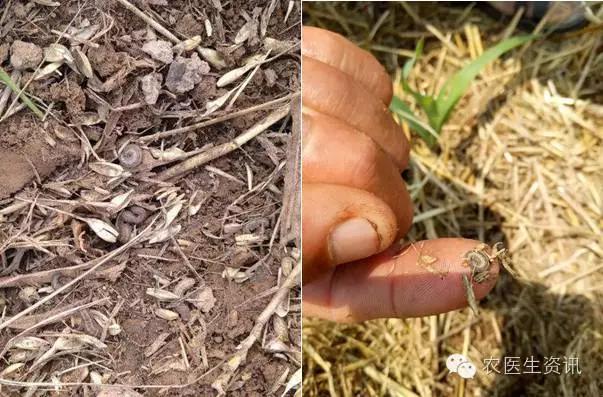
Insect holes from feeding on the roots
Reasons for this year's outbreak:
1. The corn seedling stage coincides well with the larval damage period, and the field growing environment is favorable
This year's wheat harvest period is close to the adult peak period, and the field environment for adults to lay eggs is relatively good. In most areas, the summer corn sowing period is close to normal years, and the corn seedling stage coincides well with the larval damage peak period. Wheat in all provinces is generally harvested by machine, and the ratio of returning wheat bran and straw to the field is over 90 percent; the relatively high coverage thickness in the field provides a suitable environment for adult egg-laying and larval development. In some areas, the practice of clearing furrows when sowing can reduce corn damage.
2. Meteorological conditions in most of the Huang-Huai-Hai region are favorable for the occurrence and damage of Athetis lepigone
According to monitoring and forecasts by the National Meteorological Center, in the first half of June, precipitation in most of the Huang-Huai region and parts of North China was 50 percent to 100 percent below normal; in the coming 20 days (June 16 to July 4), rainfall in most of the Huang-Huai and North China regions will be 30-70 percent above the same period in normal years, with some areas more than 100 percent above, which is favorable for the occurrence of Athetis lepigone; some areas will experience weather above 35°C, which has a certain inhibitory effect on egg-laying, egg hatching and larval development and damage of Athetis lepigone.
Control methods for Athetis lepigone
1. Ecological control:Clear wheat straw from the field, plow or rotary-till the wheat field to destroy stubble, and clear wheat straw from the corn sowing rows.
2. Physical measures:Hang Athetis lepigone sex pheromone lures in the field and add insect-killing lamps to trap and kill adults and reduce the number of eggs and larvae in the field.
3. Chemical control:Kill the adults.
(1) Pesticide spraying: combine with chemical weeding in corn and add insecticide to achieve the effect of one spray for multiple controls. In fields where the pest has not yet occurred, it is recommended to spray beta-cypermethrin or cyhalothrin, deltamethrin and others in the field, which can be combined with pre-emergence herbicides for whole-field spraying, or beta-cypermethrin + emamectin benzoate plus a safe post-emergence herbicide for whole-field spraying at the 3-5 leaf stage for prevention. If sporadic occurrence has already happened, use beta-cypermethrin + emamectin benzoate, emamectin benzoate + tebufenozide, emamectin benzoate + indoxacarb, chlorantraniliprole and other pesticides to spray the corn stems and roots and achieve the purpose of pest control.
(2) Broadcasting poison bait: when Athetis lepigone larvae reach the 3rd instar, use 4-5 kg per mu of roasted fragrant wheat bran or crushed and roasted fragrant cottonseed cake, mixed with 90% trichlorfon diluted with a small amount of water, or 500 grams of 480 g/L chlorpyrifos emulsifiable concentrate, to make poison bait, and broadcast it along the rows beside the corn seedlings in the evening.
(3) Broadcasting poisoned soil: use 300-500 ml per mu of 80% dichlorvos emulsifiable concentrate, or 500 ml of 48% chlorpyrifos emulsifiable concentrate, or 20% chlorpyrifos + phoxim and other agents with contact and fumigant action, add an appropriate amount of water and mix evenly into 25 kg of fine soil; or use 1 kg of 5% chlorpyrifos granules or phoxim granules mixed with 25 kg of fine soil, and broadcast it along the rows at the base of the corn seedling stems in the early morning. Note that the poisoned soil should not be broadcast onto the corn plants, and it should be used two days apart from post-emergence weeding to avoid phytotoxicity.
Note: pesticide application should be done before 9 a.m. on sunny days or after 5 p.m.; if rain occurs, respray promptly. Spraying should be even and thorough, and weeds at field edges and roadsides should all be sprayed. When the larvae are older, appropriately increase the dosage. Try to avoid applying pesticides during high-temperature periods to prevent human poisoning and crop phytotoxicity. (Within 7 days before and after spraying nicosulfuron herbicide, organophosphorus pesticides are prohibited.)
(4) Applying pesticide with irrigation water. For cornfields that need watering, pesticide can be applied with the water: use 1 kg per mu of 52.25% cypermethrin + chlorpyrifos or 48% chlorpyrifos, and pour it into the field when irrigating. When sprinkler-irrigating corn seedlings, the nozzle can be unscrewed and the liquid dripped plant by plant along the stems; note that the amount of liquid should be large to ensure it seeps into the place about 30 cm around the corn roots where the pests hide.
Killing pests to protect seedlings brooks no delay; timely control ensures yield and income. Note the pesticide application time: after 5 p.m.
-------------------------------------
For more agricultural hot news, more practical agricultural techniques, and more colorful interesting stories of farmers' lives, all in the "Nong Yisheng Zixun" WeChat public account (WeChat ID: newsonline1 <- long-press to copy)
Reproduction requires the consent of the author of this Toutiao account; without authorization, reproduction is prohibited.