A close relative of the piranha appears in the Yangtze River? Citizens released 40 truckloads of fish at once
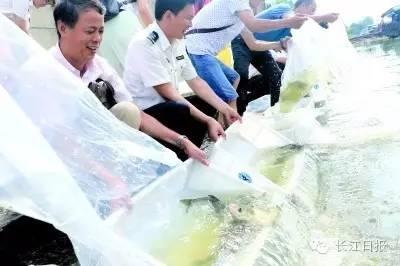
Fishery administration personnel mainly choose the Four Major Chinese Carps - black carp, grass carp, silver carp and bighead carp - for stock enhancement and release
Author: Zhan Haibo, intern reporter for Changjiang Daily
In March, Wuhan citizens released 40 truckloads of fish into the Yangtze River at one time
Red-eared sliders, Russian sturgeon, plecostomus... fish species that originally came from abroad can now all be caught in the Yangtze River. Even the freshwater pomfret, which is fairly closely related to the "piranha," has been caught in the Wuhan section of the Yangtze River.
Changjiang Daily also learned that the most astonishing case was in March this year, when Wuhan citizens organized the centralized release of 40 truckloads of fish into the river.
"Releasing fish fry is as important to me as eating." A caring Wuhan citizen who volunteers to help with releases said this.
But are these kind intentions of citizens actually good for the ecology of the Yangtze River?
Perhaps good intentions have led to bad results
"The commercial fish they buy on the market not only struggle to survive in the Yangtze River, but also damage the river's native fish species and affect the purity of the fish stocks." Xiang Jun, head of the Wuhan Agricultural Comprehensive Law Enforcement and Inspection Brigade, told Changjiang Daily that caring releases must be truly effective releases to be meaningful; otherwise, good intentions lead to bad results.
On the 22nd, at the site of Wuhan's 2016 stock enhancement and release activity, Changjiang Daily learned from the Wuhan Agricultural Comprehensive Law Enforcement and Inspection Brigade that in recent years many citizens have released fish blindly, causing a certain degree of damage to the aquatic resources of the Yangtze River.
Dozens of species of "foreign fish" have unexpectedly appeared in the Yangtze River
Law enforcement officers are removing "maze traps" set by fishermen
Not long ago, during an operation to ban illegal fishing, the Wuhan Agricultural Comprehensive Law Enforcement and Inspection Brigade once again found traces of red-eared sliders in the "maze traps" set by fishermen.
Red-eared sliders, alligator snapping turtles, golden apple snails, freshwater pomfret, African catfish, Russian sturgeon, paddlefish, hybrid sturgeon, and Nile tilapia - these fish species that do not originally exist in the Yangtze River fish resources have all been caught from the Yangtze River by personnel of the Agricultural Comprehensive Law Enforcement and Inspection Brigade during law enforcement in recent years.
A red-eared slider caught from the Yangtze River
“Red-eared sliders have been found the most.The year before last, citizens caught a plecostomus in the Han River." Xiang Jun introduced that the plecostomus is known as the "killer of freshwater fish" because it has no natural enemies in China, grows unchecked, and will devour the eggs of other fish, causing enormous damage to the native fish species of the Yangtze River. African catfish have also been found in the Yangtze River; they are extremely destructive to freshwater shrimp, and fishermen report that shrimp can no longer be caught in the Yangtze River.
Freshwater pomfret file photo, source: internet
In September 2014, near the Yangluo Power Plant, fishermen caught a freshwater pomfret. The freshwater pomfret is a tropical fish species, and it only found living space because the wastewater discharged by the Yangluo Power Plant was too warm. The freshwater pomfret is closely related to the so-called "piranha"; it has many sharp teeth in its mouth and is aggressive toward people.
Over a thousand caring groups in Wuhan buy fish for release every week
At the site of the stock enhancement and release, Changjiang Daily saw several caring citizens who volunteered to help with the release. They said that after learning there would be a stock enhancement and release activity today, they arranged via a WeChat group to come together and volunteer to help with the release.
Mr. Wang, 47, is the group owner of the WeChat group, which has more than 190 members. He told reporters that he has been releasing fish fry for more than 3 years and organizes a release activity every week. "Releasing fish fry is as important to me as eating."
He said the group organizes donations every week, then goes to the South China Seafood Market and Baishazhou Market to buy fish, and then releases them into the Yangtze River.
It is understood that there are around a thousand caring groups like this in Wuhan. In March this year, someone organized the centralized release of 40 truckloads of fish into the river.
"The commercial fish they buy on the market not only struggle to survive in the Yangtze River, but also damage the river's native fish species and affect the purity of the fish stocks." Xiang Jun told reporters that caring releases must be truly effective releases to be meaningful; otherwise, good intentions lead to bad results.
Releases must also be carried out according to regulations and done scientifically
Law enforcement officers are releasing Chinese sucker fish
"There are currently no statistics on the number of invasive foreign fish species, but the trend is increasing." The Municipal Agricultural Comprehensive Law Enforcement and Inspection Brigade said that citizens' releases are mostly individual actions with no fixed locations, occurring along both rivers and all four banks, and are often carried out when no one is watching; when discovered, they can only be discouraged.
In Chinathe Provisions on the Administration of the Stock Enhancement and Release of Aquatic Organismsexplicitly prohibit the use of exotic species, hybrid species, genetically modified species and other aquatic organism species that do not meet ecological requirements for stock enhancement and release. If units and individuals carry out large-scale aquatic organism stock enhancement and release activities on their own, they shall report to the local fishery administrative department15 daysin advance on matters concerning the stock enhancement and release, includingspecies, quantity, size, time and locationand other matters, and accept supervision and inspection.
Regarding how to release fish scientifically, the Municipal Agricultural Comprehensive Law Enforcement and Inspection Brigade also provided reasonable suggestions.
01
First, choose fish from the first generation of Yangtze River original stock. Citizens can go to professional original-stock fish farms to buy them. The fish fry in original-stock fish farms have undergone quarantine and pregnancy testing and have reached a certain size. Such fish fry have a high survival rate and can effectively achieve the purpose of release. In addition, the brigade also suggests choosing the Four Major Chinese Carps - black carp, grass carp, silver carp and bighead carp - for release, and prohibits releasing foreign fish species.
02
"Releases cannot be done blindly either. To truly achieve the purpose of release, protected animals should be released in national-level or provincial-level protected areas. We can install electronic chips for the release of precious fish species to understand the dynamics of the released fish in real time." Xiang Jun, head of the Municipal Agricultural Comprehensive Law Enforcement and Inspection Brigade, said that if citizens wish to do good, they can contact original-stock farms through the Municipal Agricultural Comprehensive Law Enforcement and Inspection Brigade to purchase the correct species for release, or participate in artificial stock enhancement and release activities. Normally, if citizens find strange species, please report them promptly to the Municipal Agricultural Comprehensive Law Enforcement and Inspection Brigade.
Changjiang Daily learned that the Wuhan Agricultural Comprehensive Law Enforcement General Brigade plans to provide a dedicated release area at the newly built dock at Hankou Jiangtan to guide everyone in scientific release.