The drone industry has entered a red ocean market. How should it develop in the future?
The drone industry is developing rapidly, but inevitable industry barriers still exist. How can we grasp the overall industry trend from a macro perspective?
In 2016, the drone industry developed rapidly, and many industries began to get involved in drones. Every cause has its effect. What are the reasons behind such rapid development of the drone industry, and what has driven the drone development process? What problems exist during the development process, and how can they be solved? What are the future development trends?
Based on these questions, Yuchen.com and China Aviation News jointly produced a China civil drone industry report, "China Civil Drone Market Analysis and Prospect Forecast" (2016 trial edition), dedicated to analyzing drone industry data, providing drone market valuations, and looking ahead to the industry's future.Industry information, within reach.On the basis of a macro grasp of the current development status and future of the drone industry, take your own career one step further.
Comprehensive development of the industrial chain: the drone industry moves toward a red ocean
From around 2007 to 2012, civil drone manufacturers sprang up like bamboo shoots after rain. From 2012 to the present, the participation of many companies such as DJI and Zero Zero Robotics has pushed consumer drones into a red ocean, ushering in an unprecedented golden age of development.
The white paper provides an in-depth interpretation of the reasons for drone development and analyzes the development status of drones from the perspective of the industrial chain, from upstream raw material production to downstream user services, offering a comprehensive introduction to the entire industry for your convenience.
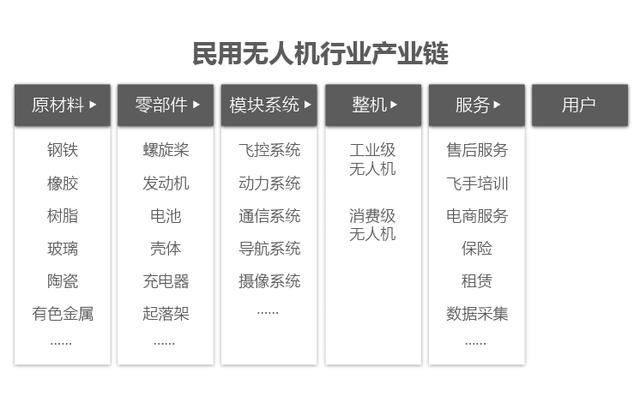
Accumulation before the outbreak: drawbacks of drone development in multiple fields begin to emerge
Through the dedicated efforts of industry professionals, drones today have been applied in fields such as agricultural plant protection, police security, power line inspection, film and television aerial photography, geographic surveying and mapping, meteorological detection, search and rescue, solar power equipment inspection, and oil and natural gas pipeline inspection, with more than 600 types of uses.
Data is the support for all information. Taking plant protection drones as an example, in 2015 China's plant protection drone fleet stood at 2,324 units (statistics from 31 provinces), with a total operating area of 11.528 million mu, with growth rates reaching 234% and 170.6% respectively. With policy incentives, the gradual maturity of the pilot training market, and the acceleration of precision agriculture, more companies will enter the plant protection drone market, and the annual product sales scale of plant protection drones is expected to reach 20 billion yuan in the future; in the police security field, as of November 2015, public security organs in 25 provinces, autonomous regions, and municipalities directly under the Central Government, and 147 operational units had been equipped with nearly 300 police drones. In addition, fields such as disaster rescue, film and television aerial photography, energy facility inspection, meteorological detection, and geographic surveying and mapping have all witnessed the application value of drones (for details, please see the industry report).
Various industries have begun to use drones, but drone applications are rarely seen. What is the reason?Immature technology and a shortage of professionals are the inevitable reasons for this result. What else? This report provides a detailed interpretation of the development status, technical advantages, barriers faced, development trends, and prospects of drones in these fields one by one.
A 20 billion yuan market scale? The drone service market is still immature
Pain points in manufacturing have stimulated the rise of the service industry. Poor industry communication capability, unsound sales channels, high price barriers, high technical difficulty, frequent accidents, insufficient supply of pilots... These industry drawbacks have promoted the development of the drone service market. The fields of media, e-commerce, leasing, operations, insurance, and pilot training are developing rapidly.Yuchen.com predicts that in the next five years (2016-2020), the scale of China's drone service market will exceed 20 billion yuan, with operational services accounting for 49% and occupying nearly half of the market.
As a member of the drone media industry, Yuchen.com predicts that future industry demand for professional media will continue to increase, and by 2020 the volume of China's drone media market will reach 240 million yuan.
Companies such as JD.com and Xiaomi have begun to enter the drone business. Although judging from the current situation, the chance of short-term success is not great, the recognition of drones across various industries has already been demonstrated. However, while seeing a bright future, one must not ignore the unavoidable shortcomings in China's drone development: a late start, an immature system, large market space, a long industrial chain, and complex business fields.In what direction will each module develop in the future? Where lie the potential and the barriers? What conditions are still needed for the market to mature?
Frequent illegal drone flights: regulation is far from enough
Illegal drone flight incidents occur frequently and are a headache. Since 2003, China has begun to establish and gradually improve its drone regulatory system.
The report details the development history of drone regulation and interprets the latest "Operating Regulations for Light and Small Drones (Trial)". What are the advantages and disadvantages of the widely recognized cloud regulation today, and what is the development trend of China's civil drone regulatory system?
Finally, China's civil drones are developing rapidly, but light is accompanied by darkness. How to quickly achieve drone industry standardization and overcome industry development barriers requires the joint efforts and discussion of industry professionals and drone enthusiasts. The purpose of the report is to convey professional industry information to practitioners, researchers, enthusiasts, and investors in the field, interpret the current state of the industry, look ahead to the industry's future, promote the establishment of industry standards, provide research and data support for the drafting and formulation of industry standards, and contribute to the development of the drone industry.
There is still a long way to go in the future. The white paper provides you with professional analysis and predictions. We wait and see how drones will develop going forward.
Please indicate Yuchen.com when reprinting. Infringement will be prosecuted!