Can the ** cotton purchase price reach 8 yuan/kg in 2016?
The following is a personal opinion, provided for reference only, does not represent China Cotton Network, and does not constitute investment advice for anyone; otherwise all consequences shall be borne by the individual!
Recently, the weather in ** has been unusually changeable, with low temperatures, frequent rain, and hail repeatedly hitting the main cotton-producing areas, greatly affecting cotton growth. Some cotton developed root rot, and some was stripped bare by hail. Some disaster-affected cotton farmers have begun to worry about this year's cotton output. Coupled with a year-on-year decline in planting area, the supply and demand pattern has changed somewhat, which has also given them hopes for the seed cotton purchase price. At present, market rumors say the ** cotton purchase price will reach 8 yuan/kg. Is this the wishful thinking of cotton farmers or the market's operating trend?
It is reported that recently cotton market futures and spot prices as well as the reserve cotton rotation out floor price have all been rising. Although there were brief fluctuations during the process, the upward trend has not been affected. Assuming the ** seed cotton purchase price really reaches 8 yuan/kg (calculated at cottonseed 0.9 yuan/jin and lint percentage 40%), this means the ** lint price will reach 17,790 yuan/ton (net weight, excluding processing fees), a full 5,000 yuan/ton or so higher than the current spot price (data from the National Cotton Market Price Monitoring System show that on June 22 the average spot price of ** cotton standard grade was 12,260 yuan/ton). In another two months or so, can the ** cotton purchase price rise to the price expected by cotton farmers?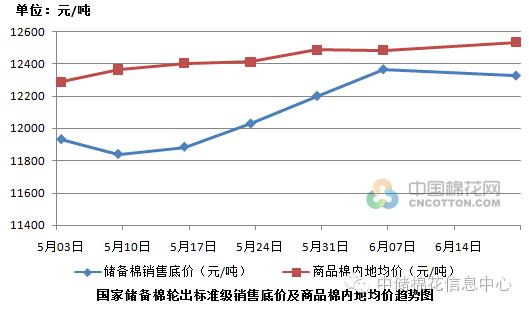
As shown in the chart above, since May 3 the reserve cotton sales floor price and the average inland price of commercial cotton have both shown an upward trend, but no one can accurately judge whether the rise can continue until new cotton comes onto the market and reach 8 yuan/kg. After all, the market is unpredictable.
Of course, from the perspective of the international market, India, as the world's largest cotton producer this year, has also seen a sharp rise in domestic cotton prices. India's cotton planting area in 2016/17 is expected to fall to about 11 million hectares, the lowest since 2009/10. The sharp decline in planting area has intensified concerns among spinning mills and middlemen, and some traders and cotton-related enterprises have also been actively purchasing and stockpiling cotton.
For cotton farmers, there are too many domestic and international factors affecting the market later on, and no one can accurately predict future cotton price trends. The pressing task is still to do a good job in cotton field management. After all, only high-quality cotton can command a high price.
(Muzi)