Innovative intercropping model achieves a win-win for the owner and farmers
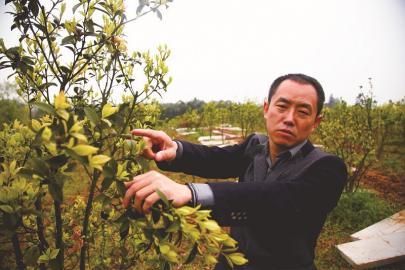
Wang Yin inspects the seed-setting of the tea-oil camellia trees.
Innovation point: The owner provides production materials such as the understory land, seeds and fertilizer, while the villagers are responsible for tending the tea-oil camellia trees and managing the short-term crops.
Benefits: The owner's tea-oil camellia trees receive effective tending, and the villagers earn income from the output of the short-term crops.
"The ones I introduced and planted are all three-year-old tea-oil camellia trees. The trees I bought and planted early last year are already bearing fruit this year. But it will still take two years before real returns begin." On June 6, in Tuanjie Village, Baijie Town, Naxi District, Luzhou City, tea-oil camellia trees were growing luxuriantly, and Wang Yin, a villager of the village and a returning entrepreneurial owner, was planning to intercrop pumpkins and taro in the tea-oil camellia forest land at the base. He said: "Although the early investment in planting tea-oil camellia is large, some income can be achieved by intercropping Chinese medicinal herbs or grain crops, using short-term returns to support long-term growth."
Intercropping can generate some short-term income, but if poorly managed, it can completely lead to spending more than one earns. Wang Yin's micro-innovation is to change the model in which the owner takes full responsibility and pays workers, into one in which the owner provides the understory land, seeds, fertilizer and plastic film, while the villagers manage the crops while tending the tea-oil camellia trees, and enjoy the income from the crop output, thus achieving a win-win for both the owner and the villagers.
On site
Returning to start a business and planting 5,000 mu of tea-oil camellia
Wang Yin is 40 years old this year. In the 1990s, he packed his bags and went to Fujian, Guangzhou and other places to make a living. After working on an assembly line for more than 10 years, he went to Shenzhen to do sales for an electronic foreign trade export company, and step by step rose from salesman and department manager to become one of the company's shareholders. In addition to a salary of about 100,000 yuan each year, he also received more than 400,000 yuan in year-end dividends.
Although he earned more than 500,000 yuan a year, Wang Yin did not stop his pace of moving forward. One day in April 2014, he read in a book that tea-oil camellia cultivation had good prospects. Thinking that his hometown, with its rolling mountains, was itself a base for China's extra-early tea cultivation, he returned home with friends in August of that year. With the support of the local government, he transferred 5,000 mu of low-quality forest land and introduced and planted big-fruit red-flower tea-oil camellia.
"I chose to plant tea-oil camellia trees because of the ecological and output benefits of tea-oil camellia." Wang Yin told this writer that camellia oil is a rare woody oil unique to our country, natural in quality and rich in nutrition, and is known as "Oriental olive oil." At the same time, tea-oil camellia can also be used as organic fertilizer, and tea saponin can be extracted from it to make high-grade cosmetic oil and medicinal oil. In the full-production period, tea-oil camellia trees can press 20 kg of camellia oil per mu, and the current selling price is more than 150 yuan/kg, so the benefits are very considerable. Wang Yin introduced that because the consumers of camellia oil are middle- and high-end groups in Shanghai, Guangdong and other places, the base strictly follows organic standards for planting, all weeding is done by hand, and it never uses pesticides or chemical fertilizers. In 2015, the entire tea-oil camellia base spent more than 2 million yuan on manual weeding and other expenses alone.
In order to grow the tea-oil camellia trees well, in addition to personally participating in planting and management, Wang Yin also hired Zhao Xueming, a tea-oil camellia expert from the Subtropical Forestry Experimental Research Center of the Chinese Academy of Forestry, as a technical consultant. Now, the tea-oil camellia trees in his fields are growing very well. "After entering the full-production period, my 5,000 mu tea-oil camellia base can press 100,000 kg of camellia oil, and the expected camellia oil income will be 15 million yuan. The base will be a green bank," Wang Yin said.
Innovation: zero-cost claiming stimulates villagers' enthusiasm. "Boss Wang, I'll be responsible for managing 20 mu of tea-oil camellia forest land on the opposite hilltop." "I'll be responsible for managing 15 mu." ... Recently, in the courtyard of the Tuanjie Village "two committees," more than 50 villagers allocated and claimed the area for intercropping pumpkins and taro under the tea-oil camellia forest this year. Soon, the 1,000 mu of intercropped tea-oil camellia forest land was fully claimed by the villagers.
"There is not a single cent of rent for the understory land, and there is also a subsidy of 100 yuan per mu. The seeds, plastic film and fertilizer are also provided by the boss. The pumpkins and taro grown are sold and all the money goes to oneself. Where else can you find such a good thing?" Wang Zhenggang, a villager from Group 3 of Tuanjie Village, said happily after claiming 15 mu of understory tea-oil camellia land.
Newly planted tea-oil camellia grows slowly and needs at least 4-5 years to bear fruit, and its early high-yield performance is not strong, so the economic benefits are not obvious. During this period, rationally intercropping low-growing Chinese medicinal herbs and crops can improve soil fertility while also achieving the effect of cultivation replacing tending and using short-term returns to support long-term growth. These crops have a short planting cycle and can be sown and harvested in the same year, which can effectively improve land utilization and increase income, making up for the shortcomings of tea-oil camellia's long growth cycle and slow returns.
"Intercropping Chinese medicinal herbs or grain crops can use short-term returns to support long-term growth, but if poorly managed, it can completely lead to spending more than one earns." In order to ensure that intercropping brings returns, and at the same time let managers also profit and strengthen their sense of responsibility, Wang Yin changed the model in which the owner took full responsibility and paid workers for management, to one in which he only provides land, seeds, fertilizer and plastic film, and the pumpkins and taro produced are purchased at a minimum protective price. Management is entirely the farmers' responsibility, and he no longer pays wages out of his own pocket. At the same time, in order to ensure timely tending of the tea-oil camellia, Wang Yin gives all villagers who claim tea-oil camellia forest land a management subsidy of 100 yuan per mu, greatly increasing the villagers' enthusiasm.
"This model is good. We get income other than land rent without bearing risks." Wang Zhenggang told this writer that growing 1 mu of pumpkins or taro guarantees at least 800 yuan in net profit. Add the 100 yuan subsidy for tending the tea-oil camellia along the way, and there is at least 900 yuan in net profit per mu, "much better than doing pure odd jobs."