New shiitake variety Qingke 212: short spawn run, high yield - can it replace 808?
Short-spawn-run, high-yield shiitake variety “Qingke 212”
Wu Yingmiao
Qingyuan County Edible Fungus Science and Technology Research Center, Zhejiang Province
★
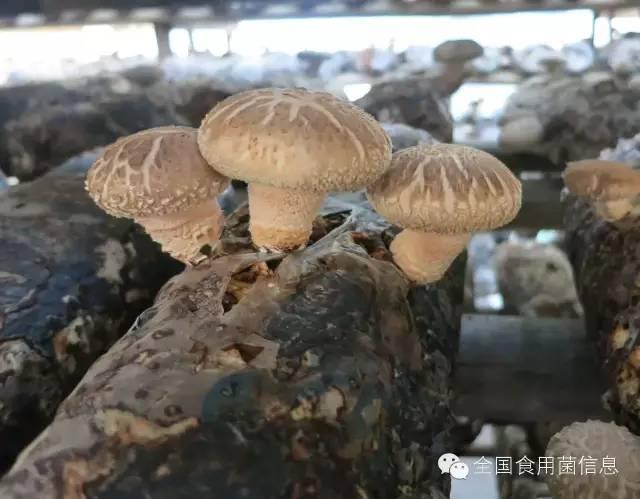
Qingke 212
★
Qingke 212 [Zhejiang (Non) Shen Jun 2015001] is a new short-spawn-run, high-yield shiitake variety bred by the Qingyuan County Edible Fungus Science and Technology Research Center in Zhejiang Province. In 2015 it passed the approval of the Zhejiang Province Non-Major Crop Variety Approval Committee. The approval opinion: this variety has a short spawn age, fruits early, has larger mushrooms, shorter stipes, good marketability, excellent mushroom quality and high yield. In the 2013-2014 multi-site regional trials in Zhejiang Province, Qingke 212 ranked first in average yield, with yields higher than varieties such as L808. In early promotion, this variety was well received and recognized by a large number of growers, and from 2013 to 2015 a cumulative 13.2 million bags were promoted.
01
1 Morphological characteristics
Qingke 212 is an early-maturing, medium to slightly high temperature type strain, with a spawn age of 80-90 days; mycelial growth temperature is 5-30°C, optimum temperature 23-25°C, optimum fruiting temperature 16-22°C. The fruiting bodies are solitary, the mushrooms are relatively large, with an average diameter of 6.3 cm and a single mushroom weight of 30.6 g, and a high rate of large mushrooms; the cap is round and neat, not prone to opening, grayish-brown on the surface, with small scales in the center and large ones at the margin; the cap is thick, the flesh tissue is dense, 1.5-3 cm thick, hard in texture, with a large incurved margin, forming a flattened hemispherical shape slightly spread out or umbrella-shaped; the stipe is relatively short, inverted cone-shaped, with a relatively large cap-diameter ratio. It has good marketability and good taste; fresh mushrooms taste tender, smooth and delicately fragrant, while dried mushrooms taste smooth with a rich aroma.
02
2 Cultivation key points
2.1 Spawn propagation: For Qingke 212 spawn production, the spawn propagation time can be reasonably arranged according to the inoculation period of the substrate bags. Stock spawn generally fills the bag in 50-55 days, and production spawn generally fills the bag in 45-50 days. Spawn inoculated too early is prone to developing tumor-like growths and aging.
2.2 Cultivation season: The suitable inoculation period is May to July, and the fruiting period is October to April of the following year; early inoculation before April advances the start of fruiting to August-September; late inoculation after August also delays the start of fruiting.
2.3 Substrate formula: hardwood sawdust 78%, wheat bran 20%, brown sugar 1%, gypsum powder 1%, with a moisture content of 50-55%.
2.4 Cultivation models: It adapts to various models such as high-shed flower shiitake, low-shed bag-removal, and high-shed bag-removal fruiting.
2.5 Perforation for aeration: During the incubation management process, attention should be paid to maintaining good ventilation conditions and promptly breaking up piles. Qingke 212 mycelium needs sufficient oxygen and requires 2-3 rounds of perforation for aeration. Breaking up and moving piles of substrate bags should avoid high-temperature weather, and bags should be handled gently and placed lightly to avoid vibrating the substrate bags.
2.6 Color-turning management: Qingke 212 substrate bags colonize quickly but turn color relatively slowly, so color-turning management should be strengthened. Timely perforation for aeration helps the substrate bags turn color, and appropriately increasing scattered light during the incubation period can promote color turning of the substrate bags. Substrate bags inoculated after July especially need timely perforation for aeration to promote color turning; otherwise, fruiting may occur before color turning is complete, with fruiting and color turning occurring simultaneously, and by the end of harvesting the first flush the substrate bags have also completed color turning.
2.7 Arrangement of substrate bags in the yard: After the mycelium of Qingke 212 substrate bags has physiologically matured, stimuli such as moving and tapping at the suitable fruiting temperature will induce a large number of fruiting bodies to develop. Substrate bags should be arranged in the yard early, at the latest 15-20 days before the fruiting period, to reduce mechanical vibration and avoid concentrated mass fruiting.
2.8 Fruiting management: Fruiting body formation requires stimulation from a day-night temperature difference of 6-8°C; appropriately increasing scattered light during the fruiting period helps improve mushroom quality. Manage with alternating wet and dry conditions: during fruiting body growth, manage toward the "wet" side to ensure the water needed for fruiting body growth; after each flush ends, incubate the mycelium for 7-10 days, manage toward the "dry" side, and strengthen ventilation and air exchange to promote recovery of the substrate bags. Supplement water appropriately according to the condition of the substrate bags and the weather, and the amount of supplemental water should decrease successively in the later stages. Measures such as mechanical vibration, temperature difference stimulation and moisture difference stimulation have a good effect on inducing buds. Fruiting occurs in a certain number of flushes, mainly concentrated in the first 2 flushes; the later the inoculation period, the more obvious the flushes.