Koi farmer Deng Runqiu breeds top-quality fish by selecting the best from a hundred
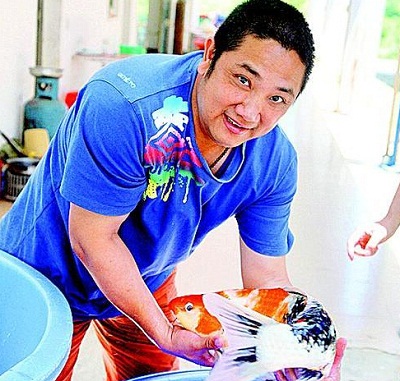
Deng Runqiu shows the koi he breeds.
Workers selecting fry.
The koi, known as the "king of ornamental fish", is a noble large ornamental fish. Its colors are brilliant and gorgeous, and its patterns are endlessly varied. In addition, it has low requirements for water quality and is easy to breed, so it is loved by many fish-keeping enthusiasts. In Tuhu Village, Longtan Town, Deng Runqiu invested in building a koi farm specifically for breeding and raising koi.
Some koi sell for over 10,000 yuan each
Entering Deng Runqiu's farm, one can see outdoor fish ponds and indoor fish ponds of various sizes. In the indoor fish ponds, the ponds are all numbered, and koi of different sizes are kept in different ponds. Workers are sitting by the ponds selecting fry; qualified fry are placed into oxygenated fish tanks, while unqualified fry are put into buckets, frozen, and then fed to turtles.
In the outdoor fish ponds, the aerators sound rhythmically, and colorful koi can be seen swimming around underwater. "This Showa koi costs more than 10,000 yuan. The price of koi is related to the fish's body shape, quality and pattern." In the outdoor fish pond, Deng Runqiu pointed to a koi about 40 cm long in the pond and told the reporter that the main koi varieties at his farm are Showa, Kohaku and Taisho.
Deng Runqiu introduced that these koi were all bred and raised by him using broodstock. Construction of the farm began in 2010, and it has more than 20 fish ponds, of which the indoor fish pond area reaches more than 1,200 sq m. At present, the farm has six or seven workers and produces nearly 20,000 fish each year.
The koi broodstock at Deng Runqiu's farm generally spawn twice a year, with one round of breeding producing about 1.8 million fry. The survival rate is about 50%, meaning about 900,000 fry survive. They then must go through three rounds of selection before finally becoming qualified ornamental koi. The first selection takes place after 35 days, when the fry have grown into finger-sized young fish, and only about 5% of the fry qualify. The second and third selections are carried out within one year, and each time only 40%-50% qualify. In the end, close to 10,000 qualified koi come from one round of breeding.
Longmen's excellent water quality prompted him to decide to make fish farming his business
How did Deng Runqiu "take a fancy" to koi farming? It turns out that Deng Runqiu is from Humen, Dongguan, and has always loved keeping koi. Fish tanks and fish ponds of all sizes at home were all stocked with koi, and he usually mastered and improved his fish-keeping skills by reading professional books, listening to friends' explanations, and figuring things out on his own.
By chance, Deng Runqiu visited Longmen with friends and found that Longmen's ecological environment was good and its water quality excellent, making it very suitable for koi farming. So after returning to Dongguan, he discussed it with his family and decided to invest in building a koi farm in Longmen. Deng Runqiu asked a friend to introduce two excellent broodstock from Japan and began exploring breeding techniques.
After some time, Deng Runqiu found that keeping koi in fish tanks and farming them at a farm were two different things. Farm breeding places more emphasis on large-scale breeding and unified management. After years of continuous research and exploration, Deng Runqiu finally mastered a relatively mature set of koi breeding techniques. Today, his koi have been sold all over the country, and he has also opened a koi sales department in Dongguan specifically responsible for selling the farm's koi.
"There were once customers from Inner Mongolia and Beijing who came specially to our farm to buy koi fry." Deng Runqiu told the reporter that his farm had already achieved initial success, and people had proactively inquired about it not only domestically but even in Southeast Asia and other places.