Blueberry Village Grows Blueberries, Farmers by the Yalu River Embrace a New Life
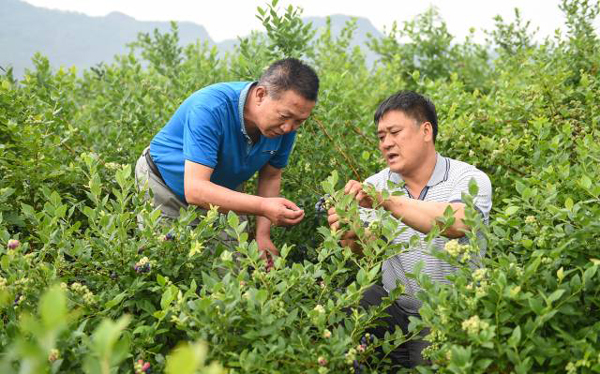
On June 23, Digou Village Party branch secretary Wang Heling (left) and villager Guo Weifu inspect the growth of blueberries.
This is a photo taken on June 23 of the blueberry fields in Digou Village by the Yalu River.
On June 23, Digou Village villagers inspect the growth of blueberries.
In the height of summer, the blueberry fields of Digou Village, located by the Yalu River on the northeastern border, are bustling with activity. Green mountains and clear waters adorn this beautiful village, and also light up the local farmers' longing for a new life.
Digou Village is known as "Blueberry Village," and its 1800 mu of blueberry planting area ranks first in Ji'an City, Jilin Province. Five years ago, this blueberry field was still a cornfield, 3 mu of which belonged to villager Ju Zhenshan. Ju Zhenshan, now 65 years old, said: "Growing corn on 1 mu of land brings in less than 500 yuan a year, while growing blueberries on 1 mu brings in 800 yuan. I contracted my land to the village, and working here every day earns me 100 yuan. Life at home is getting better and better; we've added a freezer, and the TV has been replaced with one over 40 inches."
Digou Village has 450 households, and every household is connected to blueberries. Wang Heling, the 61-year-old village secretary, told reporters that Digou Village has little land but many people, and in the past it took many detours in developing the collective economy. After more than 3 years of trials, villagers began large-scale conversion to blueberry cultivation in 2011, and now production and sales are climbing year by year. "This year is a bumper year; we estimate we can harvest nearly 1 million jin, which can sell for more than 10 million yuan."
Growing blueberries not only effectively mobilized the enthusiasm of local farmers and made Digou Village prosperous, but the village's former mud-brick houses have now been replaced by brand-new brick and tile houses. In addition, many farmers' homes have also begun using solar water heaters.
It is understood that of Digou Village's 1800 mu of blueberry fields, 1200 mu belong to the village collective economic project. Villagers contract their land to the village, and besides earning wages from weeding and fertilizing in the fields, they can also receive a farmland outsourcing subsidy of 20% of the total blueberry profits and a dividend of 30% of the total, while the remaining 50% will be used for public welfare undertakings such as building village roads and installing streetlights.
"Now we have gradually solved the problem of food and clothing." Ju Zhenshan said, "Once everyone has no work to do, they look for work every day. The village pays wages and also creates a new path for everyone to get rich."
As the blueberry fields expand year by year and the villagers' wallets grow fuller year by year, Guo Weifu, who runs a shop in Digou Village, has also tasted the benefits: "The people's consumption level has risen, and all kinds of goods in my shop sell better. The plastic film I stocked at the beginning of the year sold out completely in early spring, and now I've restocked a new batch, making it convenient for the village to buy at any time."