The entrepreneurial journey of the Cherry Valley owner, the story of a new Foolish Old Man
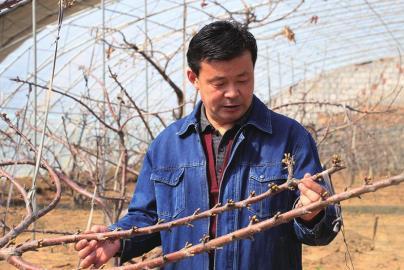
Li Changchun inspecting the cherry growth; Li Changchun reclaiming wasteland to develop cherry production
"Investing in agriculture requires large upfront input, and it is laborious and taxing, but as a villager of this village, I am willing and happy to make this investment." When he said this to the reporter, the formerly barren hills and slopes had already been transformed by Li Changchun into a "Flower and Fruit Mountain," with cherry trees, pear trees, peach trees and other fruit trees of all kinds visible everywhere across the hillsides, planted in orderly rows.
Li Changchun is a villager of Zhifang Village, Wufengshan, Changqing District. Over 28 years he grew from a migrant worker into the owner of a cherry valley covering nearly 1,000 mu. He "does not forget the well-digger when drinking water"; he not only helped the village build the road up the mountain, but also established the Zhifang Large Cherry Professional Cooperative and the Changqing District Wufengshan Large Cherry Planting Association, leading more than 600 fruit-growing households in Zhifang, Zhuzhuang, Qiuzhuang and surrounding villages out of poverty toward prosperity.
Transport difficulties kept Zhifang cherries "unknown to anyone"
Wufengshan, a sacred site of Taoism, has beautiful peaks. In recent years, the large cherries of Zhifang Village, located on the southern slope of Wufengshan, have also become renowned inside and outside the province for their large size and sweetness. Every year when the cherries come to market, merchants gather in crowds, bringing many tangible benefits to the local fruit growers. But who would have thought that Zhifang Village, now widely known for its cherries, once had cherries that no one knew about or had heard of.
Speaking of it, although cherry cultivation in Zhifang Village has a long history, the villagers' planting methods were single, the varieties few, and the scale small. Add to that the steep mountain terrain and the lack of water in the mountains and other special natural conditions, and the twenty or thirty mu of cherries in the village could only be managed extensively. "At that time, when villagers went up the mountain to tend the cherries, they all followed the gullies and 'climbed' up along narrow winding footpaths. Carrying manure, fertilizing and watering were all done by manpower; aside from carrying on the shoulder, it was hauling on a pole. Not even a 'earth ox' cart could get in," said Li Changchun. The cherries grew poorly and were hard to sell. When a good crop came in and they managed to transport some out, the bumps and knocks during transport meant they still could not fetch much of a good price.
Using the "first bucket of gold" from entrepreneurship
to return to the village and contract barren mountains
The Zhifang Village where Li Changchun grew up is a small mountain village, seventy percent mountain land and thirty percent flatland. Because the mountain soil is thin and barren and irrigation conditions are lacking, villagers could only rely on growing cherries, chestnuts and other fruit trees on the slope land near the village, with relatively low income. Like many rural people, in order to earn money, Li Changchun went out to work after graduating from junior high school. Twenty-eight years ago, having graduated from junior high school, Li Changchun worked near Wuyingshan in Jinan with people from his hometown doing building installation. As time went on, Li Changchun also became a small "labor contractor," and at the most he had sixty or seventy people working under him. Gradually, the business expanded from Jinan to surrounding cities. "There were quite a few clients from other prefectures and cities too; the farthest I went was Shaanxi," said Li Changchun.
Around 1998, while Li Changchun was doing building installation for a large bus factory, he fortunately became connected with buses. He took out most of the money he had earned from years of work and bought 6 buses at once. He hired drivers and started a bus transport business, which he ran for 10 years, accumulating a great deal of entrepreneurial wealth for him.
During the interview, many villagers in the same village said that Li Changchun had always been a "warm-hearted person." Whenever anyone had a wedding or funeral and villagers were short of money, as long as they found Li Changchun, he was never evasive. During the 2009 Spring Festival, when some villagers went to Li Changchun's home to pay New Year's calls, they encouraged him to put up money to do something for the village. "The village is so backward. You have seen the world outside. See if you can think of a way to help the village develop something." That very night, Li Changchun and his wife made the decision to contract barren mountains and start a business in the village.
Cutting through the mountain and building roads, willingly playing the modern "Foolish Old Man"
The barren mountain Li Changchun contracted has steep terrain and no water in the mountain, and the only way in was a narrow winding footpath. Not long after the Spring Festival, road building was put on the agenda. But things were not as easy as imagined. In order not to occupy good roads and affect the villagers' normal access to the mountain, the road was built along the mountain ridge at the time, but it still drew cold looks because it occupied some villagers' land or trees, and cold words drifted into the ears of Li Changchun and his wife from time to time. "You have a perfectly good life, yet you come back to this remote mountain nook to mess around?" "Opening up this mountain is like the Foolish Old Man moving the mountain; you have to be willing to put in effort, sweat and money." Once Li Changchun sets his mind on something, not even eight horses can pull him back. In order to finish the road as quickly as possible, he moved his home up the mountain, found machinery, hired workers, and began the "mountain-moving" path of building mountain roads, making terraced fields and drilling deep wells.
It is understood that in order to increase farmers' income, Li Changchun invited capable local people from the village to work on the mountain, not only providing meals, but paying wages higher than what they could earn working outside. Excavators, bulldozers, wheelbarrows, vehicles and people coming and going; stone ridges were chiseled into layer upon layer of retaining walls, and soil was piled into patch after patch of terraced fields. Water sources were surveyed, machine wells were dug deep, and water-storage ponds and dams were built. Building mountain roads required great effort. Li Changchun led the workers in scientific planning, chiseling ridges and laying stone, and pouring in mud and sand. After more than a year of working day and night, spending more than 2 million yuan, a 12.5-kilometer-long ring road around the mountain was finally completed just before the Spring Festival.
What Li Changchun did not expect was that when the New Year came again, the villagers, in order to thank him, spontaneously organized themselves and went to his doorstep to set off firecrackers as a show of gratitude.
Introducing new varieties to drive the whole village to develop circular agriculture
With the road opened, the terraced fields built, the wells dug, and electricity connected, Li Changchun went to advanced regions to learn new cherry-planting techniques, introduced high-quality large cherry varieties such as "Zaodaguo" and "Lapins," and invited experts to explain pruning and other cultivation techniques. Greenhouse cherries come to market early and earn more, so Li Changchun invested in building winter-warm greenhouses to produce early-spring cherries. Under Li Changchun's leadership, the fruit growers of Zhifang Village also expanded their cherry planting area on their own mountain slopes and hills, and he took the initiative to provide techniques to his neighbors and fellow villagers. Today, the large cherry varieties planted in Zhifang Village have expanded from the original two or three to more than twenty varieties, and the picking period has also been extended from the original 3-5 days to more than 40 days. It has become the earliest-maturing and best-tasting cherry orchard in the province.
In August 2009, Li Changchun established the Zhifang Large Cherry Professional Cooperative. Using the ecological planting and breeding circular model of "livestock breeding - biogas, biogas slurry, biogas residue - forest fruit - production of organic fruit," it developed circular agriculture. The biogas produced, besides being used for production and household energy, can also be partly used to increase light and supplement heat for greenhouse cultivation, and the CO2 generated by combustion is used as gas fertilizer, thereby increasing crop yield and improving quality.
"In the large cherry planting area, biogas residue and fully decomposed organic fertilizer are mainly used as base fertilizer, reducing the amount of chemical fertilizer used and increasing the soil organic matter content, raising large cherry yield by about 15%. Spraying biogas slurry on large cherry branches and leaves achieved a pest-control effect of more than 90%," said Li Changchun. Add to that the unique conditions of mountain spring water irrigation, ample sunshine and good ventilation, and the cherries grown are large, fleshy, high in sugar content and good in taste. A picking group from Liaocheng once joked, "People from our place haven't even gotten to drink spring water, yet the cherries here got to drink it first."
Establishing an association to lead surrounding villages out of poverty toward prosperity
In March 2010, Li Changchun established the "Changqing District Wufengshan Large Cherry Planting Association" and served as its president. Leveraging the brand resource advantage of "Provincial-Level Tourist Resort - Wufengshan," he built the "Wufengshan Large Cherry" brand, registered a trademark, and cultivated the market. The association provided full-process technical guidance in every link of large cherry production, from fertilizer and water management, pest and disease control, purchasing, processing and sales, and received very good social and economic benefits.