Pingdu cultivates "zhiliaohou" (cicada nymphs), with up to 20,000 emerging each night
Original title: Pingdu farmer figures out the breeding patterns of zhiliaohou, harvesting 20,000 in one night
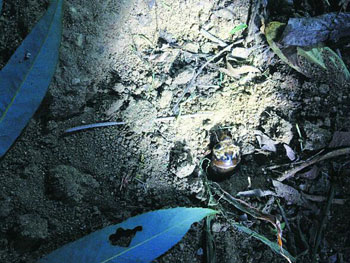
zhiliaohou
zhiliaohou
zhiliaohou
San Nong Express comprehensive report: In the depths of summer, "zhiliaohou" has once again become a delicious dish on many citizens' dining tables. To meet people's needs for food and entertainment, so-called artificially farmed golden cicadas have emerged. The night before last, the reporter went to Qufang Village in Pingdu Economic Development Zone and, in a grove of trees south of the village, found the childhood delight of the 1970s and 1980s -- catching zhiliaohou. The contractor of the grove, Li Jinjun, is an ordinary farmer. After 15 years of collection and research, he has finally achieved a scene of more than 20,000 golden cicadas emerging per night.
City dwellers go to the countryside to try it for the first time
Last night (June 30) at around 7 p.m., the reporter arrived south of Qufang Village in Pingdu Economic Development Zone and found a sign beside a grove of trees reading "Golden Cicada." More than ten cars were parked at the gate of the grove; these city residents had all come to catch "zhiliaohou."
The owner of this grove is named Li Jinjun, 53 years old, a native of Qufang Village and a genuine farmer. Following Li Jinjun through the gate, the reporter saw that outside the second gate leading to the grove, twenty or thirty adults and children were holding small red buckets, rubbing their hands in anticipation as they waited for the "market to open."
"These are all people who have come to catch zhiliaohou -- some are locals, some from Gaomi, Jimo, Jiaozhou, and some from Qingdao," Li Jinjun said. The reporter saw that the faces of these waiting people were filled with excitement. For many of them, especially the children, this might be the first time in their lives.
They only emerge en masse from their holes at 8 p.m.
"When I was little, as soon as this season came, I would grab one of those flashlights with a really long handle and go out to catch zhiliaohou. After walking a circle around the village, I could catch half a washbasin full. Some people could even just grope blindly along the tree trunks and still catch forty or fifty, and sometimes they would even touch a snake. Now? Being able to catch even one zhiliaohou by the roadside feels like winning the lottery." A ripple of memory surfaced on the face of 42-year-old Mr. He.
Since the guests had all arrived, why not let them in to catch zhiliaohou? "It's not time yet. Zhiliaohou only emerge en masse from their holes at around 7:30, reach their peak at around 8, then enter a plateau period, continuing until around midnight," Li Jinjun said confidently.
Fifteen years of study to figure out their living habits
The reporter learned that Li Jinjun could speak so confidently about the habits of zhiliaohou thanks to 15 years of exploration and experience. In 2001, Li Jinjun began to get involved in breeding zhiliaohou. "With the renovation and construction of villages and towns and the use of pesticides, zhiliaohou gradually lost their living space, and the childhood delight of catching zhiliaohou in summer drifted away. At the time I thought, if only I could farm zhiliaohou. So I looked up relevant materials and books, contacted many breeding technicians across the country, and began trying to breed zhiliaohou. At the time I was doing aquaculture, and there were dozens of willow trees beside the pond, so I planted the zhiliaohou under those willows. Unexpectedly, after a few years, the results were quite good. In 2008, I decided to expand the scale, contracted this 80 mu of land, planted willow trees, and bred zhiliaohou on a large scale. Up to now, it can be said that I have basically succeeded." Li Jinjun said that nowadays, his grove can produce an average of 20,000 "zhiliaohou" per night.
That year, he spent a week collecting 20,000 withered branches
Li Jinjun said that since the experimental planting of "zhiliaohou" in 2001, with a new generation every three to five years, he has gradually achieved semi-artificial breeding. Outside the willow grove, the reporter saw a structure resembling a vegetable greenhouse, inside which zhiliaohou eggs were being cultivated. "At the beginning I had no idea how to cultivate the eggs at all; all the eggs were collected by hand. After the Beginning of Autumn, I would take those long-handled shears and go around everywhere, cutting down any withered branches I saw. I remember that year I spent more than a week collecting 20,000 withered branches, and these branches might have hidden golden cicada eggs inside." Li Jinjun said.
Bringing childhood delight back to the children
Li Jinjun said that the golden cicada's cycle from egg to emergence is two to five years, and during that time all that needs to be done is to loosen the soil and weed the grove. "Nothing else needs to be done, and in particular any pesticide must be prohibited. My grove has quite a serious pest problem -- quite a few trees have been gnawed hollow by insects -- but I can't spray pesticide. Once you spray, you kill the golden cicadas underground." Li Jinjun said.
As for income, Li Jinjun was unwilling to talk much about it. "I think being able to recover childhood delight for our children and grandchildren is my greatest success. As for whether I can make money, that is all external to me. If one day I work out a breeding method with fixed output and fixed quantity, then I will be content. I am just an ordinary farmer, I don't seek anything, I just hope to provide everyone with a healthy and happy place." Li Jinjun said that if anyone wants to make money from this, then they need not get involved, because the breeding process is too slow -- at least four or five years -- and even after harvesting, reality may differ greatly from ideals. (Reporter Yang Haitao)