Summer grain transitions in mode of production to welcome a bumper harvest; autumn grain is the bulk and disasters are more frequent
Original headline: Minister of Agriculture Han Changfu reviews the highlights of agricultural production in the first half of the year --
Bumper summer grain harvest demonstrates the effectiveness of agriculture's mode-of-production transition
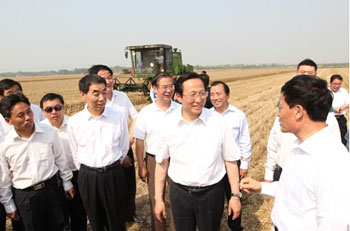
Minister of Agriculture Han Changfu talks about summer grain (illustrative image from the internet)
San Nong Zhi Tong Che comprehensive report: At present, the national summer grain harvest has basically ended. Minister of Agriculture Han Changfu said in a recent interview with an Economic Daily reporter that the highlights of agricultural production in the first half of this year were prominent: summer grain production achieved a bumper harvest, and agriculture made positive progress in transforming its mode of production and adjusting its structure.
Another bumper harvest is truly not easy to achieve
Han Changfu said that although agricultural meteorological conditions this year saw some periodic unfavorable factors, according to forecasts, total summer grain output can still reach 280 billion jin, roughly on par with last year's historic high, and overall it is still a bumper harvest year. Analyzing the factors making up summer grain output: first, sown area remained stable, with summer grain area expected at 414 million mu, of which winter wheat area was 339 million mu, both basically flat from the previous year. Second, yield per unit area decreased slightly; the three factors making up winter wheat output showed a trend of "one decrease and two increases" -- the number of ears per mu decreased, while the number of grains per ear and the thousand-grain weight both increased.
Henan is the country's largest summer grain province. In Xibei Street Village, Yucheng County, major grain grower Lu Hejun's 3,000 mu of wheat achieved another bumper harvest this year. "Purchasing agricultural inputs uniformly lowers costs; being equipped with harvesters, deep plows, sprayers and so on reduces inputs; taking the lead in promoting new varieties and applying new technologies such as deep plowing and subsoiling and soil-testing formula fertilization increases output." Old Lu has his own grain-growing know-how.
Information from the Ministry of Agriculture shows that this year's summer grain production presented 3 notable features: first, the regional layout became more concentrated, further forming the advantageous zone for strong-gluten wheat in northern Huang-Huai, the advantageous zone for weak-gluten wheat in Jiangsu's Lixiahe area and coastal areas, and the advantageous zone for medium-gluten wheat in northern Jiang-Huai and most of Huang-Huai. Second, the proportion of special-purpose varieties increased; the share of strong-gluten wheat area, for which market demand is large, reached 23.5%, up 1.5 percentage points from the previous year. Third, cost savings and efficiency gains were notable; in North China, Northwest China and other areas, water-saving wheat varieties were promoted on more than 10 million mu, an increase of more than 7 million mu over the previous year; in the groundwater funnel area of Hebei, winter wheat with high water use was reduced by more than 1 million mu; localities also integrated and promoted fertilizer-saving, pesticide-saving and other technologies to promote cost savings and efficiency gains.
"This year's bumper summer grain harvest was achieved on the basis of last year's relatively large increase in output, and it was truly not easy," Han Changfu said. The sustained bumper summer grain harvest benefited from 4 factors: first, strong policy support; the state continued to implement the minimum purchase price policy for wheat and kept the price stable, and continued to arrange 1.5 billion yuan in subsidy funds for wheat "one spray and three preventions," stabilizing farmers' enthusiasm for production. Second, improved facilities; in recent years the state has continuously strengthened agricultural infrastructure construction, building high-standard farmland that guarantees harvests despite drought or excessive rain and is high-yielding and stable-yielding, improving disaster resistance. Third, science and technology in place; high-yield and high-efficiency comprehensive cultivation technologies for wheat production were promoted over large areas, and the level of science and technology steadily improved. Fourth, effective disaster resistance; proactive disaster-avoidance technologies such as subsoiling and land preparation, precision sowing, and "one spray and three preventions" were integrated and promoted in concentrated ways, and unified prevention and control of pests and diseases was carried out in a timely manner.
Structural adjustment carried out in an orderly manner
Since the beginning of this year, the Ministry of Agriculture has taken adjusting and optimizing the planting structure as an important task in advancing agricultural supply-side structural reform, focusing on adjusting and optimizing the corn structure, vigorously improving the production capacity, quality and competitiveness of advantageous areas, reducing planting area in non-advantageous areas, and promoting agricultural transformation and upgrading. Localities vigorously advanced grain-to-feed and rice-to-soybean conversions, guiding farmers to make adjustments independently, voluntarily and in an orderly manner.
For some time, falling corn prices have left major grain growers deeply worried, while silage corn used as feed has struck real gold on another path. In Ying County, Shanxi, the net income from one mu of whole-plant silage corn is at least 500 yuan, and in Tongliao, Inner Mongolia, this figure even approaches a thousand yuan. Developing whole-plant silage corn through grain-to-feed conversion can improve grain-growing efficiency in advantageous areas, improve the soil and increase grain, and realize storing grain in the land.
Han Changfu said the results of agricultural structural adjustment are mainly reflected in two points: first, doing a good job of subtraction by reducing corn area. Judging from spring and summer planting, the trend of reducing corn area this year was obvious, especially in the "sickle bend" region where corn area was reduced considerably, and structural adjustment began to show results. According to Ministry of Agriculture agricultural monitoring, it is expected that the national corn area this year will be reduced by more than 30 million mu. Second, doing a good job of addition; the reduced corn was mainly replanted with crops needed by the market, such as soybeans, miscellaneous grains and beans, potatoes, and high-quality forage grass. It is expected that this year soybean area will increase by more than 8 million mu, miscellaneous grain area by more than 8 million mu, and forage grass and silage corn area by more than 6 million mu.
Around structural adjustment, the Ministry of Agriculture proposed reducing corn area by more than 50 million mu and increasing soybean area by 40 million mu by 2020. The Ministry of Agriculture, together with the Ministry of Finance, also integrated 3.25 billion yuan in funds to focus on supporting agricultural structural adjustment.
The development mode is accelerating its transformation
Right now, summer corn in the Huang-Huai region has already been sown. The thinking of many new-type entities is also changing. Zhao Yuguo, chairman of the Cainiu Zhangzhuang Corn Cooperative in Tieling County, Liaoning Province, believes that relying solely on selling raw corn grain is certainly not guaranteed to be profitable, and the industrial chain must be extended. This year the cooperative plans to build a processing plant to produce corn grits and corn flour, and also to build a sheep farm to realize circular planting and breeding. One jin of corn can only sell for seven jiao, while one jin of corn grits can sell for four to five yuan, and one jin of high-quality corn flour can sell for more than 10 yuan, significantly increasing comprehensive returns.
Stabilizing grain production capacity and competitiveness is the primary prerequisite for transforming agriculture's mode of production. "To achieve this, the core is to shift from focusing on annual output to focusing more on protecting and improving grain production capacity, and to realize storing grain in the land and storing grain in technology," said Zeng Yande, director of the Ministry of Agriculture's Department of Crop Production.
Changing the agricultural operating model must take the path of appropriately scaled operations. As of now, there are more than 3.41 million households nationwide operating more than 50 mu, the number of farmer cooperatives registered with industry and commerce nationwide has reached 1.412 million, and the number of family farms exceeds 877,000. To innovate agricultural operating models and accelerate the cultivation of new-type agricultural operating entities, relevant departments have proposed studying reform of the agricultural subsidy system so that subsidy funds tilt toward grain-growing farmers and new-type agricultural operating entities such as family farms.
Once summer grain is in hand, autumn grain is the bulk. Han Changfu said that judging from the current situation, spring-sown crops are growing relatively well and summer sowing is progressing smoothly. But it must be clearly seen that grain production in the second half of the year will still be affected by two unfavorable situations. One is that, affected by the super-strong El Nino, natural disasters may occur frequently; the other is that, affected by agricultural product prices, especially grain prices, the growth rate of farmers' incomes may decline.
"As long as we face up to the difficulties, firmly grasp the main line of work of transforming the mode of production and adjusting the structure, and implement all policies and measures well, we are confident of achieving all the goals of agricultural development for the whole year," Han Changfu said. (Our reporter Qiao Jinliang)