Hu Jun's Chicken Farming Story: The Experience of a Breeder
He came into chicken farming as an outsider, and ran into one setback after another. Through painstaking effort, ten thousand chickens finally reached market weight, but what it brought was not a pleasant surprise, but a nightmare. Finding business opportunities amid his troubles, he kept coming up with clever tricks. Every three months he moved his free-range chickens to a new location; the roads were hard to travel and the chickens ran wild, yet this chaotic scene held the secret to his money-making scheme. See how Hu Jun from Sichuan rose rapidly in just over three years, with annual chicken sales reaching more than 30 million yuan.
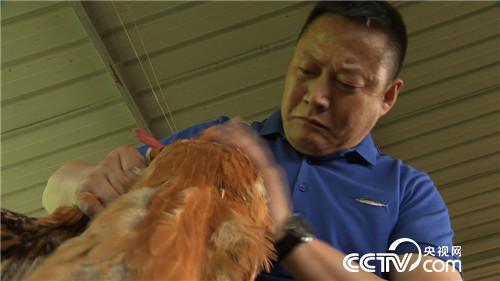
Hu Jun: We'll have four people standing at the back, one on each side, all driving them that way.
Early in the morning on May 20, 2016, Hu Jun was busy moving his more than 4,000 chickens. Many animals have a leader, but chickens do not. At the scene, these leaderless chickens were like a pile of loose sand, each going its own way, and getting them to move in one direction was no easy task.
Hu Jun: It's best if there's grain leading the way up front. If they're hungry, scatter some grain in a circle, and they'll peck along slowly, slowly, and gradually follow it.
Hu Jun planned to move these chickens from the pen up above to another pen more than 200 m away down the hillside. The distance was not far, but it was quite a chore. Even so, Hu Jun still insisted on moving the chickens to a new free-range area every three months, in order to protect the vegetation and benefit the chickens' growth.
Hu Jun: Because in some places the grass in the free-range area has already been pecked bare by the chickens. To let them still have green grass to eat, we have to move them to the next place that already has green grass. Where there is still grass, the meat quality of the chickens, and the air quality of the free-range environment, are both better.
While driving the chickens, Hu Jun also had an important task. This hillside is very steep, with gullies and ridges everywhere. For us people, it is easy to trip while walking, and for Hu Jun's chickens it is also a test. Near the pen there is a ridge, and the slope there is close to ninety degrees. When they reached this spot, some of the chickens moved with nimble steps.
Hu Jun: These chickens just charged straight up.
Some were clumsy and foolish.
Hu Jun: It bumped into it. This is a stupid chicken. Very impressive, it can get up.
And there were still others that failed again and again, and took a detour to find a place with a gentler slope.
Hu Jun: No good, you're a deserter.
In Hu Jun's eyes, these hard-to-travel places happen to be the best places to test the chickens.
Hu Jun: The slightly weaker ones will show themselves when the pen is moved. Any that get bullied, the kind of chickens that want to run away.
Catch them out and raise them separately, so that later other chickens don't fight with them and peck them to death.
Driving chickens, releasing chickens, today's Hu Jun is an expert at all of it, yet three years ago Hu Jun was still in the construction contracting business. In just over three years, Hu Jun's annual chicken sales reached more than 30 million. From small-scale trial farming to quickly becoming a leading agricultural enterprise in Chengdu. How did Hu Jun rise so rapidly?
Hu Jun, 44 this year, started out as a carpenter, and later founded a construction contracting company with annual sales of tens of millions of yuan. In 2009, Hu Jun was drawn to one advantage of agriculture, and set his heart on going into farming.
Hu Jun: In construction, sometimes you can't get paid for three years or two years, and that happens most often. What I wanted most was cash transactions, which are best, because that makes it a bit easier for the company to plan.
In 2011, Hu Jun and three shareholders founded an agricultural company. Hu Jun investigated more than a dozen specialty projects, and in the end told the shareholders he wanted to raise chickens. The shareholders were very puzzled by this.
Fan Zujian: There's nothing special about raising chickens. Because there are too many, everyone is raising chickens. At the time I thought there might not be much of a future in it.
To win the shareholders' confidence, Hu Jun decided to run a trial first. In July 2012, Hu Jun bought 1,500 chicks for trial farming. Six months later the chickens reached market weight, and because the quantity was small, they sold out quickly. Hu Jun did the math and secretly rejoiced: from just 1,500 chickens he made 20,000 yuan.
Hu Jun: They're quite easy to raise, and the cost isn't high either. Conservatively estimating a profit of ten yuan per chicken, then if I raise 100,000 I'd have one million yuan, and if I raise a million that would be incredible, ten million yuan. That's much better than doing engineering.
With this trial, Hu Jun won the shareholders' support in one move. In December 2012, to raise chickens on a large scale, Hu Jun found a good piece of land. He transferred the rights to three mountains in Minji Village, Dayi County, full of ambition to go big. But the treasure land in Hu Jun's eyes brought him trouble. Just days after construction of the chicken house began, someone came knocking.
Hu Jun: The land bureau staff came by car, and the law enforcement department said, you absolutely cannot use this, we're immediately issuing you a stop-work order on this problem, and then you must restore this land. I was stunned.
Once work stopped, Hu Jun's investment of more than 100,000 yuan would be wasted. Hu Jun quickly looked into it and learned that the land's designated use was basic farmland, and no chicken houses could be built there. Just as he entered agriculture, he took a fall. Hu Jun felt very depressed.
Hu Jun: Once I've set my sights on a goal, no matter how badly I get battered, I must charge forward. You can make backup plans, but you must never do things that turn back. You must keep charging straight ahead.
In February 2013, in Guaishi Village, Dayi County, near Xiling Snow Mountain, Hu Jun transferred the rights to nearly a thousand mu of forest land as a free-range area, invested more than 10 million yuan, built a breeding farm, and began raising improved local chickens. Next, however, he was badly hurt by a customary practice from the construction industry.
For the first batch, Hu Jun raised more than ten thousand chickens. Hu Jun and the shareholders called up friends and invited everyone to come to the farm to have fun. Seeing everyone having a great time, Hu Jun and the shareholders were also very happy.
Hu Jun: Show off the scale of my own site, let them come see it, and help us spread the word by word of mouth. I thought this was good.
Shareholder Xu Yong: They all said it was great, great, amazing, amazing. At the time I had that sense of pride.
The arrival of relatives and friends made the farm lively and bustling. But soon problems appeared. During the interview, Hu Jun went into the chicken house early in the morning and found that some chickens had died. He told the reporter that on such a large chicken farm, a few chickens dying in a day was not surprising, it was normal. But when in April 2013, not long after he started farming, he first discovered several dozen dead chickens, far exceeding the normal situation, it scared him badly.
Hu Jun: If I didn't keep it under control, I figured the money I'd invested early on would basically be down the drain, a total loss. Not just losing money, I might lose everything.
A pen of four thousand chickens cost more than 200,000 yuan. Given the situation at the time, within a month Hu Jun's chickens would all be dead. Only then did Hu Jun realize that in the construction industry it was common to lead visitors around and explain things when people came, but for the farming industry, leading relatives and friends into the chicken house was actually a major taboo.
Hu Jun: Crowds of people are the biggest carriers of bacteria. When they come in, they may have eaten poultry anywhere outside, or visited other places for inspections, so they carry bacteria on them. That's why later we didn't let them into the pens.