A vegetable-growing marvel is rewriting the history of Chinese agriculture
In March 2009, a letter from Xinjiang County, Yuncheng City, Shanxi Province landed on the desk of then Premier of the State Council Wen Jiabao. It was a report on achievements and related suggestions showing that integrated biological technology could increase crop yields by 0.5-2 times compared with chemical technology, while reaching organic quality in the same year. The author of the letter was Ma Xinli, who at the time served as deputy director of the Standing Committee of the Xinjiang County People's Congress.
A month later, on April 24, Ma Xinli received notice that the State Council would send a China fertilizer industry investigation team led by the renowned soil fertility and nutrition scientist Academician Liu Gengling to Xinjiang for research. Because Academician Liu had fallen ill, the trip was instead led by Min Jiukang, director of the Soil and Fertilizer Institute of the Chinese Academy of Agricultural Sciences, with a party of 11 people. They had originally planned to stay in Xinjiang for only one day, because no one in the investigation team believed that the per-mu yields of tomatoes, cucumbers, green peppers and other vegetables there could exceed 40,000 jin; the yields they were familiar with were just over 10,000 jin, and it felt as if they had returned to 1958, with another Great Leap Forward on the way. But when these 11 people set foot on the land of Xinjiang, saw with their own eyes one after another greenhouse brimming with heavy fruit, and visited one household after another of farmers whose yields and incomes had increased, they had to extend their trip and change their plans.
On June 26, 2013, the "Chinese-style organic agriculture high-quality and high-yield cultivation technology," led by Ma Xinli, whose core content is "organic carbon fertilizer + compound probiotics + plant light-absorbing agent + plant yield-increasing agent + plant repair technique," was appraised at the Chinese Academy of Agricultural Sciences by a national-level expert group headed by Professor Wu Weihua, an academician of the Chinese Academy of Sciences and plant physiologist, as a domestically industry-leading achievement. This technology can increase grain crop yields by more than 20%, increase vegetable yields by 0.5-2 times, and reach organic quality in the same year.
Ma Xinli is vice chairman of the Organic Agriculture Professional Committee of the China Agricultural Resources and Regional Planning Society, vice chairman of the National Organic Agriculture Industry Alliance, and founder and chief scientist of Beijing Siling Agricultural Technology Co., Ltd. Some call him a "vegetable-growing marvel," while more people in the industry compare him with Yuan Longping and describe him as "a grassroots scientist who came from the fields and is rewriting the history of Chinese agriculture."
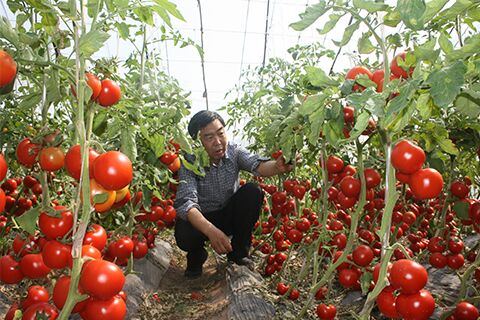
Ma Xinli graduated in 1978 from the vegetable specialty of the Horticulture Department of Shanxi Agricultural University. He has successively worked at the Yuncheng City Vegetable Company in Shanxi Province, the Xinjiang County Science and Technology Commission, the county vegetable bureau, and the county people's congress, and has long been engaged in research and promotion of organic biological agricultural technology on the rural front line. In 1991, the "Lubai No. 1" Chinese cabbage variety whose promotion he led won the second prize of the Shandong Provincial Science and Technology Achievement Promotion Award, and in 1998, the bird-wing-shaped ecological greenhouse he led the design of won the first prize of the Shanxi Provincial Standardization Science and Technology Progress Award.
Starting in 2004, Ma Xinli began integrated research on new biological organic agricultural technology. His original organic agriculture cultivation technology of "organic carbon fertilizer + compound probiotics + plant light-absorbing agent + plant yield-increasing agent + plant repair technique" replaced chemical agriculture with biological agriculture. At the Lihu Organic Vegetable Professional Cooperative in Xixingzhuang, Xinjiang County, the per-mu yields of eggplant and cucumber exceeded 50,000 jin year after year, and tomato per-mu yields exceeded 40,000 jin, 2-3 times higher than conventional yields, while reaching organic quality in the same year. In 2010, the "method for field cultivation of organic vegetables" whose research he led, and in 2013, the "technical integration method for developing efficient organic crop planting" whose research he led, both obtained national invention patents, and he was publicly elected as an international scientist.
Ma Xinli is the author of China's first monograph on organic vegetable cultivation. He has published more than 30 monographs through national-level publishers, with a total circulation of more than 1 million copies, four of which have been designated by the National Science and Technology Commission and the Central Agricultural Broadcasting School as promotion and training textbooks. In November 2015, in Beijing, he recorded his research results in biological organic agriculture as a seven-episode program titled "Treasure Book of Getting Rich." The program has now been listed by the Publicity Department of the CPC Central Committee as key promotion content for the "13th Five-Year Plan" and will be broadcast in rotation on 250 municipal and county-level television stations across the country.
For more than ten years, Ma Xinli and his technical team have been carrying out nationwide promotion of the "Chinese-style organic agriculture high-quality and high-yield cultivation technology." They have organized and participated in more than 400 special lectures and technical training sessions, with footprints across 30 provinces, municipalities and autonomous regions nationwide, and direct promotion area of more than 1.6 million mu. More than 100 practical success cases from all over the country all show that this technology can achieve yield increases in various agricultural crops: grain crops, fruits and others increase by at least more than 20%, while vegetables, Chinese medicinal materials and others increase by 0.5-2 times, reaching organic quality in the same year.
Now, in order to promote the "Chinese-style organic agriculture high-quality and high-yield cultivation technology" more widely and deeply across the country and around the world, to improve land in rural China that has been seriously polluted by pesticides and chemical fertilizers, to increase farmers' yields and incomes, and to free consumers from fear about food safety, Ma Xinli, just retired at the age of 62, has once again teamed up with several young people to found Beijing Siling Agricultural Technology Co., Ltd., to create the "Ma Xinli" agricultural product brand labeled "organic quality, affordable price, delicious, inexpensive, nutritious, safe," and to establish the "Ma Xinli Chinese-style Organic Agriculture Research Institute" at the Yangling National Modern Agricultural High-tech Demonstration Zone in Shaanxi, where he personally serves as president. Guided by the purpose of "being based in Yangling, facing the whole country, and carrying out continuous research and promotion of high-quality and high-yield biological organic agriculture cultivation techniques and land improvement techniques," the research institute has already formed an expert team of more than 10 people and proposed 12 preliminary research topics on innovative high-quality and high-yield organic agriculture technologies for the whole country. The promotion and implementation of these research topics and results are expected to further influence the direction and process of China's biological organic agriculture and further rewrite the history of Chinese agriculture.