Ruan Yi, director of the Gutian County Kexing Edible Fungi Research Institute, leads mushroom farmers to prosperity
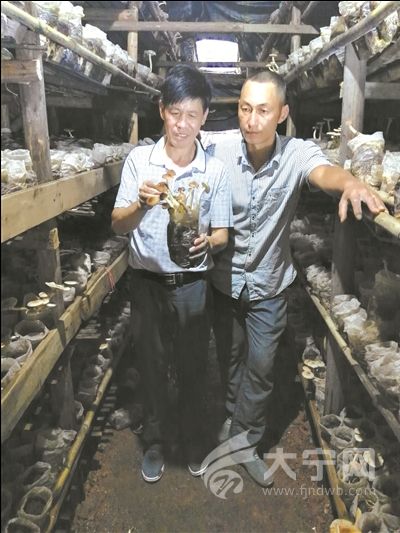
Ruan Yi (first from left) is guiding mushroom farmers on summer mushroom fruiting management.
Ruan Yi, male, Han ethnicity, born in December 1958, joined the Party in October 1984. This onetime college entrance exam failure became an edible fungi expert through his diligent study and unremitting efforts. In 1995, he founded the Gutian County Kexing Edible Fungi Research Institute, striving to promote his research results and lead his fellow villagers to prosperity together.
Having devoted himself to edible fungi production research for more than thirty years, he has undertaken more than 20 edible fungi research projects at the provincial, municipal and county levels, and published more than 20 papers in various national journals. After every sale of mushroom spawn, he would go deep into mushroom farmers' homes to collect and solve practical problems arising in the edible fungi cultivation process. For some financially struggling mushroom farmers, he provided help with both funds and technology, making his due contribution to the sustainable development of Gutian County's edible fungi industry and the increase of farmers' incomes.
A few days ago, Ruan Yi, director of the Gutian County Kexing Edible Fungi Research Institute, came to the homes of mushroom farmers in Pinghu Town to promote the new tea tree mushroom variety and to collect and solve practical problems arising in the edible fungi cultivation process. Whenever people talk about this locally born "folk edible fungi expert," the local people all give a thumbs-up. Having devoted himself to edible fungi production research for more than thirty years, he has successively won more than ten honorary titles, including "National Rural Science and Technology Spark Leader," "National Agricultural Technology Promotion Contribution Award," "National Rural Science Popularization Leader," and "Fujian Province Outstanding Rural Practical Talent." Behind these shining honors is his persistent pursuit of science and his extraordinary contribution to the edible fungi industry.
Today, Gutian County, known as the "Capital of Chinese Edible Fungi," has about 70% of its labor force engaged in edible fungi production, supply and marketing activities, and the edible fungi industry has become an important pillar industry locally. However, in the 1980s, growing edible fungi was still a high-risk industry. Because the technology was immature, and production and sales were primitive and extensive, many mushroom farmers lost everything, and people did not dare to try easily. Ruan Yi, who farmed at home after failing the college entrance exam, saw that his fellow villagers, due to poor transportation, were guarding their small plots of land and living off the weather, leading impoverished lives. He saw it with his own eyes and felt anxious in his heart. So while working in the fields, he carefully observed industries that could lead to prosperity and found that growing mushrooms was an industry with prospects.
"I started with a mushroom shed of less than 1 mu. I had no funds, so I borrowed 300 yuan from my family, and that year's bumper mushroom harvest earned me 500 yuan." Recalling the early days of starting his business, Ruan Yi showed a touch of nostalgia. After tasting the sweetness of growing edible fungi, he was even more energized. He began teaching himself various kinds of edible fungi cultivation knowledge while seeking instruction from teachers everywhere, painstakingly exploring the mysteries of the edible fungi world. The continuous improvement of his production and management skills made his edible fungi production advance by leaps and bounds, and Ruan Yi finally carved out a path of development. At the same time, he also imparted his techniques to the young people in the village without reservation. In 1995, he founded the Gutian County Kexing Edible Fungi Research Institute, striving to promote his research results and lead his fellow villagers to prosperity together.
In 1997, the tea tree mushroom was successfully introduced from Jiangxi as a new member of the edible fungi family. Because tea tree mushrooms are highly nutritious and taste good, they were deeply welcomed by the market. However, because it was a new variety and some techniques were not yet fully mature, mushroom farmers encountered a 40% contamination rate of raw material logs during cultivation, which affected production efficiency. "The needs of mushroom farmers are where my responsibility lies." Although the Kexing Edible Fungi Research Institute is only a private research institution, Ruan Yi took the responsibility upon himself. Every day he shut himself in the laboratory doing repeated experiments, and in just a few months he lost several jin.
Opportunity always favors the prepared mind. Near the Spring Festival, Ruan Yi went home and saw everyone adding tea tree ash water to the ingredients when making white rice cakes. "Isn't tea tree ash alkaline? And aren't tea tree mushroom spawn also extracted from tea trees?" Everything suddenly became clear. Regardless of the fact that the Chinese New Year was approaching, he immediately ran back to the laboratory and began testing the culture medium for tea tree mushrooms again. Having broken through the key point, Ruan Yi, after a long period of repeated experiments, finally succeeded in breeding the "Gucha No. 2" tea tree mushroom variety. This variety has the advantages of early fruiting, fast flushing, strong stress resistance and high yield. It was quickly promoted and cultivated throughout the county, making tea tree mushrooms a new fungus that Gutian County mushroom farmers rushed to grow.
A single flower does not make spring; only when a hundred flowers bloom together is the garden full of spring. He also persisted in spreading what he had learned to every inch of Gutian's land and into the hands of every mushroom farmer. To this end, Ruan Yi led the entire institute staff in traveling everywhere, compiling technical materials, conducting technical training, establishing demonstration bases, and going deep into fields and mushroom sheds to solve technical problems for mushroom farmers. Over the years, his footprints have covered mushroom sheds large and small throughout Gutian.
"Wherever there is difficulty, there he is." Li Rengui, a mushroom farmer from Jizhao Village in Chengxi Subdistrict, moved his whole family from elsewhere. Seeing the rapid development of Gutian's edible fungi industry, he borrowed money to grow 60,000 logs of tea tree mushrooms. But because he had not mastered the key technical points, the logs were seriously contaminated. Li Rengui was so anxious that he could not sleep at night. On someone's recommendation, he found Ruan Yi. After learning about the situation, Ruan Yi went with him to the mushroom shed without another word, plunged into analysis and research, gave technical guidance according to the cause of the problem, and provided "Gucha No. 2" tea tree mushroom spawn free of charge. With his help, Li Rengui earned more than 100,000 yuan that year, not only paying off his debts but also having a slight surplus, which made him throw himself into edible fungi production with even greater enthusiasm.
Ruan Yi is not only a "close friend" in the hearts of Gutian mushroom farmers, but also a "warm-hearted expert" in the eyes of edible fungi practitioners outside the province and even abroad. Over the years, the Kexing Research Institute under his leadership has provided technical training and technical consulting to more than 30,000 person-times of mushroom farmers across the country, and given away more than 30,000 copies of technical materials free of charge, solving a large number of technical problems encountered by mushroom farmers in the production of tea tree mushrooms, flower mushrooms, king oyster mushrooms and others. In 2000, the Kexing Edible Fungi Research Institute was listed by the United Nations "South-South Cooperation" organization as an international edible fungi technical training internship base, and has successively taught 430 foreign trainees from 73 countries, receiving high praise from foreign trainees and leaders of provincial and municipal science and technology departments.