Student returns home to start a business growing Chinese medicinal herbs, leading villagers to establish a cooperative
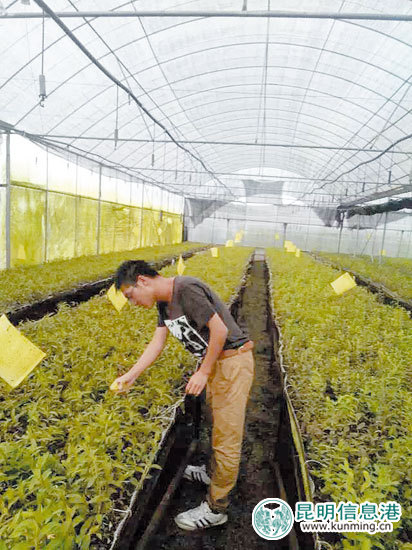
The entrepreneurial team keeps constant watch over the growth of the Chinese medicinal herbs.
"Although I got into university, whenever I thought of the backwardness and poverty of my hometown, I always wanted to do something." In the 2013 college entrance examination, Zhao Qingzao, who lives in Tiechang Village, Yulu Township, Huize County, Qujing City, was admitted to Yunnan University Dianchi College. Although he had come to a big city, whenever he thought of his hometown in the impoverished Wumeng mountain area, where villagers relied on low-yield crop farming to make a living, he felt that as the third university student to come out of the village, he had an obligation to help his fellow villagers break away from a life of depending on the weather.
After repeated setbacks and unremitting efforts, together with a group of university students who shared the dream of starting a business, he registered and established Kunming Chixiang Soil Technology Co., Ltd., obtained the patent usage rights for a "water-retaining agent," returned to his hometown to establish a cooperative with farmers, and led local farmers in developing a modern agricultural project of growing Chinese medicinal herbs, so that the barren land that once could only produce "potatoes and corn" worth a few jiao could grow precious Chinese medicinal herbs. Now Zhao Qingzao is leading his fellow villagers onto the path of escaping poverty and becoming prosperous.
Confusion:
"Corn and potatoes" dictate the village's fate
In 2010, Yunnan suffered a drought unseen in a century, and in Zhao Qingzao's home village, the drought cracked the farmland, leaving farmers unable to cultivate and forcing them to leave their homes to work elsewhere... Having experienced all this, Zhao Qingzao told reporters that rural life was hard, the land dry and barren, and the only harvest was corn cobs and potatoes. These traditional crops could only fill their stomachs, and only when there was plenty of rain; if disaster struck, villagers could only tighten their belts... For this reason, Zhao Qingzao kept searching for ways to change his hometown's poverty and lead farmers out of poverty toward prosperity.
Seeing the land that the people of his hometown worked so hard on yield nothing, Zhao Qingzao's cousin Liu Yugui, a graduate student at Yunnan University, in order to solve the problem of agricultural land water use, researched and invented a scientific achievement that plays a water-saving, water-retaining and fertilizer-retaining role in agroforestry planting and soilless cultivation: the GN700 water-retaining agent. Upon learning that his cousin had successfully developed the water-retaining agent, Zhao Qingzao excitedly went to discuss the possibility of starting a business with him, but reality was cruel: no funds, no equipment, no income. Talking about starting a business on the strength of a single research product alone was a bit like a fool's dream.
Surprise:
The land is relatively suitable for growing Chinese medicinal herbs
Yang Yongkun was Zhao Qingzao's university class monitor, warm-hearted and sincere. When he learned that Zhao Qingzao was agonizing over wanting to change his hometown's poverty and was frowning because he had no idea how to start a business, he took the initiative to find Zhao Qingzao and learn about the situation. Afterwards, the two hit it off immediately. After weighing the advantages and shortcomings of all aspects, they unanimously identified the project of "giving back to their hometown," which could change the living conditions of most people, as having great feasibility and potential for development. After a brief discussion with his family, Yang Yongkun decided to put the money he had earned from a small shop he had run since his first year of university into the project as his "stake," thus becoming Zhao Qingzao's first co-investor. Today the two have become each other's most trusted partners.
With an investor and his cousin's "water-retaining agent" patented technology, growing ordinary low-income crops would still fundamentally fail to change the villagers' economic level. Clearly, this was the issue Zhao Qingzao's team (later renamed Caiyun Bencao) most needed to think about.
At an accidental family gathering, Zhao Qingzao seemed to find his entrepreneurial direction. At the gathering, someone brought up the matter of going into the mountain gullies to dig up Chinese medicinal herbs to sell for money. Hearing this, Zhao Qingzao had a flash of inspiration: perhaps growing Chinese medicinal herbs was the "miracle cure" for changing farmers' living conditions! When he told Yang Yongkun this idea, the two immediately sought out university agricultural experts to first analyze the feasibility of the growing conditions. Upon learning that the village's jurisdiction was at a latitude relatively suitable for growing Chinese medicinal herbs, they were so excited they could not sleep all night. In December 2015, with support from all sides, their entrepreneurial team registered and established Kunming Chixiang Soil Agricultural Technology Co., Ltd., and the "Caiyun Bencao Entrepreneurship Project" was officially launched, opening the curtain on an entrepreneurial venture based on water-retaining agent application in a modern internet agriculture+ project.
Effort:
Five villagers agreed to trial-plant Bai Ji (Bletilla striata)
In the following months, through extensive Chinese medicinal herb planting experiments, they concluded that using water-retaining agent technology could alleviate the water requirements of large-scale local Chinese medicinal herb cultivation while also improving the yield and quality of the herbs. They acted at once. After a series of procedures including applying for patent use, the Caiyun Bencao project team obtained the core technology and usage rights for the GN-700 soil water-retaining agent, and after inspections with relevant planting technology experts, designated Cuoluoyu Villager Group, Tiechang Village Committee, Yulu Township, Huize County, an area with relatively loose soil, a dry climate, severe water loss and much arable wasteland, as the site for the first rural planting cooperative.
"For generation after generation we've grown potatoes and corn. Can Chinese medicinal herbs grow here?" After visiting many local farming households and being turned away many times, 5 households nodded in agreement. In the end, they each contributed 50 mu of land to participate in growing Chinese medicinal herbs.
With the land secured, the entrepreneurial team and farmers in the Wumeng mountain area established their first agricultural cooperative: the Huize Shanlv Planting Professional Cooperative. This cooperative was the team's self-operated base. Based on Huize's local climate, and with analysis by technicians from the agricultural science station, they guided local farmers in growing the Chinese medicinal herb Bai Ji (Bletilla striata). Through the application of the water-retaining agent, problems such as insufficient soil and water resources were effectively improved, and the cooperative's Bai Ji yield increased by 50 percent over expectations. When the medicinal material was purchased by a pharmaceutical company at a price many times higher than that of "potatoes and corn," the villagers smiled, and Zhao Qingzao and the other members of the entrepreneurial team smiled too.
Results:
Chinese medicinal herbs have already doubled the villagers' income
To help farmers grow Chinese medicinal herbs, they provided seedlings and technical guidance to the villagers free of charge. Even when they ran into cash-flow difficulties, the members of the entrepreneurial team still rushed about every day looking for partners and financing. After hitting countless walls, when the person in charge of Kunming Zhongyou Fengyu Technology Co., Ltd. learned about the Caiyun Bencao team's entrepreneurial project, he was moved by these university students' persistence and refusal to admit defeat, and immediately expressed willingness to cooperate with Chixiang Soil Technology Co., Ltd. and provide financial assistance.
As of now, the Caiyun Bencao team has led five rural households, including 16 people, to successfully establish the Huize Shanlv Planting Professional Cooperative, and has attracted young adults from three households to return home to start businesses. Zhao Qingzao revealed that Bai Ji is a crop with a periodic growth cycle, and at present the cooperative's profits are mainly based on dandelion cultivation. The income dividends from Chinese medicinal herbs have already multiplied the average annual household income of the five farming families several times over. Upon learning that Chinese medicinal herbs could be grown on their land and sold at a good price, many villagers who had gone out to work proactively approached Zhao Qingzao, expressing willingness to establish a new cooperative by contributing land as shares. At present, preparations for the new cooperative have been included in the company's development plan for the second half of the year.
Driven by the successful operation of the Huize Shanlv Planting Professional Cooperative and with Chinese medicinal herb cultivation technology relatively mature, Zhao Qingzao decided to have team members gain an in-depth understanding of rural land use and to build a "government + farmers + company" development strategy. From May 20 to 22, 2016, the 7-member Caiyun Bencao entrepreneurial team expanded the survey area and visited the Tiechang Village Committee, Yulu Township, Wumeng mountain area, Huize County, Qujing, Yunnan Province, with the aim of identifying the factors restricting the further development of Chinese medicinal herb cultivation in the area and laying the foundation for the company's second cooperative.