Ran Congjin, a Pubugou Hydropower Station resettler, strikes up a pastoral harvest song
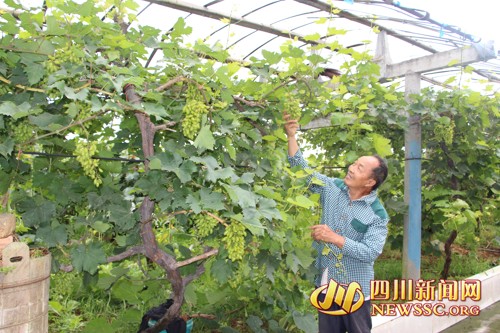
The grapes hanging all over the trellis carry Uncle Ran's hopes for a bountiful harvest
It has been 10 years since the Pubugou Hydropower Station resettlers moved into Danleng, and today they have fully integrated into local development, growing fruit, raising livestock, and working nearby, living happily together and helping one another with local residents. Their children have intermarried with local residents. Not only that, some resettlers who integrated into Danleng have even become village officials, leading resettlers and local people to develop industries and get rich together; some have teamed up with local art enthusiasts to form an art promotion troupe, volunteering from time to time to promote Danleng and sing the praises of their new life. Ran Congjin and his wife, approaching 70 years old, relying on diligence and perseverance and on their love of a better life, have become a widely known large-scale fruit-growing household and outstanding examples among Danleng's Pubugou Hydropower Station resettlers of "being able to move out, settle stably, and get rich."
Uncle Ran Congjin working in the fields
Eagerly learning to grow fruit
"A total of 8660 kilograms, 10.6 yuan per kilogram, 91796 yuan in all. Please have a look." On March 27 of this year, Boss Zhang from Harbin handed several stacks of crisp renminbi to Ran Congjin. Counting the money, Uncle Ran said happily, "If he hadn't made seven or eight trips and said a whole basketful of nice words, I still wouldn't have been willing to sell."
On June 29, 2006, Ran Congjin's family moved from Ya'an to Danleng. Their son and daughter had gone out to establish their own families and careers, rarely coming home more than a few times a year. Ran Congjin, approaching his sixties, and his wife could not sit idle, so they decided to return to the fields and keep farming. The village allocated Ran Congjin 4 mu of Shiranui citrus trees. At first, lacking experience and skills, he grew only 1500 kilograms of fruit in a year, and the quality was poor, so it did not fetch a good price. "Only after the county agriculture bureau sent teachers to guide me hand by hand, and with my own self-study and research, did the orchard's output slowly increase, the quality gradually improve, the price get higher and higher, and the income get better and better," Ran Congjin told the reporter happily.
Under the guidance of experts from the agriculture bureau, Ran Congjin gradually mastered the skills of "waiting on" the fruit. He and his wife dug 0.8-meter-deep drainage and ventilation trenches between the fruit trees with their own hands and bagged nearly 30,000 fruits one by one. With deep trenches and high beds, sod culture, pruning and shaping, drilling and fertilizing, scientific pesticide use, and being willing to thin the fruit, the old couple did everything related to the fruit meticulously. They even recorded in detail what fertilizer and which pesticide were used, constantly summarizing and exploring cultivation know-how. From 2008 to now, Uncle Ran has set up on his living room wall a year-round work calendar for the citrus orchard and vineyard. Uncle Ran made the "orchard management work calendar" into a wall calendar and hung it in the main room. He scientifically arranges the key points of fruit tree care for each month according to the solar terms: "January, winter pruning should be heavy, clean the orchard; February, apply spring fertilizer, irrigate, prune away some flower branches; March, re-prune flower branches, prevent and control red and yellow spiders and flower maggots, add foliar fertilizer, heavy fertilizer and heavy watering... November, prevent disease and protect fruit, spray Jinguo 100, wipe out late shoots; December, spray 10PPm 24D plus Daisheng, prevent fruit drop." Where there is effort, there is harvest, and the sweat of hard work brought the joy of a bountiful harvest. Starting in 2009, the "Shiranui" on Uncle Ran's 2700 sq m of land has steadily produced around 9000 kilograms year after year. Compared with the income from growing garlic sprouts, garlic scapes, and other vegetables back in his hometown 10 years ago, the income is nearly 10 times higher. "Growing 'Shiranui' is exchanged with effort, and you have to be willing to invest. This year my family invested 24000 yuan directly. My family's total income, plus the more than 1000 kilograms sold earlier, is more than 100,000 yuan, and after deducting costs it is still more than 90,000 yuan." Uncle Ran said happily that he regards Danleng as his second hometown. Over the past 10 years, his income has risen a lot and his days are happier.
Humming, playing, and singing in praise of his hometown
On the bench in Uncle Ran's main room are books on citrus, grapes, and other topics and various management tools, and on the wall hang suona, flute, erhu, and other musical instruments. When he is tired from work, he plays a folk song or an old song on an instrument in the main room, expressing the joy of happiness after becoming rich. In his spare time from busy farming, Ran Congjin often joins the Sunset Red band organized by the village, going from village to village and household to household to perform for the masses, bringing happiness to others while also making himself happy. Uncle Ran, who loves entertaining himself, also often carries his erhu to the fields, playing and singing by himself, letting the music nurture the fruit. Neighboring villagers all say, "The Shiranui at Uncle Ran's house grew up listening to the erhu, it's different from everyone else's!"
"The experience on the orchard management work calendar is what I summed up from practice after coming to Danleng, and I am even more willing to use my successful experience to help more people here." "After getting rich himself, he always remembers to help his fellow villagers. If any family's fruit trees have problems, he will definitely put down his own work and hurry to someone else's orchard; if any friend asks him to guide fruit tree cultivation techniques, from planting seedlings to management, he teaches without reservation. Uncle Ran is very warm-hearted," said neighbor Xiao Liu.
"Beautiful Danleng is my home, in spring the fruit trees bloom everywhere..." Uncle Ran, approaching 70, was in the orchard playing "Fields of Hope" on his erhu while happily humming a song he had adapted himself. In his heart, beautiful and fertile Daya Danleng has long been the new home where he and his wife live and work in peace and contentment.