Shenmu desert yields edible oil, plans to cultivate 1 million mu of wild cherry
Desert control and sand prevention only involve investment with no output. How can this vast sandy land in Shenmu be turned into a form of production capacity? At the "2016 Council Meeting of the Woody Oil Crops Branch of the China Agriculture and Forestry Industry Federation and the Inaugural Meeting of the Woody Oil Crops Expert Group" held at 9:00 a.m. on July 5, 2016, Zhang Yinglong, president of the Shenmu County Ecological Protection and Construction Association, told us: Shenmu is further committed to building and establishing scientific research development for a sand-control culture.
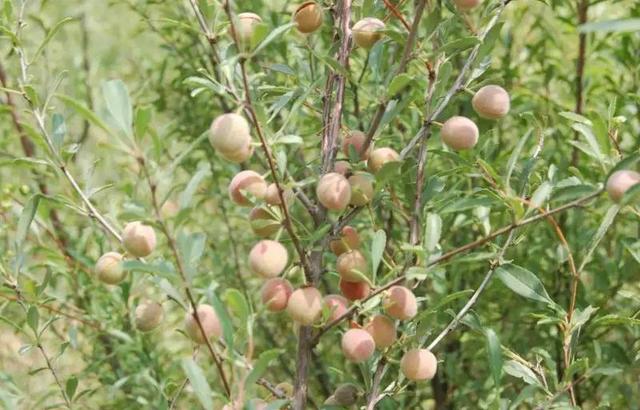
As early as 2003, the Shenmu area was already committed to building high-yield demonstration forests of Prunus pedunculata (long-stalked peach). This achieves a double harvest of local economic benefits and environmental benefits. After 13 years of continuous research and improvement, the planting of Prunus pedunculata has begun to show results. At the same time, in its work on combating land degradation, the association actively practices the use of waste to produce bio-organic fertilizer, promotes organic agricultural planting to protect water resources, and provides strong support for environmental protection.
Prunus pedunculataAlso known as long-stalked peach, it is commonly called "wild cherry" in the northern Shaanxi region. It belongs to the order Rosales and family Rosaceae. It is a shrub with a flowering period in May and a fruiting period from July to August. It grows on sunny gravelly slopes or at the foot of slopes in hilly areas, and is also found in dry grasslands or desert steppes. It is currently planted in places such as Shenmu in Yulin and Inner Mongolia. It is an excellent woody oil-bearing shrub species. After processing, the seed kernels of Prunus pedunculata can be used as edible oil. In 2013, Prunus pedunculata edible oil was approved by the National Health and Family Planning Commission as a new food ingredient.
In July 2014, the State Forestry Administration approved the establishment of the Prunus pedunculata Engineering Technology Research Center. The center will closely integrate with the major technical needs in China's Prunus pedunculata industry sector, aim at industrial upgrading and production efficiency, and use technology integration, maturation, and transformation as its main means to carry out research and demonstration of Prunus pedunculata industrial demonstration technology. From 2003 to the present, the afforestation area of Prunus pedunculata is approximately 100,000 mu.
Zhang Yinglong emphasized during the meeting:Because of the unique climatic conditions, topographic conditions, and soil conditions of the northern Shaanxi region, planting Prunus pedunculata is more difficult than in other places. The association first planted Prunus pedunculata on a small scale, and after the planting technology reached certain conditions, it then increased promotion efforts and planting efforts. It strives to make Prunus pedunculata planted in the Shenmu area form an intensive, mechanized, and sustainable planting model. At the same time, the association will also strengthen the building of its scientific research team to reduce the planting cost of Prunus pedunculata. In the future, Yulin is expected to invest in creating 1 million mu of Prunus pedunculata forest land. It will continuously develop and utilize the Prunus pedunculata industry chain, plan it well, continuously tap the potential of Prunus pedunculata, and make a success of demonstration models, turning them into "bonsai" before carrying out comprehensive promotion.
On July 5, 2016, in order to actively promote and implement the various work arrangements for members of the Woody Oil Crops Branch made on March 31, unite the core strength of the branch, and serve members more precisely, the branch decided after study to convene the "2016 Council Meeting of the Woody Oil Crops Branch of the China Agriculture and Forestry Industry Federation and the Inaugural Meeting of the Woody Oil Crops Expert Group." The meeting was held as scheduled at 9:00 a.m. at Shenmu Tianfeng International Hotel.
Guests attending this meeting included Yang Chao, Director-General of the State-owned Forest Farms and Forest Tree Seed and Seedling Work Station of the State Forestry Administration; Xu Xinqiao, Party Secretary of the Research Institute of Forestry of the Chinese Academy of Forestry; Wang Haojie, Director of the Research Institute of Subtropical Forestry of the Chinese Academy of Forestry; and Shi Sheqiang, Deputy Director of the Shaanxi Institute of Sand Control; as well as more than 80 leaders and 14 experts from the Yulin Municipal Forestry Bureau, the Shenmu County Government, the Shenmu Forestry Bureau, and the Shenmu Ecological Protection and Construction Association.