Wealth bounces up and down, he has a clever plan to rake in money
These are ancient spirits of the mountain forest: sensitive, alert, and hard to find. He was a earthworks contractor who switched to farming sika deer. He thought he had money and a project, but never imagined the road to riches would be so tough. The sika deer left him with no home to return to, yet he sorted out his thinking and restructured his plans, and finally reaped an unexpected fortune.
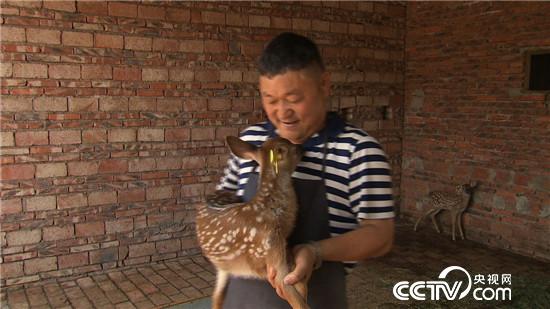
This is near Meihua Mountain in Liancheng County, Fujian Province. At 10 p.m., night had long since fallen, when Yang Hanhua suddenly discovered that his sika deer, worth more than 200,000 yuan, had not come back on time. Yang Hanhua was very anxious. He took people up the mountain to search in different directions.
Yang Hanhua: Several dozen haven't come back. Before, they would come back as soon as the time came, but today they didn't. I'm very worried. Generally they stay up high, under the trees up high, watching us warily. Let's go take a look.
In the mountain forest at night, even walking is difficult, and finding the sika deer depends entirely on experience. Just then, the workers at the top of the mountain suddenly spotted traces of the sika deer.
Yang Hanhua: Up there.
Worker: They're all here.
Yang Hanhua: Oh, you rascal, over here, come up here, turn off your light, turn it off as soon as you come up.
After the flashlights were turned off, the reporter spotted dozens of glinting green lights in the woods.
Yang Hanhua: They're all over here, green light, do you see the green light?
The faintly glinting green light from their eyes belongs to the sika deer Yang Hanhua farms. At this hour, they should have returned to the pen.
Yang Hanhua: They know how to go back, go back, go back, they probably got lost.
Six years ago, Yang Hanhua gave up an engineering business that easily brought in several hundred thousand yuan a month and returned to his hometown in the mountains to farm sika deer. Not only does he raise the sika deer well, in the eyes of many people he also has an extraordinary knack for making money.
Fu Zhidong, Director of the Bureau of Animal Husbandry, Veterinary Medicine and Fisheries: Bringing sika deer to our south should count as a relatively difficult undertaking, and this farm has solved it well in several respects.
Sika deer farmer: I see that the sika deer on Mr. Yang's side have already adapted to the climate here, which gives me great confidence. I believe Mr. Yang can earn money that others have not earned, and this has given me great inspiration.
Everyone says that with his sika deer, Yang Hanhua not only earns more per animal than others, he also earns money from the sika deer that others cannot. So what exactly is Yang Hanhua's secret to making money?
During the day, sika deer are much more sensitive than at night. They are not only afraid of people, but also very afraid of the camera. Even if the photographer stands alone several meters away, as soon as the camera is turned on and aimed at one of them, it turns its head and runs, and it is very hard to get close. Although sika deer are timid, every part of them is valuable. Yet the business opportunity Yang Hanhua discovered in sika deer came about by accident.
This is a fresh deer antler weighing about 1,600 grams, now worth more than 9,000 yuan. Six years ago, when Yang Hanhua first got this thing, he was very surprised.
In the autumn of 2009, a friend in Shanxi who was in the farming business gave Yang Hanhua a deer antler, and the price of this deer antler surprised Yang Hanhua greatly.
Yang Hanhua: I was very amazed. At the time I felt it was very precious, so I asked him whether this thing was expensive. He said it was not very expensive. I said that in our south these things are all very expensive.
Yang Hanhua is from Liancheng, Fujian. In his understanding, selling deer antler was like selling gold, all sold by the gram, and one gram would sell for several dozen yuan. But when Yang Hanhua asked around, at that time in Shanxi, the most valuable thing on a deer - fresh deer antler - cost only a few yuan per gram. It was precisely when the sika deer market was very poor.
Sika deer farmer: At the high point, one breeding buck could sell for twenty or thirty thousand yuan. At that time, one adult deer could not fetch the price of a sheep. Many people culled their deer. The market was very bad, at the lowest point of China's deer farming industry.
Such a poor market, yet it made Yang Hanhua's heart light up. In 2003, after Yang Hanhua was laid off from a state-owned enterprise, he went to Shanxi and took up contracted engineering, bringing in several hundred thousand yuan a month.
In 2009, when he heard that the sika deer market was bad, Yang Hanhua instead became interested. The market had been at a low point for several consecutive years, deer antler could not fetch a good price, and farmers were all reducing their herd sizes. Yet most people thought that sika deer, which are raised in the north, were also being farmed in the south. At that time, in Yang Hanhua's hometown of Fujian Province, there were more than 20 sika deer farming households in total. Yang Hanhua went to inspect every one of them, and he found that the market there was not good either, and every household's farming scale was small, with the largest raising about ten or so.
Yet just at this time, Yang Hanhua decided to give up his profitable engineering business and return to Fujian to farm sika deer, saying that sika deer farming would definitely be far more profitable than doing engineering.
Yang Hanhua: I carefully calculated it. If it is run well and managed well, this is better than anything, better than doing engineering, because this is something long-term, as long as we manage it well.
Careful calculation was not just something he said casually. Yang Hanhua had specifically studied finance before and had worked as an accountant in a state-owned enterprise for more than ten years. He judged that deer antler's market was only temporarily cold, that prices would not stay depressed forever, and that few people raising them was exactly a good opportunity to enter the market.
Yang Hanhua: If we are going to raise them, we should raise more. The reason is on the cost side: with the same number of people, if the number raised is larger, won't our costs come down? When you have more and the scale is larger, it is easier to promote.
In the spring of 2010, Yang Hanhua came to this mountain hollow. He took out all his savings of 3 million yuan, went to the forestry department to process the relevant certificates, rented more than 200 mu of wasteland, and built the factory buildings with his own hands. At nearly 10,000 yuan per animal, he bought more than 130 sika deer from Shanxi. At that time he never imagined that this road to wealth with sika deer would be full of suspense.
Sika deer are covered with white plum-blossom spots, and the males have antlers. They are alert by nature, nimble in movement, good at running, and very strong at jumping.
Yang Hanhua, having caught the scent of the tempting profits of farming, planted several kinds of grass such as alfalfa to supplement the sika deer's nutrition. When it was hot in summer, he sprayed water on the sika deer to cool them down. He also sought advice from agricultural experts in the county, worked out farming methods suited to the local environment, and improved everything from the pens to the feed. He put all his thought into it.
On the morning of the interview day at 6 o'clock, because a customer was coming to buy fresh deer antler, Yang Hanhua and the workers prepared to cut the deer antler, the first time this year. The first step in cutting deer antler is to anesthetize the sika deer with an anesthetic dart. This is no easy task.
Yang Hanhua: They are very good at dodging. Wait until it steadies, then once it steadies, blow it hard, and only then will it work. Otherwise you will miss.
When the young antlers of a male sika deer have not yet grown into hard bone, they are covered in velvet and contain blood, and are called deer antler. After the deer antler is cut, new ones will grow in about 60 days.
Yang Hanhua: Right now it is furry and soft.
Reporter: It really is soft.